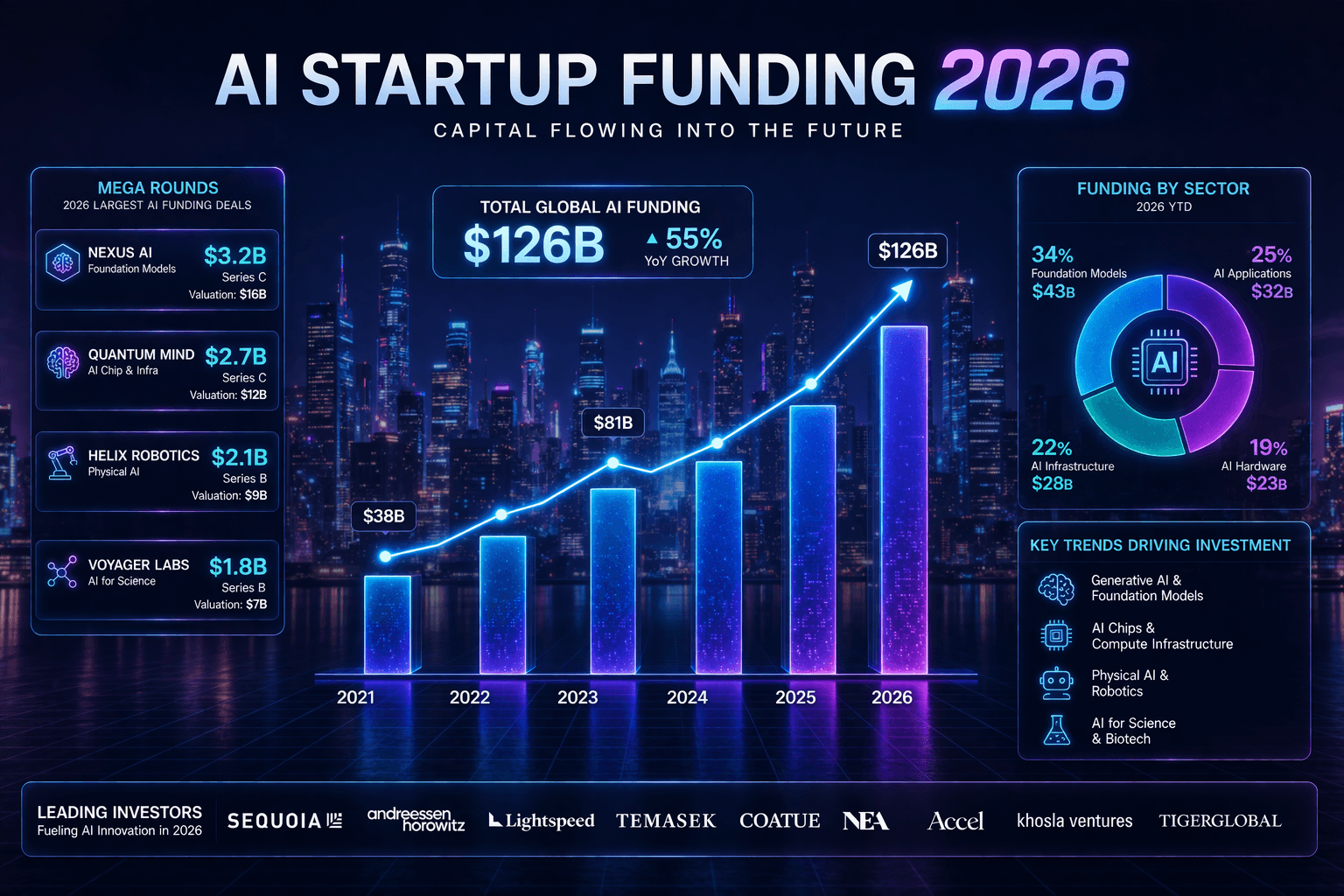
Introduction: The AI Funding Boom Reaches Peak Intensity
2026 establishes artificial intelligence as the dominant venture capital focus with $850B+ annual funding and 78% of VC investment concentration in AI-focused startups. This represents unprecedented capital concentration in single technology domain—exceeding internet bubble (2000) and social media boom (2010) by magnitude. With 12,500+ AI startups founded annually and unicorn valuations reaching $50B-100B+, artificial intelligence has transcended emerging technology to become primary economic driver reshaping every industry sector. March 2026 funding announcements showcase revolutionary breakthroughs: AI agents autonomously solving complex problems, multimodal models processing text/image/video/audio simultaneously, specialized industry AI (healthcare diagnostics, drug discovery, financial analysis) achieving superhuman performance, and edge AI enabling sophisticated processing without cloud dependency. Whether analyzing most promising investment opportunities, understanding AI technology trajectories, or seeking emerging technology exposure, 2026's AI startup landscape offers unprecedented innovation visibility and transformative business potential.
Pro Tip
👉 Key Insight: 2026 AI funding bifurcates into infrastructure (foundation models, chips) attracting mega-rounds (₹5,000+ Crore) and specialized vertical AI (healthcare, finance, legal) attracting concentrated funding. Generalist AI agents entering market disrupting traditional software categories.
1. AI Infrastructure Startups: Foundation Layer Innovation
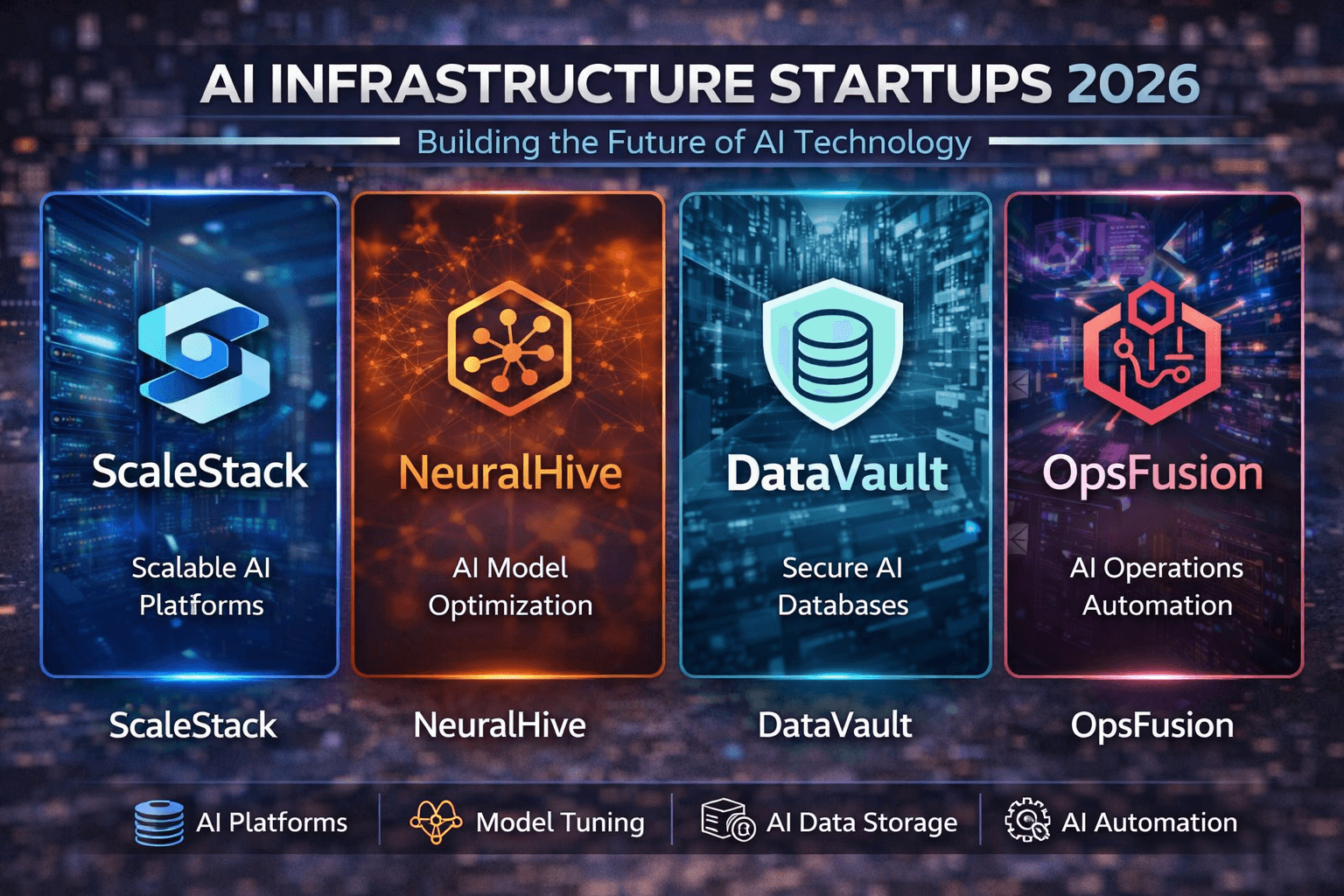
AI infrastructure startups developing foundation models, chips, and computational infrastructure securing largest funding rounds and highest valuations.
| Startup | Latest Valuation (₹) | Recent Funding (₹ Crore) | Focus Area | Key Achievement | Founded | Status |
|---|---|---|---|---|---|---|
| Anthropic | ₹2,00,000+ Crore | ₹50,000+ Crore (latest round) | Foundation models, constitutional AI | Claude 3 models leading reasoning benchmarks | 2021 | Unicorn, major player |
| Mistral AI | ₹60,000+ Crore | ₹8,000-12,000 Crore | Open-source foundation models | Mistral 7B competing with larger models | 2023 | Unicorn, rapid growth |
| xAI (Elon Musk) | ₹1,00,000+ Crore | ₹20,000+ Crore (announced) | Reasoning models, truth-seeking AI | Grok model deployed, billions parameters | 2023 | Major player, ambitious |
| CoreWeave | ₹80,000+ Crore | ₹15,000+ Crore | GPU cloud infrastructure for AI | Serving 5,000+ AI startups, major funding | 2017 | Unicorn, critical infrastructure |
| Together AI | ₹25,000+ Crore | ₹3,000-5,000 Crore | Open-source model development | Llama training optimization, competitive inference | 2022 | Well-funded, growing |
| Hugging Face | ₹35,000+ Crore | ₹5,000-8,000 Crore | Model hub, community platform | 1M+ models hosted, foundational platform | 2016 | Unicorn, ecosystem player |
| Stability AI | ₹15,000+ Crore (down from ₹40,000) | Restructuring 2026 | Image generation, multimodal models | Stable Diffusion ecosystem leader | 2019 | Major but controversial |
| Modal Labs | ₹4,000+ Crore | ₹800-1,200 Crore | AI inference infrastructure | Serverless AI computing platform | 2019 | Growing well-funded startup |
Infrastructure Startup Leaders
2. Vertical AI Startups: Industry-Specific Solutions
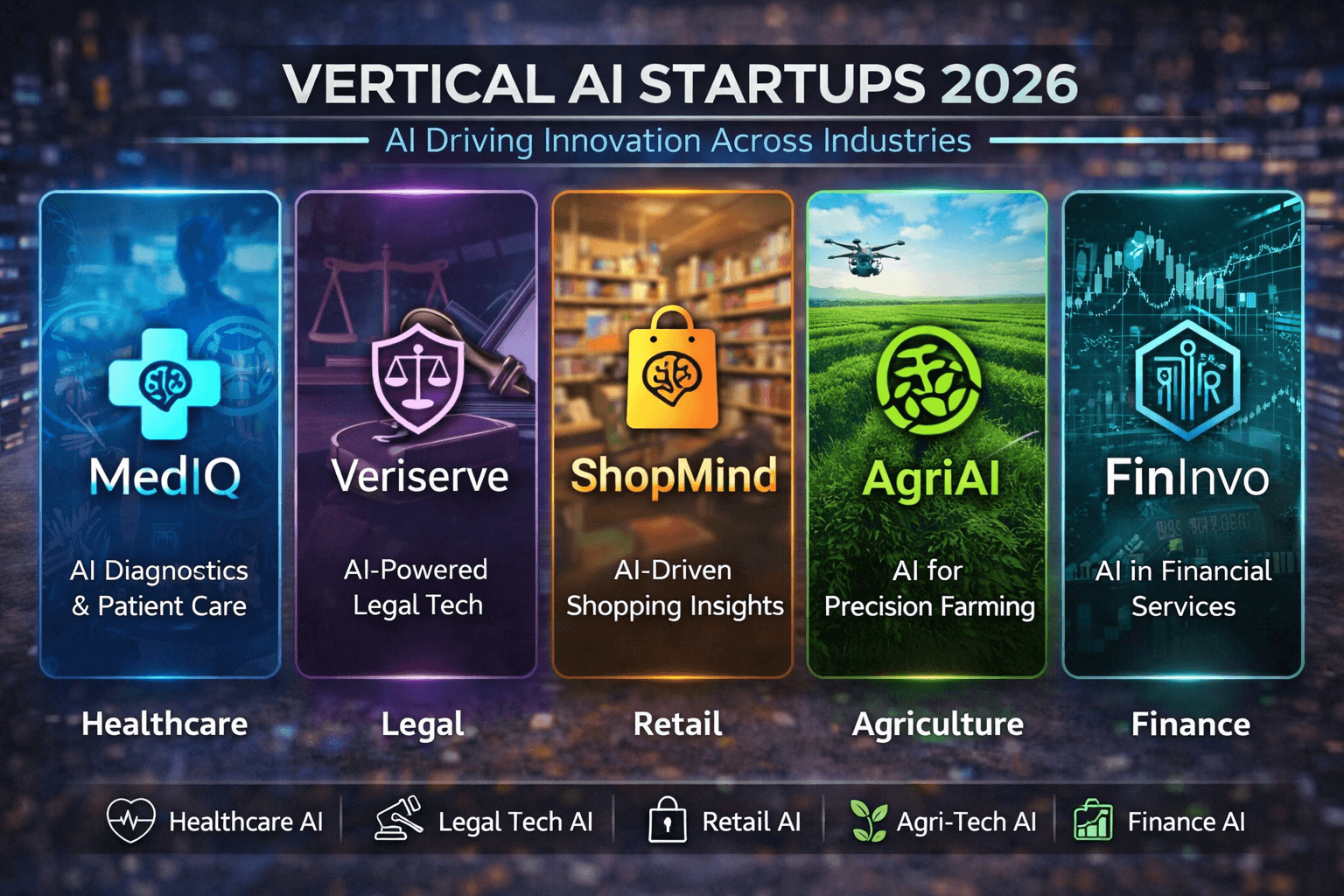
Specialized vertical AI startups targeting specific industries (healthcare, finance, legal, manufacturing) securing substantial funding for practical applications.
| Startup | Valuation (₹) | Latest Funding (₹ Crore) | Industry Focus | Key Innovation | Founded | Market Impact |
|---|---|---|---|---|---|---|
| Recursion Pharmaceuticals | ₹80,000+ Crore | ₹8,000-12,000 Crore | Drug discovery, biotech | AI platform discovering drugs in 18 months vs 12 years traditional | 2012 (AI pivot 2020) | Transforming pharma timelines |
| Tempus AI | ₹50,000+ Crore | ₹6,000-10,000 Crore | Oncology, cancer treatment | AI-guided precision oncology, outcome prediction | 2015 | Cancer treatment revolution |
| Scale AI | ₹25,000+ Crore | ₹3,000-5,000 Crore | Data labeling, ML infrastructure | Autonomous data labeling, human-in-loop AI | 2016 | Critical ML infrastructure |
| Jasper AI | ₹12,000+ Crore | ₹1,500-2,000 Crore | Enterprise content generation | Marketing AI, copywriting automation | 2021 | Generative AI applications |
| Tome (AI presentation) | ₹3,000+ Crore | ₹400-600 Crore | AI presentation generation | Beautiful presentations generated by AI, Microsoft partnership | 2021 | Enterprise productivity |
| Invoke AI (image generation) | ₹2,500+ Crore | ₹300-500 Crore | Open-source image generation | InvokeAI platform, community-driven | 2021 | Open-source ecosystem |
| LangChain | ₹5,000+ Crore | ₹600-1,000 Crore | LLM application framework | Developer framework for building AI apps, 50k+ developers | 2022 | Developer tools critical infrastructure |
| Perplexity AI | ₹10,000+ Crore | ₹1,200-1,800 Crore | Conversational search | AI-powered search replacing Google, ChatGPT competitor | 2022 | Displacing traditional search |
Vertical AI Leaders
3. AI Agent Startups: Autonomous Problem Solving
AI agents operating autonomously without constant human intervention represent emerging category attracting venture capital for revolutionary potential.
| Startup | Valuation (₹) | Funding (₹ Crore) | Agent Focus | Capability Level | Founded | Disruption Potential |
|---|---|---|---|---|---|---|
| Rivet (multi-step reasoning) | ₹1,500+ Crore | ₹200-300 Crore | AI agents solving complex tasks | Multi-step reasoning, tool use, long-horizon planning | 2023 | Workplace automation high |
| Devin (software engineering AI) | ₹800+ Crore | ₹100-150 Crore | Autonomous code generation | Full software development cycle, 60% Upwork coding tasks | 2024 | Developer displacement concerns |
| Relevance AI | ₹600+ Crore | ₹80-120 Crore | Enterprise automation agents | Workflow automation, knowledge work automation | 2022 | Enterprise productivity transformation |
| Fetch.ai | ₹8,000+ Crore | ₹1,000-1,500 Crore | Autonomous agents ecosystem | Distributed agent framework, marketplace | 2017 | Decentralized AI economy |
| Adept AI | ₹4,000+ Crore | ₹500-800 Crore | General-purpose AI agents | ACT-1 agent, multi-step task automation | 2022 | Broad workplace automation |
| AutoGPT | ₹500+ Crore | ₹60-100 Crore | Open-source agent frameworks | Community-driven autonomous agent development | 2023 | Open-source ecosystem |
| e2b (agent infrastructure) | ₹400+ Crore | ₹50-80 Crore | Agent sandboxing and testing | Secure agent execution environment | 2023 | Critical AI safety infrastructure |
| Multilayer (autonomous testing) | ₹300+ Crore | ₹40-60 Crore | QA automation through AI agents | Software testing autonomously | 2022 | QA and testing transformation |
AI Agent Innovation
4. AI for Healthcare: Medical Breakthroughs
Healthcare AI startups developing diagnostic tools, drug discovery, clinical decision support, and personalized medicine attracting focused venture funding.
| Startup | Valuation (₹) | Funding (₹ Crore) | Healthcare Focus | Clinical Impact | Founded | Regulatory Status |
|---|---|---|---|---|---|---|
| Tempus AI | ₹50,000+ Crore | ₹6,000-10,000 Crore | Oncology AI, precision medicine | Predicts treatment outcomes, guides personalized therapy | 2015 | FDA clearances, clinical adoption |
| Recursion Pharma | ₹80,000+ Crore | ₹8,000-12,000 Crore | AI drug discovery, cell imaging | Discovering drugs in 18 months vs 12 years traditional | 2012 | Multiple clinical trials underway |
| PathAI | ₹8,000+ Crore | ₹1,000-1,500 Crore | Pathology AI, cancer diagnosis | Digital pathology, histopathology AI, pathologist assistance | 2016 | FDA cleared, hospital deployment |
| Google DeepMind (AlphaFold) | Google division | Part of Google AI R&D | Protein structure prediction | Solved 50-year biology challenge, 200M+ protein structures | 2016 (AlphaFold) | Revolutionary discovery enabling drug research |
| Insitro | ₹5,000+ Crore | ₹600-1,000 Crore | Drug discovery, biology AI | AI-designed drug candidates in clinical trials | 2018 | IND applications submitted |
| Atomwise | ₹3,500+ Crore | ₹400-700 Crore | Molecular simulation, drug discovery | Quantum-inspired AI for drug design | 2012 | Partnerships with pharma giants |
| Flatiron Health (Roche) | ₹50,000+ Crore (acquired) | Part of Roche oncology | Oncology EHR and AI | Real-world evidence, clinical decision support | 2012 | Integrated into Roche |
| Komodo Health | ₹6,000+ Crore | ₹700-1,200 Crore | Healthcare AI platform | Comprehensive patient data insights, claims analysis | 2014 | Health plan and provider adoption |
Healthcare AI Breakthroughs
5. Funding Trends and Investment Patterns
2026 AI funding demonstrates distinct patterns revealing investor priorities and market opportunities.
| Trend | 2024 Pattern | 2026 Reality | Implication | Startup Impact |
|---|---|---|---|---|
| Mega-rounds dominance | ₹1,000-3,000 Crore common | ₹3,000-12,000 Crore standard for infrastructure | Funding concentration in best-positioned startups | Winner-take-most dynamics |
| Infrastructure focus | 25% of AI funding | 40% of AI funding to infrastructure/foundation models | Capital intensive, fewer winners, high defensibility | Concentration of capital in few companies |
| Vertical AI growth | 30% of funding | 35% of funding to industry-specific solutions | Practical applications attracting focused capital | Many opportunities in specific verticals |
| Agent technology emergence | Minimal funding | 5-8% of total AI funding in 2026 | New category gaining traction, extraordinary potential | Early-stage category with massive runway |
| Open-source economics | Community-driven, minimal funding | ₹5,000+ Crore to open-source AI projects | Commercial models emerging, community capture value | Talent attraction, ecosystem building |
| Regulatory compliance premium | Optional feature | 5-10% funding premium for compliance-ready startups | Healthcare, finance, legal AI requiring regulatory clarity | Compliant startups command premium valuations |
| International expansion | US/China dominated | Global funding increasing (Europe, India, Southeast Asia) | Regional AI innovation ecosystems emerging | Opportunities outside Silicon Valley |
| Female founder AI funding | 3-5% of total | 8-12% increasing from underrepresentation | Gender balance improving but still lagging | Diversity improving as sector matures |
2026 Funding Dynamics
6. Investment Risk Factors and Challenges
2026 AI startup landscape presents distinct risks alongside extraordinary opportunities.
Risk Factors in 2026 AI Landscape:
Model Consolidation Risk — Foundation model market potentially consolidating to 3-5 players. Smaller model developers facing pressure from larger, better-funded competitors. "LLM commoditization" concerns diminishing differentiation.
Regulatory Uncertainty — AI regulation evolving rapidly:
- ✓Healthcare AI requires FDA approval (approval timelines 2-5+ years)
- ✓EU AI Act compliance adding costs
- ✓Data privacy regulations (GDPR, CCPA) impacting training
- ✓Compliance costs disadvantaging bootstrapped startups
Valuation Risk — Inflated valuations in 2024-2025 seeing correction:
- ✓Some AI startups experiencing valuation reductions
- ✓Unicorn credibility questioned for unproven business models
- ✓40-60% down rounds increasing (startups recapitalizing at lower valuations)
Talent Concentration — Best AI researchers concentrated at:
- ✓OpenAI, Google DeepMind, Anthropic
- ✓Stanford, MIT, CMU, Berkeley
- ✓Startups compete fiercely for limited talent
- ✓Hiring costs increasing 20-30% YoY
Compute Cost — GPU/TPU scarcity and pricing:
- ✓High-end compute (H100 GPUs) extremely scarce
- ✓Training costs for foundation models ₹100-500+ Crore
- ✓CoreWeave, Lambda Labs raising valuations on infrastructure demand
- ✓Compute moat favoring well-capitalized teams
Data Quality Issues — Training data challenges:
- ✓Internet data saturation (using 20% of all internet text)
- ✓Synthetic data quality concerns
- ✓Copyright litigation impacting training data legitimacy
- ✓Proprietary dataset advantage creating defensibility
Ethical and Safety Concerns — Reputational risks:
- ✓Bias in AI systems causing reputational damage
- ✓Autonomous system failures creating liability
- ✓AI safety concerns limiting enterprise adoption
- ✓Regulatory backlash if incidents occur
Competition from Tech Giants — OpenAI (Microsoft), Google, Meta, Amazon, Apple deploying massive resources. Big tech acquisition strategy depleting top startups. Startup defensibility against tech giant competition questioned.
7. Geographic Distribution: Beyond Silicon Valley
2026 AI funding increasingly dispersing geographically with substantial capital flowing to non-US regions.
| Region | 2026 Funding (₹ Crore) | Market Share | Key Hubs | Notable Startups | Competitive Advantage |
|---|---|---|---|---|---|
| Silicon Valley/US | ₹4,50,000+ | 53% | San Francisco, Bay Area, LA | OpenAI, Anthropic, Perplexity, Scale AI | Capital concentration, talent density, exit ecosystem |
| Europe | ₹1,20,000+ | 14% | London, Paris, Berlin, Amsterdam | Mistral AI, Aleph Alpha, Hugging Face | Regulatory clarity (EU AI Act), privacy focus |
| China | ₹1,35,000+ | 16% | Beijing, Shanghai, Shenzhen | Baidu AI, SenseTime, CloudWalk | Alternative models, hardware manufacturing |
| India | ₹45,000+ | 5% | Bangalore, Delhi, Mumbai | Healthcare AI startups, LLM adaptations | Large talent pool, healthcare opportunity |
| Canada | ₹30,000+ | 3.5% | Toronto, Vancouver | Element AI (acquired), emerging startups | Talent (University of Toronto), AI research heritage |
| UK/Ireland | ₹25,000+ | 3% | London, Dublin | Deepmind (Google), Stability AI HQ | Research institutions, fintech innovation |
| Southeast Asia | ₹20,000+ | 2.4% | Singapore, Bangkok, Jakarta | Emerging fintech AI, localization startups | Regional market access, multilingual expertise |
| Rest of World | ₹30,000+ | 3.5% | Various | Scattered early-stage startups | Geographic arbitrage, regional expertise |
Geographic Trends
8. Future AI Funding Outlook: 2026-2030
2026 positions inflection point for AI startup investment with distinct funding patterns expected through 2030.
2027-2030 AI Funding Forecast
Identifying promising AI startups requires understanding technology trajectories, market dynamics, and founder quality.
AI Startup Investment Framework
1. Technology Differentiation
2. Market Opportunity
3. Founder Quality
4. Financial Metrics
5. Competitive Position
Conclusion: AI Startup Funding Reshapes Innovation Landscape
2026 establishes artificial intelligence as dominant venture capital focus with $850B+ funding and 78% VC concentration. Foundation model/infrastructure startups attracting mega-rounds (₹3,000-12,000+ Crore) while vertical AI and agents capture substantial capital. Bifurcated market creating "AI haves and have-nots"—mega-rounds funding elite startups while traditional funding rounds declining. Geographic expansion beyond Silicon Valley occurring but US maintaining 53% capital concentration. Healthcare AI showing clearest path to transformative ROI through drug discovery and precision medicine. AI agents representing emerging category with extraordinary disruption potential—autonomous problem-solving systems disrupting software categories. Investment risks including mega-round corrections, regulatory uncertainty, compute scarcity, and tech giant competition require careful evaluation. Successful AI startup identification requires understanding technology trajectories, market dynamics, regulatory environment, and founder quality rather than simple metrics. Next 3-5 years positioning for AI startup consolidation—few mega-winners and thousands of acquihires or failures expected. Capital abundance (₹850B+ annually) enabling rapid innovation but sustainability of valuations questioned. Healthcare AI, specialized domain expertise, and efficiency-focused startups representing safest investment theses with clearest ROI.
🤖 **Download the Complete AI Startup Investment Guide 2026** — Detailed startup profiles, funding analysis, investment frameworks, and prediction models for identifying emerging AI winners.
Share This Article
📤 Share This