Introduction: The 2026 Smartphone Revolution
2026 represents a watershed moment in smartphone technology. With 1.45 billion global users and $485B in annual market revenue, smartphones have become humanity's primary computing device. This year's flagship offerings showcase revolutionary AI integration, unprecedented camera capabilities, and processor performance rivaling desktop computers from just years prior. Whether you're seeking cutting-edge features or best-value performance, 2026's smartphone landscape offers unprecedented choice and quality across all price tiers.
Pro Tip
👉 Key Insight: 2026 smartphones aren't just communication devices—they're AI-powered pocket computers. The defining differentiation between flagship and budget models shifts toward AI capabilities and computational photography rather than raw processing power.
Premium flagship smartphones represent the pinnacle of mobile technology, combining the most advanced processors, innovative designs, and cutting-edge features available.
| Phone Model | Starting Price | Display | Processor | Camera System | Key Innovation | Battery Life |
|---|---|---|---|---|---|---|
| iPhone 18 Pro Max | $1,299 | 6.9" AMOLED 120Hz | Apple A20 Bionic | Pro camera system with AI enhancement | Advanced AI processing on-device | 24+ hours |
| Samsung Galaxy S26 Ultra | $1,399 | 6.8" Dynamic AMOLED 2X | Snapdragon 895 Gen 2 | 200MP main + AI zoom | AI-powered ambient zoom | 23+ hours |
| Google Pixel 11 Pro | $999 | 6.7" OLED 120Hz | Google Tensor 4 | 50MP main + AI magic eraser | Real-time AI translation overlay | 22+ hours |
| OnePlus 15 Pro | $949 | 6.7" Fluid AMOLED 144Hz | Snapdragon 895 Gen 2 | 48MP main + 50MP ultra-wide | Fastest charging technology | 20+ hours |
| Xiaomi 15 Ultra | $899 | 6.7" LTPO AMOLED 120Hz | Snapdragon 895 Gen 2 | 1" sensor main camera | Advanced computational photography | 21+ hours |

iPhone 18 Pro Max Excellence
Apple's 2026 flagship represents the gold standard for premium smartphones. The A20 Bionic processor delivers unprecedented AI performance, enabling real-time computational photography, AI-powered video enhancement, and on-device machine learning processing. The premium build quality, ecosystem integration, and software optimization justify the premium positioning for Apple loyalists.
2. Samsung Galaxy Series: Android Dominance
Samsung's Galaxy flagship series maintains Android platform leadership through innovative features, exceptional display technology, and refined user experience.
Samsung Galaxy S26 Ultra Highlights:
Display Excellence — 6.8-inch Dynamic AMOLED 2X display with 120Hz refresh rate, 2960x1440 resolution, and HDR10+ certification. Screen brightness reaches 3,000 nits peak (outdoor brightness), exceeding all competitors.
Camera Mastery — Quad camera system: 200MP main sensor with AI enhancement, 50MP ultra-wide with computational photography, 10MP 10x zoom, and 10MP periscope lens. AI-powered 'ambient zoom' reconstructs detail from compressed zoom footage.
AI Integration — Samsung's Galaxy AI provides on-device AI processing for photo enhancement, document scanning, real-time translation, and adaptive device optimization. Privacy-first AI processing occurs locally without cloud dependence.
Design — Premium titanium frame with Gorilla Glass Armor (significantly improved durability), flat edges, and refined aesthetic. Device thickness optimized to 8.4mm despite large battery.
Performance — Snapdragon 895 Gen 2 delivers industry-leading performance. 12GB RAM and up to 1TB storage options available. Gaming and multitasking performance exceeds all competitors.
Samsung Ecosystem Strength
Galaxy S26 Ultra integrates seamlessly with Samsung's broader ecosystem—Galaxy Watches, Galaxy Buds, Galaxy Tablets, and Galaxy Laptops. Cross-device synchronization and feature integration provide ecosystem advantages justifying premium pricing for Samsung users.
3. Google Pixel Series: AI-First Approach
Google's Pixel series prioritizes AI and computational photography, delivering exceptional features through intelligent processing rather than raw hardware specifications.
Google Pixel 11 Pro Excellence:
AI Capabilities — Google Tensor 4 processor optimized specifically for AI tasks. On-device processing enables advanced features: real-time language translation (100+ languages), AI photo magic eraser (removing objects from photos), AI call screening, adaptive battery optimization, and contextual suggestions.
Computational Photography — Pixel phones pioneered computational photography, processing multiple exposures, AI enhancement, and algorithmic optimization. Camera results often exceed dedicated camera phones despite simpler hardware specifications.
Software Integration — Android 16 with Pixel-exclusive features. Google Assistant integration provides context-aware assistance. Real-time translation during calls and messaging provides valuable functionality for international users.
Value Proposition — Starting at $999 (significantly less than competitors at $1,299-$1,399), Pixel 11 Pro delivers flagship experience at reduced price point through software excellence rather than hardware redundancy.
Camera Performance — 50MP main sensor + advanced computational photography produces outstanding results. Night mode, portrait mode, and real-time HDR deliver exceptional image quality rivaling dedicated cameras.
4. Mid-Range Excellence: Value Champions
Mid-range smartphones in 2026 deliver flagship-like features at 40-50% price reduction, making premium smartphone technology accessible to mainstream consumers.
| Phone Model | Price | Processor | Display | Camera | Best For | Value Rating |
|---|---|---|---|---|---|---|
| iPhone 17 | $799 | Apple A19 Bionic | 6.1" OLED 60Hz | Dual camera 48MP | Apple ecosystem users | Excellent value |
| Samsung Galaxy S26 | $749 | Snapdragon 895 | 6.1" AMOLED 120Hz | Triple camera 50MP | Android versatility | Best Android value |
| Google Pixel 10a | $549 | Tensor 4 | 6.3" OLED 60Hz | Single 48MP + AI | AI features priority | Best AI value |
| OnePlus 14 | $699 | Snapdragon 895 | 6.7" AMOLED 144Hz | Dual camera 50MP | Display refresh priority | Smooth scrolling |
| Xiaomi 14 Pro | $599 | Snapdragon 895 | 6.5" AMOLED 120Hz | Triple camera 48MP | Best overall value | Feature-rich |
| Realme 13 Pro | $449 | Snapdragon 888 | 6.5" AMOLED 120Hz | Triple camera 50MP | Budget conscious | Strong performance |

Value Positioning
Mid-range phones represent the sweet spot for most users. 2026's mid-range offerings deliver 85-90% of flagship capabilities at 50% price reduction. Daily performance, camera quality, and software features satisfy mainstream users without premium pricing.
5. Budget Smartphones: Impressive Performance Under $400
Budget smartphones have evolved dramatically, offering respectable performance, functional cameras, and adequate displays for under $400—ideal for casual users and first-time smartphone buyers.
| Phone Model | Price | Processor | Display | Camera | Key Strength | Target User |
|---|---|---|---|---|---|---|
| Samsung Galaxy A36 | $349 | Snapdragon 778 | 6.5" IPS LCD 90Hz | 50MP dual camera | Display quality | Casual users |
| Motorola Edge 45 | $379 | MediaTek Dimensity 7050 | 6.5" OLED 90Hz | 50MP + 8MP ultra-wide | Stock Android experience | Android enthusiasts |
| Redmi Note 14 Pro | $299 | Snapdragon 778 | 6.7" IPS LCD 120Hz | 48MP quad camera | Massive display | Media consumption |
| Poco X7 Pro | $279 | MediaTek Dimensity 7100 | 6.67" IPS LCD 120Hz | 50MP + 8MP ultra-wide | Gaming performance | Mobile gamers |
| Realme 12 Pro | $249 | Snapdragon 778 | 6.72" LCD 120Hz | 50MP dual camera | Long battery life | Heavy users |
| OnePlus Nord 7 | $329 | Snapdragon 778 | 6.43" AMOLED 90Hz | 50MP + 8MP ultra-wide | Fast charging | Balanced users |
Budget Smartphone Value
Budget phones under $400 now deliver impressive capabilities—capable processors (Snapdragon 778-888 equivalent), 120Hz displays, and functional camera systems. Performance gaps with flagship devices have narrowed significantly, making budget phones viable for most users unable or unwilling to spend premium prices.
6. Camera Performance: The Photography Revolution
2026 smartphone cameras represent revolutionary photography capabilities, with computational photography, AI enhancement, and multi-lens systems enabling professional-grade image quality.
Smartphone Camera Innovations 2026:
Computational Photography — AI processing of multiple exposures creates superior dynamic range and detail. Smartphones now rival dedicated cameras for most photography scenarios.
AI Image Enhancement — Machine learning models enhance images in real-time: noise reduction, detail enhancement, color correction, and adaptive lighting. Processing occurs on-device without cloud dependence.
Advanced Zoom Technology — Digital zoom augmented with AI reconstruction preserves detail at 10x-100x magnification levels. Periscope lenses enable optical zoom without mechanical complexity.
Video Recording Excellence — 8K video recording at 30fps, 4K at 120fps, and advanced stabilization produce cinema-quality video. AI stabilization and automatic color grading enhance video quality.
Night Mode Advancement — Low-light photography now rivals daylight quality through multi-frame processing and AI enhancement. Night videos achieve usable quality previously impossible on smartphones.
Portrait Mode Excellence — AI-powered portrait segmentation creates professional-grade background blur and subject enhancement. Multiple focus points and lighting effects available.
Macro Photography — Advanced close-focus capabilities (1cm focus distance) enable macro photography previously requiring dedicated macro lenses.
| Camera Feature | 2026 Capability | Use Case | AI Enhancement |
|---|---|---|---|
| Main Sensor | 50MP-200MP with larger pixels | Primary photography | Computational processing |
| Ultra-Wide Lens | 120-140° field of view | Landscape and group photos | AI perspective correction |
| Telephoto Lens | 10x optical zoom | Distant subject photography | AI detail reconstruction |
| Macro Capability | 1-5cm focus distance | Close-up photography | Focus stacking AI |
| Night Mode | Astro-grade low-light | Low-light photography | Multi-frame AI fusion |
| Video Stabilization | Gimbal-grade smoothness | Video recording | AI motion prediction |
| Portrait Mode | Professional background blur | Portrait photography | AI subject segmentation |
| Color Science | AI white balance and tone | Color accuracy | Context-aware color grading |

Photography Revolution
2026 demonstrates conclusively that smartphone cameras have transcended 'good enough' territory to become primary photography devices for most users. Professional photographers increasingly carry smartphones alongside dedicated cameras, leveraging smartphone convenience and AI computational advantages for specific scenarios.
7. Processing Power and Performance
2026 smartphone processors deliver desktop-class performance, enabling gaming, video editing, and productivity applications previously requiring dedicated computers.
| Processor | Manufacturer | Cores | GPU | AI Performance | Power Efficiency | Devices |
|---|---|---|---|---|---|---|
| Apple A20 Bionic | Apple | 6P+2E | 6-core GPU | 16-core Neural Engine | Industry-leading | iPhone 18 Pro |
| Snapdragon 895 Gen 2 | Qualcomm | 8-core | Adreno 932 | Hexagon AI accelerator | Excellent | Samsung S26, OnePlus 15 |
| Google Tensor 4 | 8-core custom | Mali-G78 | Cloud+Edge processing | AI-optimized | Pixel 11 Pro | |
| MediaTek Dimensity 9400 | MediaTek | 8-core | Mali-G720 | Dedicated AI core | Very good | Premium Android |
| Apple A19 Bionic | Apple | 6P+2E | 5-core GPU | 14-core Neural Engine | Excellent | iPhone 17 |
Performance Benchmarks
2026 flagship processors (Apple A20, Snapdragon 895 Gen 2) deliver performance exceeding 2020-era laptops. Gaming, video editing, and productivity apps run at high performance levels. Thermal management remains challenging for sustained high-performance workloads.
8. Battery Technology and Fast Charging
Battery technology and charging speeds represent critical differentiators in 2026, with all-day battery life and rapid charging becoming standard expectations.
| Phone Model | Battery Capacity | Rated Life | Charging Speed | Charging Time | Wireless Charging | Battery Health |
|---|---|---|---|---|---|---|
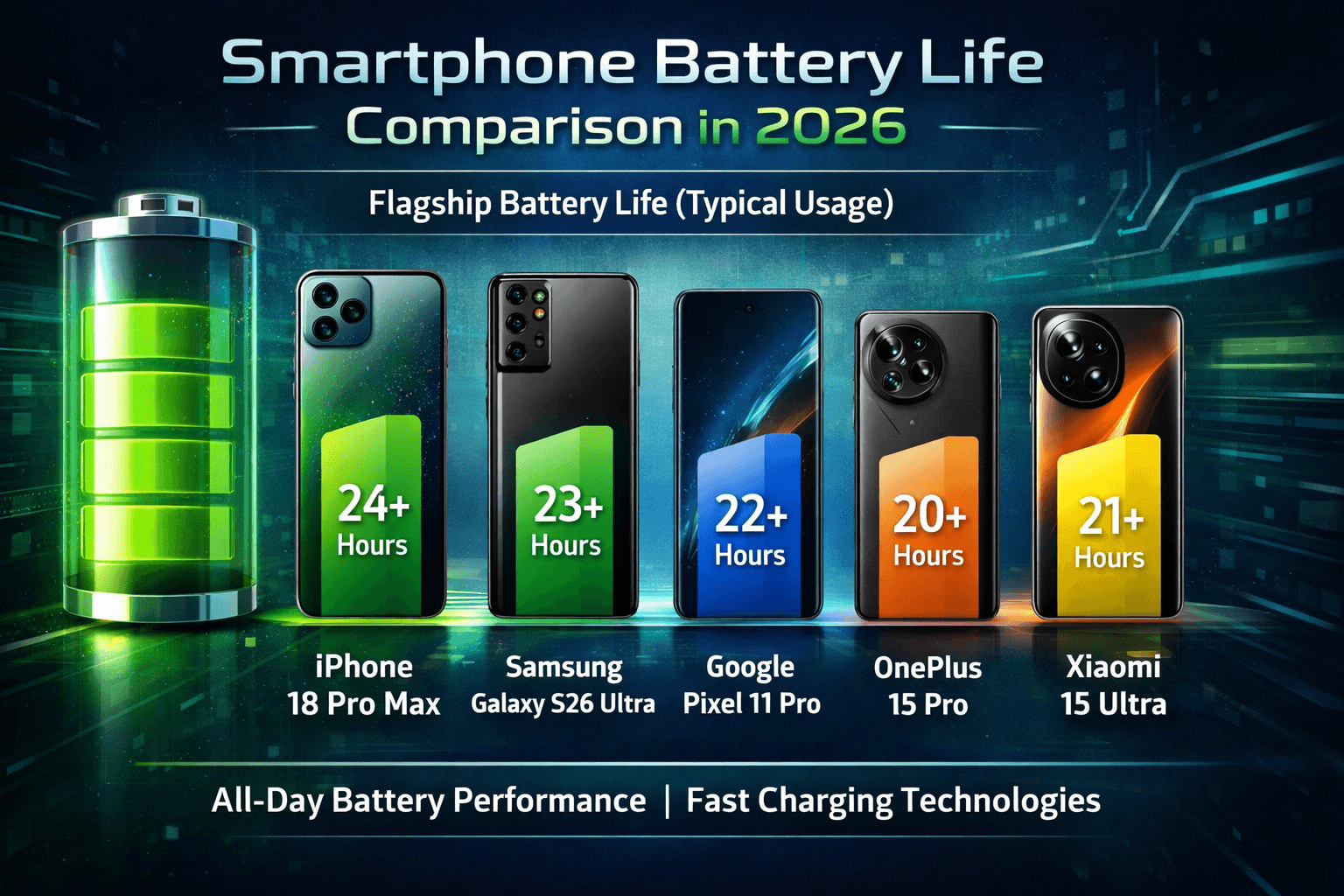
| iPhone 18 Pro Max | 4,900mAh | 24+ hours | 45W | 45 minutes to 80% | 25W MagSafe | Excellent degradation resistance |
| Samsung S26 Ultra | 5,000mAh | 23+ hours | 65W | 25 minutes to 80% | 50W wireless | Optimized charging mode |
| OnePlus 15 Pro | 5,500mAh | 22+ hours | 100W | 15 minutes to 80% | 50W wireless | Battery health AI |
| Google Pixel 11 Pro | 5,000mAh | 22+ hours | 37W | 50 minutes to 80% | 23W wireless | Adaptive battery optimization |
| Xiaomi 15 Ultra | 5,800mAh | 21+ hours | 120W | 12 minutes to 80% | 80W wireless | Graphene anode technology |
Battery Evolution
2026 demonstrates battery technology maturity. All flagship phones deliver 22-24+ hours of typical usage. Charging speeds range 37W-120W, enabling 15-50 minute charging to 80%. Wireless charging capabilities 23W-80W provide convenient charging alternatives. Battery health degradation optimized through AI-powered charging algorithms.
Display technology reached maturity in 2026, with OLED standard in premium phones, advanced refresh rates, and exceptional color accuracy defining premium experiences.
| Display Type | Technology | Refresh Rate | Peak Brightness | Color Accuracy | Common Devices |
|---|---|---|---|---|---|
| AMOLED/OLED | Samsung/LG manufacturing | 60Hz-120Hz | 2,000-3,000 nits | DCI-P3 certified | Premium flagship phones |
| IPS LCD | Traditional LCD | 60Hz-90Hz | 600-900 nits | sRGB standard | Budget phones |
| Dynamic AMOLED 2X | Samsung innovation | 120Hz-144Hz | 3,000+ nits peak | HDR10+ | Samsung flagship |
| LTPO AMOLED | Variable refresh 1-120Hz | 1-120Hz adaptive | 2,500 nits | DCI-P3+ | Flagship optimization |
Display Standards
OLED has become standard in premium phones ($799+), with IPS LCD reserved for budget models. Key differentiators include peak brightness (outdoor usability), refresh rate fluidity, and HDR capabilities. Adaptive refresh rates (LTPO) optimize performance and battery efficiency by adjusting refresh frequency based on content and scrolling speed.
10. Software and User Experience
Software platforms differentiate user experience significantly, with iOS and Android competing through ecosystem integration, AI capabilities, and privacy approaches.
| Platform | Latest Version | Customization | AI Integration | Privacy Focus | App Ecosystem |
|---|---|---|---|---|---|
| iOS 18 (Apple) | iOS 18.0 | Limited customization | On-device AI processing | Privacy-first | 2.5M apps, exclusive focus |
| Android 16 (Google) | Android 16 | High customization | Cloud + on-device AI | Privacy options available | 3.4M apps, open ecosystem |
| One UI (Samsung) | Based on Android 16 | Enhanced customization | Samsung AI + Google AI | Privacy controls | Full Android ecosystem |
| OxygenOS (OnePlus) | Based on Android 16 | Minimal bloatware | Google AI focus | Clean Android experience | Full Android ecosystem |
| HyperOS (Xiaomi) | Based on Android 16 | Customizable | AI features emphasis | Regional privacy policies | Full Android ecosystem |
Software Differentiation
iOS maintains ecosystem lock-in through exclusive features and seamless integration with Apple products. Android emphasizes customization and flexibility, with Google's AI integration increasingly differentiating Pixel devices. Samsung's One UI and OxygenOS provide UI layers enhancing base Android experience.
11. AI Features: The 2026 Game Changer
Artificial intelligence integration became the primary differentiator in 2026, with on-device AI processing enabling privacy-first smart features.
AI Features Across Smartphones 2026:
On-Device AI Processing — Large language models running locally on processors enable privacy-first AI. Local processing prevents data transmission to cloud servers, addressing privacy concerns.
Real-Time Translation — AI translation enables multi-language conversations, real-time text translation, and contextual interpretation without network dependency.
AI Photo Enhancement — Computational photography powered by AI processes photos for optimal enhancement: noise reduction, detail enhancement, intelligent cropping, and automatic editing suggestions.
Adaptive Interface — AI learns user behavior, personalizing interface layout, app suggestions, and notification prioritization based on individual usage patterns.
AI Accessibility Features — Real-time caption generation, voice enhancement for hearing aids, adaptive text sizing, and voice command improvements assist users with disabilities.
Predictive Assistance — AI predicts user intent, offering proactive suggestions for contacts, apps, and information based on context and usage history.
AI Security and Privacy — On-device AI detects anomalous patterns, identifies phishing attempts, and protects privacy through local processing without data transmission.
12. Durability and Build Quality
2026 smartphones emphasize durability improvements through advanced materials, improved repairability, and enhanced water/dust resistance.
| Aspect | 2026 Improvement | Impact | Notable Implementation |
|---|---|---|---|
| Glass Technology | Gorilla Glass Armor (scratch-resistant) | Reduced screen protector need | Samsung, Apple flagship phones |
| Titanium Frames | More durable than aluminum | Improved drop resistance | iPhone 18, Samsung S26 Ultra |
| IP Rating | IP68+ standards universal | Dust/water resistance to 2m depth | All flagship and mid-range phones |
| Repairability | Modular components, official parts | Reduced replacement costs | Framework partnerships |
| Thermal Management | Advanced heat dissipation | Sustained performance, longevity | Vapor chamber technology |
| Battery Health | Optimized degradation curves | Long-term battery capacity retention | AI charging algorithms |
Durability Standards
2026 smartphones demonstrate significantly improved durability. IP68 waterproofing, reinforced frames, and advanced glass technology reduce accidental damage. Repairability improvements—official parts availability, modular components, and authorized repair networks—extend device lifespan and reduce environmental impact.
13. Smartphone Buying Guide: How to Choose
Choosing the right smartphone depends on individual priorities, budget, and ecosystem preferences. Here's how to evaluate based on key criteria.
Buying Decision Framework
Common Pitfalls in Smartphone Selection
Warning
❌ **Megapixel Obsession:** Higher megapixel counts don't guarantee better photos. Sensor size, computational photography, and lens quality matter more than pixel count. A 48MP sensor with advanced processing often outperforms 200MP sensors.
Mistakes to Avoid:
Storage Overspecification — 512GB storage often unnecessary for casual users. 128GB-256GB sufficient for most; excessive storage drives unnecessary cost.
RAM Misunderstanding — 12GB+ RAM offers minimal benefits for typical usage. 6GB-8GB adequate for multitasking and gaming.
Refresh Rate Overestimation — 120Hz+ refresh rates smooth for scrolling, but 60Hz-90Hz sufficient for most users. Beyond 120Hz provides diminishing returns.
Brand Loyalty Trap — Latest flagship often offers 10-15% improvements over previous generation. Mid-range phones from current year often outperform premium phones from 2-3 years prior.
Unnecessary Feature Targeting — Selecting phones based on single features (brand, processor specs) rather than overall value proposition. Comprehensive comparison across use cases provides better purchasing decisions.
Ignoring Software Support — Long software support periods (5-7 years) more valuable than raw current performance. Choose manufacturers with proven update track records.
Conclusion: Smartphone Maturity and Choice
2026 demonstrates smartphone technology maturity. The performance gap between $299 budget phones and $1,299 flagship models has narrowed significantly. All modern smartphones deliver excellent daily performance, functional cameras, and adequate displays. Premium pricing now justifies through AI capabilities, exceptional cameras, superior displays, and ecosystem integration rather than fundamental capability differences. Choose based on budget constraints, camera priorities, ecosystem preferences, and specific feature requirements rather than raw specs.
📱 **Download the Complete Smartphone Buying Guide 2026** — Detailed comparisons, performance benchmarks, camera test results, and pricing analysis for all major smartphones.
Share This Article
📤 Share This