
Introduction: Indian Higher Education Landscape and Ranking Evolution
2026 Indian higher education landscape transformed by accessibility, quality variation, and global competitiveness—1,000+ universities, 50,000+ colleges, and 30+ million students with massive stratification in outcomes. NIRF (National Institutional Ranking Framework) and QS World Rankings establishing transparency: top 50 institutions (IITs, DU, Delhi University, premium private) commanding 50-60% salary premium over lower-tier colleges (₹25-35L annual salary vs. ₹12-15L), and research output correlating with reputation and placement outcomes. Post-pandemic educational disruption visible: online learning normalization, remote placements, and skill-based hiring emerging alongside traditional degree preference. March 2026 institutional hierarchy distinct: Tier 1 (IITs, AIIMS, Delhi University, premium private—₹3-8L annual cost), Tier 2 (NITs, state universities—₹1-3L annual cost), Tier 3 (regional colleges—₹50K-1.5L annual cost), and Tier 4 (low-tier private—₹75K-2L annual cost). Placement outcomes diverging sharply: top 50 institutions achieving 95%+ placement at ₹20-50L average starting salary, mid-tier 80-90% placement at ₹10-15L, lower-tier 50-70% placement at ₹6-10L. Whether targeting IIT admission (JEE cutoff top 1%), seeking quality state/private institution, or evaluating transfer options, 2026's educational ecosystem offers multiple pathways with varying cost-benefit profiles and career outcomes.
Pro Tip
👉 Key Insight: University ranking premium declining (top 50 vs. top 500 earning differential 50-60% in 2015 vs. 30-40% in 2026)—individual performance and skills increasingly mattering vs. institution prestige alone. However, network effects, campus recruiting, and reputation still provide 30-40% advantage. Strategic choice: excellent student at Tier 2 institution (top 10% class) often outperforms mediocre student at Tier 1 (bottom 30% class). Financial ROI calculation critical: ₹50L+ premium private cost vs. ₹5L government institution—salary differential needs to justify 10x cost difference.
1. NIRF and Global University Rankings 2026
Comprehensive overview of NIRF rankings, QS World Rankings, and other frameworks evaluating Indian institutions.
| Rank | Institution | Type | NIRF Score | QS World Rank | Avg. Placement Salary (₹) | Placement Rate (%) | Key Strength |
|---|---|---|---|---|---|---|---|
| 1 | IIT Bombay | Central University | 94.0 | 171 (world) | ₹28-35L | 98%+ | Engineering, research, alumni network |
| 2 | IIT Delhi | Central University | 93.5 | 206 (world) | ₹27-32L | 98%+ | Engineering, placement record, faculty |
| 3 | IIT Madras | Central University | 93.0 | 250 (world) | ₹26-31L | 97%+ | Engineering, innovation, research |
| 4 | IIT Kanpur | Central University | 92.5 | 316 (world) | ₹24-28L | 97%+ | Engineering, research, faculty quality |
| 5 | IIT Kharagpur | Central University | 92.0 | 290 (world) | ₹24-27L | 97%+ | Engineering, heritage, placement |
| 6 | Delhi University | State University | 89.5 | 350 (world) | ₹12-18L | 85%+ | Academics, faculty, Delhi location |
| 7 | University of Calcutta | State University | 88.0 | 500+ (world) | ₹10-14L | 75%+ | History, academics, research |
| 8 | IIT Roorkee | Central University | 91.0 | 370 (world) | ₹22-26L | 96%+ | Engineering, heritage, placements |
| 9 | AIIMS Delhi | Medical Institute | 90.5 | 200-250 (medical) | ₹15-25L (medical specialist) | 98%+ (within medical) | Medical education, research, reputation |
| 10 | Banaras Hindu University | Central University | 87.5 | 400-450 (world) | ₹10-15L | 80%+ | Heritage, academics, multidisciplinary |
| 11-20 | NIT Tier 1 (Trichy, Surathkal, Warangal, Rourkela, Allahabad) | Central Universities | 75-80 | 600-800 (world) | ₹12-18L | 85-90% | Engineering, placement, affordability |
| 20-50 | Premium Private Universities (Ashoka, FLAME, etc.) | Private | 70-80 | 400-600 (world) | ₹15-22L | 90-95% | Academics, placements, campus |
| 50-100 | Regional State Universities (Pune, Lucknow, BHU affiliate colleges) | Mixed | 55-70 | 700-1000 (world) | ₹8-12L | 75-85% | Affordability, regional prestige |
| 100+ | Lower-Tier Private and State Colleges | Mixed | <60 | 1000+ (world) | ₹5-8L | 50-70% | Variable (highly inconsistent) |
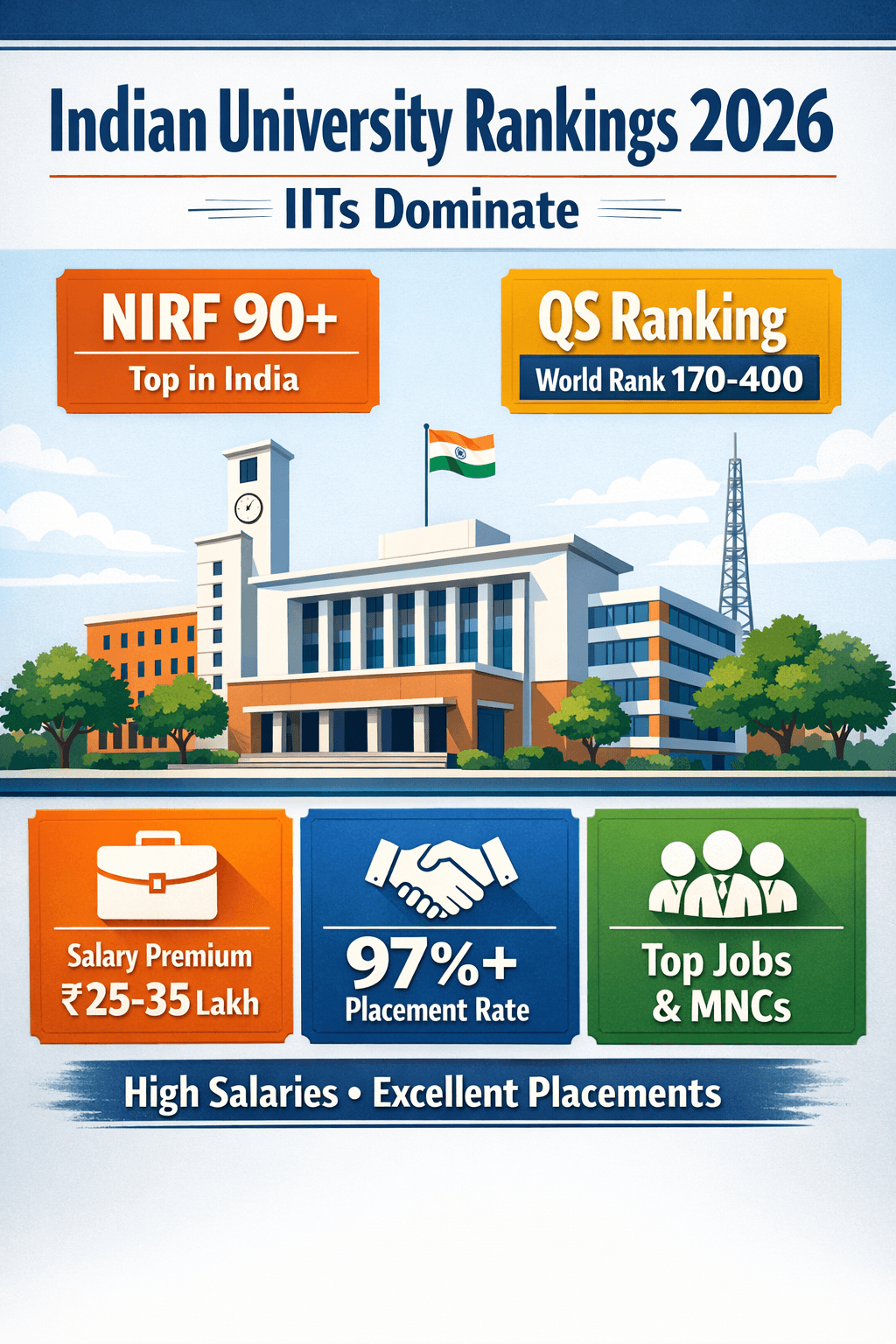
University Ranking Analysis
2. Institutional Comparison by Stream and Career Outcomes
Stream-specific analysis comparing top institutions across engineering, business, medicine, and liberal arts disciplines.
| Stream | Top 3 Institutions | Avg. Placement Salary (₹) | Placement Rate (%) | Cost (4-year, ₹) | Career Outcomes | Key Hiring Companies |
|---|---|---|---|---|---|---|
| Engineering (CS/IT Focus) | IIT Bombay, IIT Delhi, IIT Madras | ₹32-50L (top placements) | 98%+ | ₹10-15L | Tech giants (Google, Microsoft, Amazon), startups, finance | Google, Microsoft, Amazon, Apple, JP Morgan, Goldman Sachs |
| Engineering (Non-CS) | IIT Bombay (Mech), IIT Kharagpur (Civil), IIT Madras (Aero) | ₹22-28L | 97%+ | ₹10-15L | Core companies (BHEL, Larsen & Toubro), oil & gas, infrastructure | BHEL, L&T, Reliance, IOCL, Infosys, TCS |
| Business/MBA | IIM Ahmedabad, IIM Bangalore, IIM Calcutta | ₹28-45L (2-year average) | 99%+ | ₹20-30L (2-year) | Management consulting, investment banking, finance, startup founding | McKinsey, BCG, Goldman Sachs, Flipkart, Airbnb |
| Medicine | AIIMS Delhi, AIIMS other, Government Medical Colleges | ₹15-25L (starting resident), ₹50L+ (senior specialist) | 98%+ (in medical field) | ₹5-10L (government), ₹30-50L (private) | Hospital residencies, private practice, specializations, research | Apollo Hospitals, Fortis, Max Healthcare, private practice |
| Science/Research | Delhi University, BHU, University of Calcutta | ₹8-15L (academia/research focus) | 70-80% | ₹1-3L | Academia (professor, researcher), government jobs, NGOs | Universities, research institutes (CSIR, ICMR), government agencies |
| Liberal Arts | Ashoka, FLAME, Miranda House (DU) | ₹12-25L (diverse careers) | 85-90% | ₹20-40L (private), ₹50K-2L (DU) | Consulting, media, NGOs, finance, civil service, entrepreneurship | Consulting firms, media companies (NDTV, Huffpost), NGOs, finance |
| Law | National Law School (Bangalore), Delhi University Law, NALSAR | ₹15-30L (law firms), ₹5-10L (public interest) | 90%+ | ₹5-15L | Law firms, in-house counsel, judiciary, public interest law, corporate | Rajinder Singh & Hollingsworth, Nishith Desai, Khaitan & Co |
| Hospitality/Tourism | IHM Delhi, IHM Bangalore, AIHM | ₹10-18L (starting) | 85%+ | ₹8-12L | Hotels (ITC, Taj, Oberoi), food service, travel, event management | Taj Group, ITC Hotels, Oberoi, Marriott, Hyatt |
Stream-Specific Deep Analysis
3. Institution Selection Framework and College Admission Strategy
Strategic framework for selecting optimal institution based on career goals, financial constraints, and academic profile.
College Selection and Admission Strategy
CAT (Management/MBA):
Choice 4: Medicine (AIIMS vs. Private)
Conclusion: Strategic Institution Selection Enabling Career Success
2026 Indian higher education landscape demonstrates clear stratification: Tier 1 institutions (IITs, Delhi University, premium private) enabling 50-60% salary premium over Tier 3-4, yet with declining marginal returns (Tier 1 vs. Tier 2 differential ₹10-15L annually, Tier 2 vs. Tier 3 differential ₹3-8L). NIRF and global rankings providing transparency enabling informed decision-making, though rankings imperfectly correlating with career outcomes. Institution selection critically important within constraints: JEE/CAT/NEET rank determining realistic tier accessible, financial capacity influencing cost-benefit calculation, and career alignment ensuring optimal specialization choice. Engineering (IIT/NIT) highest immediate earning (₹25-35L year 1), management (IIM) fastest growth trajectory (30-50% annual), medicine (AIIMS) highest long-term earning (₹80-150L+ practicing), reflecting field-specific economics and career paths. Strategic optimization possible within tier: top 10% lower-tier student often outperforming bottom 50% higher-tier, suggesting individual effort and initiative mattering more than prestige beyond certain threshold. Financial ROI analysis critical: IIT (₹12L cost, 17x return 5-year) vs. premium private (₹40L cost, 2.5x return)—cost-benefit calculation essential. Alternative pathways increasingly viable: excellence in Tier 2 institution + postgraduate degree/MBA enabling comparable outcomes to Tier 1 undergraduate at lower total cost. Future Indian education landscape evolving: skill-based hiring emerging alongside degree preference, online learning legitimacy increasing, and reputation premium declining (30-40% vs. 50-60% historically). Overall institutional selection complexity manageable through: clear career goal definition, realistic rank/financial assessment, decision matrix weighting preferences, and post-admission optimization through excellence and networking. Best opportunity: strategic institution choice aligned with abilities and goals + individual excellence within that institution = career success and earning potential maximization. Ultimate success formula: Right institution match + top performance within tier + portfolio building + networking + interview excellence = competitive career launch.
🎓 **Download the Complete University Rankings and Selection Guide 2026** — Detailed ranking analysis, stream-wise institutional comparison, selection framework, financial ROI models, and strategic admission planning.
Share This Article
📤 Share This