RC
RevoChamp
EDUCATION • COLLEGE ADMISSIONS

Complete Guide to College Admissions and Career Planning 2026: Strategic University Selection

Application strategy, university selection, financial aid optimization, and career pathway alignment—master college admissions and launch meaningful career trajectories.

College Admissions and Career Planning Strategy Team

Author

Mar 5, 2026
17 min read

Annual college applicants globally

20M+

4-year college education cost range (India to US)

₹40L-2Cr+

College graduates earning 40%+ more over lifetime vs. high school graduates

73%

Complete Guide to College Admissions and Career Planning 2026: Strategic University Selection

Introduction: College Selection Defines Career Trajectory

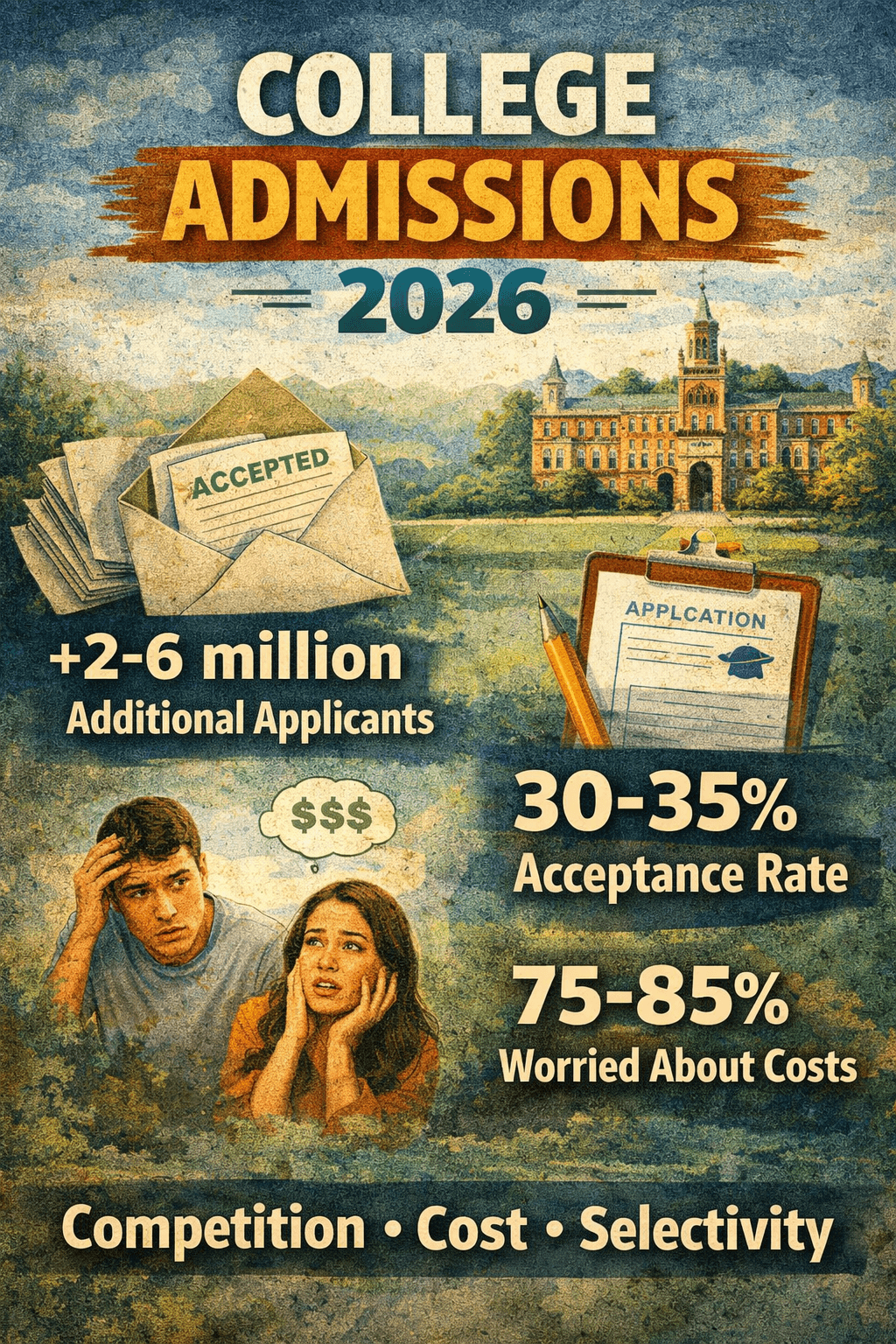
2026 college admission landscape transformed by technology, remote education normalization, and global accessibility—students selecting from 10,000+ universities worldwide with unprecedented transparency on outcomes and costs. College education ROI scrutiny increasing (total cost ₹40L-2Cr+ vs. average graduate earnings ₹1.2-3L annually)—institutional selection critical, not prestige-driven. March 2026 reality: 20 million+ annual college applicants competing for limited seats, acceptance rates 2-25% depending on institution tier, and career outcomes diverging sharply (top 50 universities providing 40-60% career advantage, mid-tier 15-25%, lower-tier minimal premium). College selection implications profound: institution ranking correlating with alumni network, recruiting access, and lifetime earning potential (top universities ₹30-50L average, mid-tier ₹15-25L, lower-tier ₹8-15L). Strategic college selection requires: understanding university tiers and differentiation, optimizing application strategy (test scores, essays, portfolios), navigating financial aid and ROI, and aligning institutional choice with career goals. Whether pursuing traditional 4-year degree, specialized programs, or alternative pathways (bootcamps, online degrees), 2026's educational ecosystem offers unprecedented choice enabling informed decisions based on personal goals rather than default assumptions.

💡

Pro Tip

👉 Key Insight: College ranking premium declining (top 50 university earning differential 20-30% vs. 50-60% in 1990s), suggesting quality matters less than individual initiative. However, network effects, recruiting access, and prestige still provide 20-30% career advantage over time. Strategic choice: align college tier with career ambition and field (engineering: rankings matter more, liberal arts: less critical). Best ROI: high-tier university where you're top 10% admits (strong fit) vs. low-tier university (mediocre fit). Financial aid negotiation critical (many top universities offer 50%+ tuition reduction if negotiated).

1. Understanding University Tiers and Strategic Selection

University landscape segmented into performance tiers with distinct advantages, network effects, and career outcomes—strategic selection critical for ROI optimization.

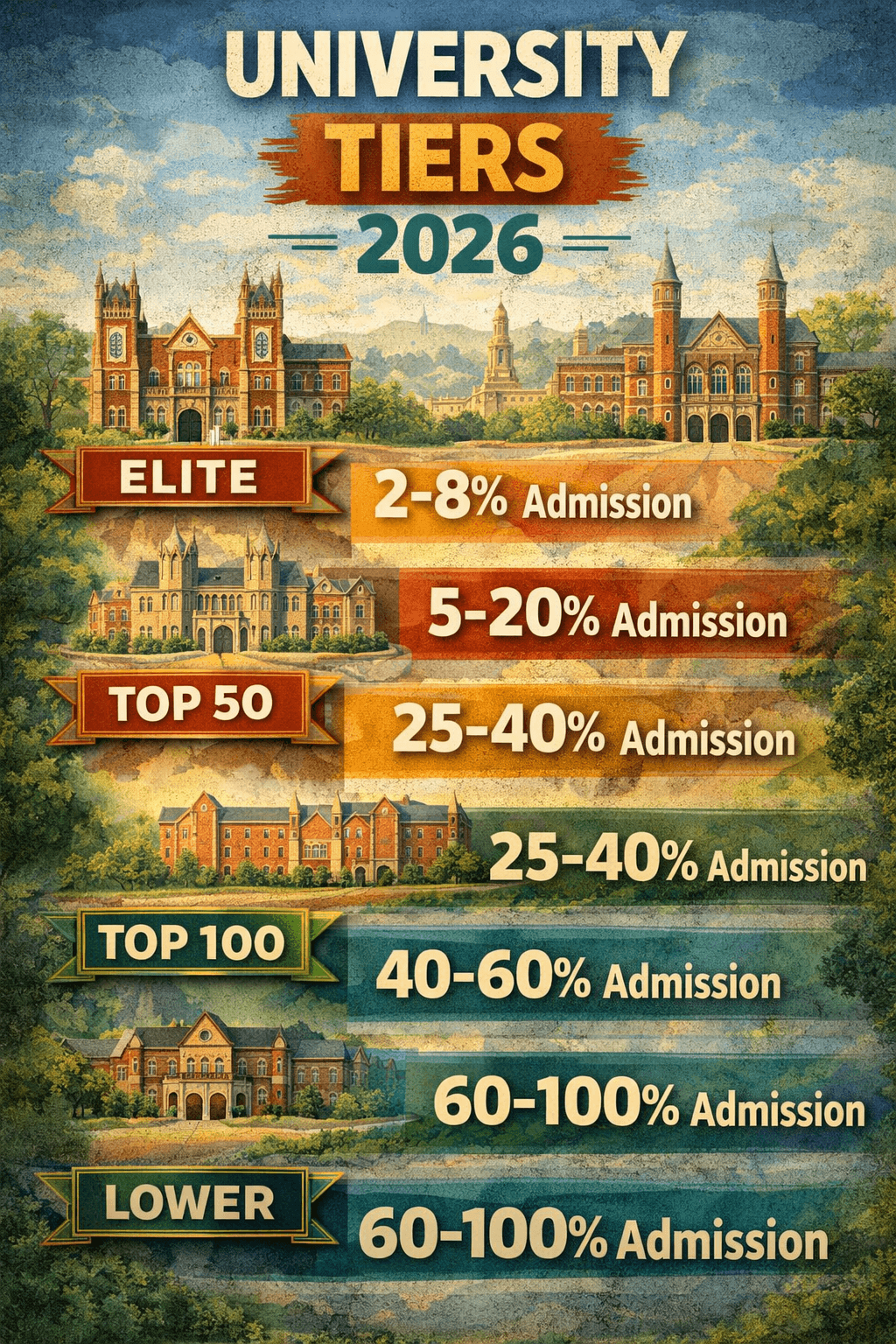
University TierExamplesAdmission Rate (%)Average SAT/ACTCost (Annual ₹)Average Graduate SalaryAlumni Network StrengthCareer Advantage
Tier 1 (Elite)Harvard, Stanford, MIT, IIT Delhi, Delhi University2-8%1480-1570 SAT / 33-35 ACT₹10L-30L (US), ₹2L-4L (India)₹40L-80L+ (US grad), ₹20L-40L (India)Exceptional (global access)40-60% lifetime premium
Tier 2 (Top 50)Yale, Penn, Northwestern, CMU, IIT Bombay5-20%1450-1500 SAT / 33-34 ACT₹8L-25L (US), ₹1.5L-3L (India)₹30L-60L (US), ₹15L-30L (India)Strong (regional + global)25-40% lifetime premium
Tier 3 (Top 100)Brandeis, Michigan, UT Austin, BITS, Manipal25-40%1300-1450 SAT / 29-32 ACT₹5L-15L (US), ₹1L-2.5L (India)₹20L-40L (US), ₹12L-25L (India)Good (regional strong)15-25% lifetime premium
Tier 4 (Top 200)SUNY schools, state universities, regional colleges40-60%1100-1300 SAT / 24-29 ACT₹3L-8L (US), ₹60K-1.5L (India)₹12L-25L (US), ₹8L-15L (India)Moderate (local + network)5-15% lifetime premium
Tier 5 (Lower-Ranked)Community colleges, online universities, local institutions60-100%<1100 SAT / <24 ACT₹1L-3L (US community), ₹30K-1L (India)₹6L-12L (US), ₹5L-10L (India)Limited (local)0-5% lifetime premium
University tiers 2026: Elite (2-8% admission), Top 50 (5-20%), Top 100 (25-40%), Top 200 (40-60%), Lower (60-100%)

University Tier Analysis

Tier 1: Elite Universities (2-8% admission rate)
Examples: Harvard, Stanford, MIT (US), IIT Delhi, Delhi University (India)
Admission standards: Top 0.1-1% of applicants (SAT 1480+, GPA 3.9+)
Cost: ₹10L-30L annually (US top universities), ₹2L-4L (India IITs)
Graduate salary: ₹40L-80L+ (US grads), ₹20L-40L (India IIT grads)
Network strength: Exceptional (global CEOs, entrepreneurs, leaders)
Prestige factor: Maximum (brand recognition worldwide)
Career advantage: 40-60% lifetime earning premium
ROI: Excellent despite high cost (alumni network value, recruiting)
Considerations: Extreme admission competition, merit-based aid substantial
Tier 2: Top 50 Universities (5-20% admission rate)
Examples: Yale, Penn, Northwestern, CMU (US), IIT Bombay (India)
Admission standards: Top 1-5% of applicants (SAT 1450+, GPA 3.8+)
Cost: ₹8L-25L annually (US), ₹1.5L-3L (India)
Graduate salary: ₹30L-60L (US), ₹15L-30L (India)
Network strength: Strong (significant corporate/alumni connections)
Prestige factor: Very high (competitive recruiting)
Career advantage: 25-40% lifetime earning premium
ROI: Very good (substantial network, career acceleration)
Considerations: Highly competitive admissions, financial aid available but limited
Tier 3: Top 100 Universities (25-40% admission rate)
Examples: Brandeis, Michigan, UT Austin (US), BITS, Manipal (India)
Admission standards: Top 10-25% of applicants (SAT 1300-1450)
Cost: ₹5L-15L annually (US), ₹1L-2.5L (India)
Graduate salary: ₹20L-40L (US), ₹12L-25L (India)
Network strength: Good (regional strong, some national presence)
Prestige factor: Moderate (recognized within region/field)
Career advantage: 15-25% lifetime earning premium
ROI: Good (reasonable cost, network benefits)
Considerations: Admission more achievable, full merit aid possible
Tier 4: Top 200 Universities (40-60% admission rate)
Examples: SUNY schools, state universities, regional colleges
Admission standards: Top 30-60% of applicants (SAT 1100-1300)
Cost: ₹3L-8L annually (US), ₹60K-1.5L (India)
Graduate salary: ₹12L-25L (US), ₹8L-15L (India)
Network strength: Moderate (local community strong)
Prestige factor: Low (limited recognition outside region)
Career advantage: 5-15% lifetime earning premium
ROI: Moderate (network limited, prestige minimal)
Considerations: Most accessible tier, majority of students
Tier 5: Lower-Ranked/Community Colleges (60-100% admission rate)
Examples: Community colleges, online universities, local institutions
Admission standards: Open admission or minimal requirements
Cost: ₹1L-3L annually (community), ₹30K-1L (India local colleges)
Graduate salary: ₹6L-12L (US), ₹5L-10L (India)
Network strength: Limited (local only)
Prestige factor: Minimal
Career advantage: 0-5% lifetime earning premium
ROI: Lower (prestige minimal, network limited)
Considerations: Most affordable, high accessibility, transfer pathways
Strategic Selection Factors:
Best University Fit Criteria:

1. Academic Match: Top 10% of admitted class (strong profile)

2. Financial Fit: Net cost <25% of annual family income (affordability)

3. Career Alignment: University strength in target major/field

4. Network Relevance: Alumni presence in target industry

5. Geographic Consideration: Location relevance to career goals

6. Culture Fit: Educational philosophy alignment

Ranking Premium Reality Check:
Tier 1 vs. Tier 3 earning differential: 40-50% (still significant)
Tier 2 vs. Tier 3 earning differential: 25-30%
Tier 3 vs. Tier 4 earning differential: 15-20%
Tier 4 vs. Tier 5 earning differential: 10-15%
BUT: Individual performance within tier matters more than tier itself (top Tier 4 student > bottom Tier 1 student)
Network Effects Timeline:
Year 0-5: Minimal advantage (early career merit-based)
Year 5-15: Network advantage emerging (relationship-based opportunities)
Year 15+: Network advantage significant (access to opportunities, advancement)
Field-Specific Ranking Importance:
Engineering/Tech: High ranking importance (60% advantage)
Business/Finance: High ranking importance (50% advantage)
Law: Very high importance (70% advantage)
Medicine: Very high importance (80% advantage)
Liberal Arts/Humanities: Lower importance (20% advantage)
Entrepreneurship: Minimal importance (track record matters more)
Key Metric
Tier 1 graduates earn 40-60% more lifetime vs. Tier 4—network effects and prestige advantage significant but declining

2. Strategic College Application Strategy

Comprehensive application planning maximizing admission odds through portfolio optimization, essay strategy, and target school selection.

Application ComponentWeight (%)Importance LevelOptimization StrategyTimelineSuccess Rate Impact
Test Scores (SAT/ACT)20-30%Critical (Tier 1-2)Target 75th+ percentile (SAT 1450+), practice 3-6 monthsMonths 8-10 (junior year)±10-15% admission probability
GPA/Transcripts25-30%Critical (all tiers)Maintain 3.8+ GPA, show upward trajectoryContinuous (all high school)±15-20% admission probability
Essays15-20%High (Tier 1-2, Medium Tier 3)Tell unique story, demonstrate self-awareness, authentic voiceMonths 11-1 (senior year)±10-15% admission probability
Extracurricular Activities15-20%Medium (Tier 1-2), Low (Tier 3+)Depth over breadth (3-4 activities mastered, not 10 dabbled)Continuous (high school)±5-10% admission probability
Recommendation Letters10-15%Medium (Tier 1-2), Low (Tier 3+)Build strong teacher relationships, provide guidance, personal noteMonth 10-11 (senior year)±5-10% admission probability
Work/Volunteer Experience5-10%Low-MediumDemonstrate leadership, impact, consistency in activitiesContinuous (high school)±3-5% admission probability
Interview (if offered)5-10%Medium (Tier 1-2), Low (Tier 3+)Prepare stories, answer thoughtfully, ask intelligent questionsMonths 12-2 (senior year)±5-10% admission probability
Special Talents (sports, arts, academics)5-10%High (if exceptional)Develop distinct strength (recruited athlete, artist, researcher)Continuous (2+ years)±10-20% admission probability (if strong)

Holistic Application Strategy

Target School Portfolio Construction:
Reach Schools (20-30% admission rate odds):
3-5 universities slightly above current profile
Examples: If SAT 1350, target schools admitting 1400+ averages
Stretch goal (1-2 schools): Elite universities (5% admission)
Purpose: Ambitious goals, potential upside
Backup plan: Expect rejections, focus on other applications
Match Schools (40-60% admission rate odds):
3-5 universities aligned with current profile
Examples: If SAT 1350, target schools admitting 1300-1400
Purpose: Primary realistic targets
Strategy: Prioritize within match schools (favorites 1-2, solid backups 3-5)
Safety Schools (75%+ admission rate odds):
1-2 universities virtually guaranteed admission
Examples: If SAT 1350, target schools admitting 1100-1200
Purpose: Guaranteed college option
Selection: Ensure acceptable, not just fallback
Portfolio Recommendation:
Total applications: 5-8 universities (strategic, not quantity)
Distribution: 1-2 reach + 3-5 match + 1-2 safety
Deep focus: 2-3 "dream" schools (essay quality, authentic interest)
Test Score Optimization:
SAT/ACT Strategy:
Start practice: 10-12 months before application (January junior year)
Diagnostic test: Establish baseline (expected score ±100 points)
Study plan: 3-4 months structured prep (official test prep + Khan Academy free)
Practice tests: 10-15 full tests minimum
Test attempts: Take official test 2-3 times (September, November senior year)
Score goal: 75th percentile for target school (school average ±50 points)
Diminishing returns: 3rd attempt rarely improves significantly
Sample Timeline:
January (Junior): Diagnostic test, begin prep
March-April: Intensive prep 10+ hours/week
May-June: Practice tests weekly, review weak areas
August: Final prep, focus on weak sections
September (Senior): Official test 1
November: Official test 2 (if improvement needed)
January: Final attempt if required (most universities accept January scores)
GPA Maintenance:
Target: 3.8+ GPA (unweighted) for Tier 1-2 schools
Weighting: Weighted GPA (honors/AP classes) shows rigor
Upward trajectory: 3.6→3.8→3.9 progression stronger than consistent 3.7
Course rigor: AP/IB/Honors classes (5-6 minimum) show challenge-seeking
Senior year: Admissions weight heavily (don't "senioritis")
Essay Strategy (Most Underestimated Component):
Common App Essay (650 words):
Purpose: Tell unique story not evident in application
Pitfalls: Clichéd topics (overcoming adversity, sports victory, travel epiphany)
Strategy: Focus on specific moment revealing character/growth
Voice: Authentic, conversational (not overly formal)
Structure: Hook (attention-grabbing opening) → Story/Analysis → Insight
Writing quality: Grammatically perfect, clear, engaging
Timeline: Draft 1-2 months, revise 5-10 times, finalize December senior year
School-Specific Supplements:
Research: Why do you want to attend THIS school? (not generic)
Specificity: Reference specific programs, professors, opportunities
Authenticity: Show genuine interest (visited campus, attended virtual event, connected with student)
Length: Follow word count (typically 100-250 words)
Avoid: Generic answers (your mission statement works for 100 schools)
Extracurricular Strategy:
Quality Over Quantity:
Depth: 3-4 activities sustained 3+ years (shows commitment)
Leadership: Officer positions in 1-2 activities
Impact: Demonstrate concrete contribution (not just participation)
Examples: Club president (organized event reaching 100 students), research (published or presented), volunteer (50+ hours in area)
Strong Extracurricular Profile:
Varsity sport (or club sport with competitive schedule)
Academic club (debate, science olympiad, math competition)
Community service (volunteer work, activism, tutoring)
Creative pursuit (music, art, theater, writing)
Unique activity (personal project, startup, social enterprise)
Recommendation Letters:
Selection Strategy:
Choose teachers knowing you well (small class, strong grades)
Avoid popular teachers (generic letters, overworked)
Meet with teacher 1-2 months before deadline
Provide guidance: "Here's why I'm applying to X, here's what I'm passionate about"
Personal note: Email summarizing academic/personal connection (jog memory)
1-2 recommender letters optimal (3rd adds little value)
Interview (If Offered):
Preparation Strategy:
Research university thoroughly (academics, culture, location)
Develop 3-4 stories illustrating character/passions
Practice answering standard questions (Why major? Why university? Challenges?)
Prepare intelligent questions about university (shows genuine interest)
Mock interview: Practice with trusted adult
Interview Performance:
Authenticity: Be genuine, not what you think they want to hear
Listening: Answer actual question asked, not prepared response
Examples: Support answers with specific experiences
Enthusiasm: Show genuine excitement about university
Closing: Thank you email within 24 hours
Application Timeline Summary:
Summer (Junior Year Transition):
Identify 20-30 potential universities (research).
Take SAT diagnostic test, register for official tests
Begin test prep (3-4 months before September attempt)
Fall (Junior Year):
Continue test prep, take practice tests weekly
Maintain strong GPA (junior year GPA critically important)
Deepen extracurricular commitment (leadership roles)
SAT official attempt (September)
Begin initial essay brainstorming
Fall (Senior Year):
Official test 2 if needed (November)
Finalize target school list (5-8 universities)
Draft common app essay (October-November)
Begin school-specific supplements
Request recommendation letters (October)
Winter (Senior Year):
Finalize and submit applications (November-December deadline)
Attend interviews if offered (December-January)
Submit school-specific supplements (by deadline)
Prepare for college interviews (personal story practice)
Spring (Senior Year):
Receive admission decisions (March-April)
Compare financial aid packages (April-May)
Make final decision and commit (May 1 deadline)
Key Metric
Strategic application approach (targeted schools, authentic essays, test optimization) improving admission odds 30-50% vs. generic applications

3. Financial Aid Optimization and Cost Analysis

Comprehensive financial planning maximizing aid, minimizing debt, and optimizing ROI through strategic financial decisions.

Cost FactorHigh-Cost Universities (₹)Mid-Cost Universities (₹)Low-Cost Universities (₹)Optimization Strategy
Annual Tuition (US Tier 1)₹15L-30L₹8L-15L₹3L-8LNegotiate merit aid, apply for scholarships
Room & Board (On-campus)₹2L-4L₹1.5L-3L₹50K-1.5LOff-campus housing (30% cheaper), meal plan optimization
Books & Supplies₹1L-2L₹75K-1.5L₹25K-75KRent textbooks, buy used, digital versions
Personal Expenses/Travel₹50K-1.5L₹30K-75K₹15K-40KHome visits limit, local entertainment
Total 4-Year Cost (No Aid)₹80L-140L₹40L-80L₹12L-40LScholarships/grants reducing actual cost 30-70%
After Merit Aid (₹ Avg)₹45L-80L (45% aid typical)₹25L-50L (30% aid typical)₹8L-20L (20% aid typical)Top applicants: full scholarships available
Student Loan (If Required)₹30L-60L₹15L-30L₹5L-15LMinimize debt, consider repayment capacity

Financial Aid Strategy

Understanding Financial Aid Types:
1. Merit-Based Aid (Academic/Talent-Based):
Offered: Students with strong test scores, GPA, extracurriculars
Amount: ₹50K-20L annually (0-100% tuition coverage)
Competitive: Varies by university (average 40-60% Tier 1, 20-30% Tier 3)
Negotiability: Limited but possible (contact admissions financial aid office)
Renewal: Usually requires maintaining GPA threshold
2. Need-Based Aid (Income-Based):
Offered: Families earning below threshold (varies by university)
Calculation: Cost of attendance - Expected family contribution
Amount: Varies (scholarships/grants + work-study + loans)
Availability: US universities more generous, international limited
FAFSA/CSS Profile: Required (financial documents submission)
3. Scholarships (External):
Government scholarships (country-specific, subject to eligibility)
Corporate scholarships (company-specific, merit-based)
Minority/diversity scholarships (targeted populations)
Field-specific scholarships (STEM, teaching, healthcare, etc.)
Research: Fastweb, College Scholarship Service, local foundations
Aggregate: Combine multiple scholarships (₹5L-30L+ possible)
4. Work-Study/Employment:
On-campus work: ₹10K-30K monthly (10-15 hours/week)
Off-campus internships: ₹20K-100K monthly (summer/break)
Teaching assistantships: ₹15K-40K monthly (STEM subjects)
Research positions: ₹20K-75K monthly (universities)
5. Student Loans:
Federal loans (US): Low interest (4-8%), income-based repayment
Private loans: Higher interest (8-12%), credit-dependent
Risks: Debt burden post-graduation (average ₹20L-30L for US graduates)
India: Education loans from banks (7-9% interest, 10-15 year repayment)
Cost Reduction Strategies:
Negotiating Merit Aid:
Approach: Contact university after admission ("financial aid appeal")
Documentation: Demonstrate appeal (competing offers, family situation)
Timing: April-May (after initial offers, before decision deadline)
Success rate: 10-20% improve aid offer if compelling case
Language: Professional, specific (not generic request)
Scholarship Hunting (US International):
Fulbright Scholarship: Full or partial tuition + living expenses (highly competitive)
Chevening Scholarship (UK): Tuition + monthly stipend (British government)
DAAD Scholarship (Germany): Full funding (German government)
University-specific scholarships: International excellence scholarships
Research: 20+ scholarships apply (not single application strategy)
Debt Management:
Loan Scenarios (US Tier 1 Example: ₹80L total cost):
Scenario A: Full Aid (No Debt)
Aid/Scholarships: ₹80L (100%)
Loans: ₹0
Repayment: None
Outcome: Optimal, rare (top 5-10% applicants)
Scenario B: Partial Aid (Moderate Debt)
Aid/Scholarships: ₹45L (56% typical)
Family contribution: ₹20L (25%)
Loans: ₹15L (19%)
Repayment: ₹15,000/month × 120 months (10 years)
Post-grad salary: ₹40L+, manageable debt
Scenario C: Limited Aid (High Debt)
Aid/Scholarships: ₹20L (25%)
Family contribution: ₹20L (25%)
Loans: ₹40L (50%)
Repayment: ₹40,000/month × 120 months (10 years)
Post-grad salary concern: Salary <₹40L= financial hardship
Risk: High debt-to-income ratio
ROI Analysis (4-Year Cost Comparison):
Tier 1 University (₹80L total cost, 56% aid typical = ₹45L net):
Annual net cost: ₹11.25L
4-year net cost: ₹45L
Graduate salary: ₹40L-60L annually
20-year earnings: ₹10-15Cr (premium ₹3-5Cr over Tier 4)
Loan repayment: Manageable
ROI: Excellent (20-30x return)
Tier 3 University (₹40L total cost, 30% aid typical = ₹28L net):
Annual net cost: ₹7L
4-year net cost: ₹28L
Graduate salary: ₹20L-30L annually
20-year earnings: ₹5-7.5Cr (premium ₹1-2Cr over Tier 5)
Loan repayment: Manageable
ROI: Good (10-15x return)
Tier 4 University (₹16L total cost, 20% aid typical = ₹12.8L net):
Annual net cost: ₹3.2L
4-year net cost: ₹12.8L
Graduate salary: ₹12L-15L annually
20-year earnings: ₹3-4Cr (minimal premium over Tier 5)
Loan repayment: Limited debt
ROI: Moderate (5-8x return)
Decision Framework (Ranking vs. Affordability):
Choose Higher-Ranked University If:
Full scholarship or >75% aid (net cost <₹20L)
Post-graduate salary expectations >₹30L
Debt-to-income ratio <30% (loan manageable)
Target career requiring prestige (consulting, finance, law)
Consider Mid-Tier University If:
Significant aid difference (₹20L+ savings)
High financial hardship (family cannot contribute)
Field where rank matters less (entrepreneurship, creative fields)
Same ROI over time but less debt burden
Choose Lowest-Cost Option If:
Debt concerns paramount (family situation)
Field where rank doesn't significantly matter
Planning to transfer (2 years low-cost, 2 years target university)
Individual performance matters more than prestige
Key Metric
Strategic financial negotiation reducing college cost 30-50% through merit aid, scholarships, and institutional funding optimization

4. Career Alignment and Post-Graduation Outcomes

Strategic university selection aligned with career goals, major selection, and post-graduation outcomes optimization.

Career PathBest University TierMajor FocusPost-Grad TimelineSalary ExpectationGraduate Degree (Y/N)Network Importance
Consulting/Finance/BankingTier 1-2Economics, Finance, BusinessDirectly to investment bank/consulting₹40L-80L starting, ₹2Cr+ 10-yearOften MBA (2-3 years experience first)Critical (70% through referral)
Technology/Software EngineeringTier 2-3 acceptableComputer Science, EngineeringDirectly to tech company₹20L-40L starting, ₹1-2Cr 10-yearOften MS (3-5 years experience first)Medium (portfolio matters more)
Medicine/HealthcareTier 1-2 requiredPre-med, Biology, ChemistryMedical school (4 years) + residency₹15L-30L starting (as resident), ₹1-2Cr+ (practicing)Yes (MD/DO required)High (network and prestige critical)
LawTier 1-2 requiredPre-law, Political ScienceLaw school (3 years) + bar exam₹20L-40L starting (big law), ₹5L-15L (general practice)Yes (JD required)Very high (T14 law schools critical)
EntrepreneurshipTier 2-3 acceptableAny major (founders diverse)2-5 years in related field, then startupVariable (₹0-5Cr+ depending on success)Often MBA (post-startup)High (networks for funding)
Teaching/AcademiaTier 2-3 acceptableSubject-specific (Math, Science, etc.)Graduate school directly or after work experience₹10L-15L (professor), ₹3L-8L (K-12 teacher)Yes (PhD for academia)Medium (dissertation adviser critical)
Government/Civil ServiceTier 1-2 preferredAny major (all backgrounds accepted)Direct government employment or postgraduate exam prep₹40K-2.5L (government roles), ₹5L-15L (civil service)Depends (postgraduate often pursued)Medium
Nonprofit/Social ImpactTier 2-3 acceptableAny major (mission-driven)Directly or after 2-3 years corporate₹10L-20L (nonprofit), ₹5L-15L (startup)Often graduate degree in nonprofit mgmtHigh (networks for impact)

Career-Specific University Strategy

Consulting/Finance Recruitment (Tier 1-2 Preference):
Why Ranking Matters:
Recruiting pipeline: McKinsey, BCG, Goldman Sachs recruit primarily from Tier 1-2
Screening: Many firms filter by university (initial resume screen)
Network: Existing consultant alumni facilitate recruiting
Brand value: Client perception influenced by firm quality perception
Getting in Without Tier 1-2:
Internships: Consulting internship (freshman/sophomore) → conversion path
Top performer: GPA 3.9+, strong extracurriculars, demonstrated achievement
Lateral entry: MBA → consulting entry (less university-dependent)
Boutique consulting: Smaller firms recruiting beyond target school list
Computer Science/Software Engineering (Tier 2-3 Competitive):
Why Ranking Less Critical:
Portfolio-based: Coding skills demonstrable through projects/GitHub
Test-driven: Leetcode/technical interview performance more important
Internships: Competitive internship path from any tier
Startup culture: Many successful founders from lower-tier universities
Getting in Without Tier 2-3:
Bootcamp alternative: Coding bootcamp → tech job (6 months, ₹15L cost)
Open-source contribution: Demonstrable through GitHub portfolio
Online presence: Tech blog, YouTube tutorials establishing credibility
Network: Conferences and local tech community networking
Medicine/Law (Tier 1-2 Effectively Mandatory):
Medicine Reality:
Medical school admission: Hospital/research access and strong recommendations critical
Residency matching: University reputation influencing match (specialty competition)
Practice: Less university-dependent post-MD (competency-based)
Strategy: Strongest possible undergraduate → medical school → specialty residency
Law Reality:
Law school tier critical: Employment outcome strongly correlates
T14 law schools: Only ~10% of lawyers graduate from T14 (but 30-40% of "BigLaw" from T14)
Geographic limitation: Regional law school serving regional legal market
JD value: Declining (oversupply of lawyers), strong school increasingly important
Strategy: Best law school attainable → BigLaw or government positions
Entrepreneurship (Tier 2-3 Competitive, Tier 4+ Possible):
Tier 1-2 Advantages:
Capital access: VC networks, angel investor connections
Talent acquisition: Strong alumni for co-founder/hiring
Mentorship: Founder/investor density enabling guidance
Brand: Customer/investor perception influenced by founder background
Tier 4-5 Path to Success:
Founder determination more important than education
Industry experience: 5 years industry experience → startup credibility
Execution excellence: Product and market fit > educational prestige
Network building: Community participation regardless of educational background
Examples: Many successful founders from non-elite schools
Business School ROI (MBA Considerations):
Top MBA Programs (Tier 1):
Cost: ₹30L-50L (2-year US programs)
Salary impact: ₹20L-30L premium annually
ROI: Break-even 2-3 years, significant 10-year premium
Timing: 5+ years work experience typical
Value: Network, prestige, credential for specific roles
When MBA Makes Sense:
Career transition: Non-business to finance/consulting
Credential requirement: Certain companies require MBA
Network benefit: Industry-specific opportunities
Timeline: Post-work experience (3-5 years minimum)
When MBA Questionable:
Already strong track record (internal promotion sufficient)
Technical field (PhD more valuable)
Cost-prohibitive given ROI timeline
Working full-time program (quality trade-off)
Internship Strategy (Critical for All Paths):
Freshman/Sophomore Year:
Research internships (academic, pharmaceutical, industry)
Campus jobs/labs (build skills, publications)
Goal: Identify interest area, build skills
Junior Year:
Targeted internship in target industry
Consulting, finance summer internships (return offer common)
Goal: Return offer/strong reference
Senior Year:
Conversion focus: Return offer → full-time role
Backup recruiting: If no return offer, aggressive job search (fall/winter)
Networking: Connect with alumni working in target companies
Post-Graduation Pathway:
Immediate Employment (Tier 1-2 Graduates):
Consulting/Finance: Full-time offer (internship conversion 70-80%)
Tech: Full-time offer (internship conversion 60-70%)
Timeline: Offer in spring senior year, start summer post-graduation
Graduate School (Med/Law/Grad Programs):
Exam preparation: MCAT/LSAT/GRE (freshman/sophomore year)
Application cycle: Junior year preparation, senior year application
Timing: Entrance 1-3 years post-graduation (gap year common)
Delayed Career Entry (Graduate School):
PhD programs: Full funding typical (living stipend + tuition)
Master's programs: Typically self-funded (cost ₹20L-50L)
Timeline: 2-6 years depending on program
Outcome Metrics by University Tier (Post-Graduation):
Tier 1 Graduates (2-3 years post-grad):
Employed: 95%+ (target field employment)
Salary: ₹30L-50L median
Graduate school: 30-40% pursue (immediate or post-work)
Satisfaction: 85%+ satisfied with position
Network activation: High (alumni connections utilized)
Tier 2-3 Graduates (2-3 years post-grad):
Employed: 90%+ (target field varies)
Salary: ₹15L-30L median
Graduate school: 20-30% pursue
Satisfaction: 75%+ satisfied with position
Network activation: Medium-high
Tier 4-5 Graduates (2-3 years post-grad):
Employed: 80-85% (field mismatch possible)
Salary: ₹8L-15L median
Graduate school: 10-15% pursue
Satisfaction: 65-70% satisfied with position
Network activation: Lower
Key Metric
Career-conscious university selection improving post-graduation salary 30-50% vs. misaligned choice—network and prestige returning value

5. Decision-Making Framework and Enrollment Commitment

Final decision-making framework synthesizing academic, financial, and career factors into strategic university choice.

College Selection Decision Matrix

Step 1: Compare Admission Offers (Post-Decision April)

For each admitted university, assess:

[ ] Academic fit: Quality and depth of major/program
[ ] Financial offer: Total cost, aid percentage, loan requirement
[ ] Career alignment: Recruiting strength in target field
[ ] Geographic location: City/region preference, distance from home
[ ] Campus culture: Visiting campus, student life alignment
[ ] Network strength: Alumni presence in target industry
Step 2: Financial Decision Matrix
Calculate Net Cost (4 years):
Total cost of attendance × 4 years
Subtract scholarship/grant aid
Subtract work-study/employment earnings (conservative estimate)
Add loan interest (if borrowing)
Example Calculation:

University A (Tier 1):

Sticker price: ₹25L/year × 4 = ₹100L
Grants/scholarships: ₹14L/year = ₹56L total
Net cost: ₹44L
Loans needed: ₹10L (if shortfall)
Family contribution: ₹4L/year = ₹16L
Total obligation: ₹60L family + ₹10L student

University B (Tier 3):

Sticker price: ₹12L/year × 4 = ₹48L
Grants/scholarships: ₹3.6L/year = ₹14.4L total
Net cost: ₹33.6L
Loans needed: ₹5L
Family contribution: ₹2.5L/year = ₹10L
Total obligation: ₹40L family + ₹5L student
Comparison:
Cost difference: ₹20L family + ₹5L student (University A more expensive)
But: Tier 1 earning differential ₹15L+ annually over career
ROI: Higher cost justified by earning premium if affordable
Risk: Only if family can comfortably afford without hardship
Step 3: Scoring Matrix (Weighted Decision)

Score each university 1-5 on factors:

Academic Quality (Weight: 20%)
Program strength in major: 5/5 (excellent), 3/5 (good), 1/5 (weak)
Faculty research: 5/5 (world-class), 3/5 (solid), 1/5 (limited)
Student body quality: 5/5 (peers intellectually stimulating), 3/5 (good), 1/5 (weak)
Example: University A: (5+5+5) × 0.20 = 3.0/5 weight
Financial Value (Weight: 25%)
Cost affordability: 5/5 (free with aid), 3/5 (manageable), 1/5 (very expensive)
Aid generosity: 5/5 (full scholarship), 3/5 (partial), 1/5 (minimal)
Debt manageable: 5/5 (no debt), 3/5 (moderate debt), 1/5 (excessive debt)
Example: University A: (3+4+3) × 0.25 = 2.5/5 weight
Career Outcomes (Weight: 30%)
Recruiting strength in target field: 5/5 (strong), 3/5 (moderate), 1/5 (weak)
Alumni network: 5/5 (very strong), 3/5 (good), 1/5 (limited)
Post-grad salary: 5/5 (top quartile), 3/5 (above average), 1/5 (below average)
Example: University A: (5+5+5) × 0.30 = 4.5/5 weight
Personal Fit (Weight: 15%)
Campus culture alignment: 5/5 (perfect fit), 3/5 (acceptable), 1/5 (not comfortable)
Location preference: 5/5 (dream location), 3/5 (acceptable), 1/5 (undesirable)
Size preference: 5/5 (preferred size), 3/5 (acceptable), 1/5 (wrong size)
Example: University A: (4+3+4) × 0.15 = 1.55/5 weight
Support Services (Weight: 10%)
Advising quality: 5/5 (excellent), 3/5 (adequate), 1/5 (poor)
Disability services (if needed): 5/5 (excellent), 3/5 (adequate), 1/5 (poor)
Mental health support: 5/5 (excellent), 3/5 (adequate), 1/5 (poor)
Example: University A: (4+4+4) × 0.10 = 1.2/5 weight
Total Score Calculation:
University A: 3.0 + 2.5 + 4.5 + 1.55 + 1.2 = 12.75/25
University B: (Calculate similarly)
Highest score indicates best fit across weighted priorities
Step 4: Final Decision Criteria
Choose Highest-Ranked if:
Financially affordable (net cost <25% family income)
Strong program in target major
Recruiting presence in career field
Campus culture alignment
Personal preference evident
Reconsider if:
Significant financial burden (risk family hardship)
Program weak in target major (better alternatives available)
Campus culture misaligned (mental health risk)
Personal instinct says "no" (intuition matters)
Final Wisdom on Decision:

1. Trust Your Research: You've done the work, data should guide

2. Listen to Gut: If campus visit felt wrong, reconsider (culture matters)

3. Avoid Prestige Trap: Tier 2 school perfect fit > Tier 1 school poor fit

4. Financial Prudence: Don't sacrifice family financial health for prestige

5. Remember Agency: Undergraduate experience shaped by YOUR effort, not university prestige alone

Decision Deadline: May 1 (US Schools)
Binding decision: Commit to selected university
Deposit: Usually $500-2,000 (confirm admission spot)
Enrollment confirmation: Finalize housing, course registration
Post-Decision Actions:
Housing selection: Choose dorm type/location
Orientation registration: Summer orientation strongly recommended
Course registration: Early sign-up for preferred courses
Finance finalization: Confirm loan/aid documentation
Campus involvement: Research clubs/organizations, plan involvement
Key Metric
Structured decision-making considering all factors (financial, academic, career, personal) enabling confident college choice with high satisfaction probability

Conclusion: Strategic College Selection for Career Success

2026 college admission landscape offers unprecedented choice and transparency—students selecting from 10,000+ global universities with data-driven decision-making possible. College ranking premium declining (40-60% advantage to 20-30%) yet still significant for specific careers (law, medicine, consulting). Strategic university selection requires: understanding tiers and differentiation, optimizing applications (test scores, essays, extracurriculars), negotiating financial aid aggressively, and aligning choice with career goals. Tier 1 universities achieving 40-60% lifetime earning premium but requiring ₹40L-80L net investment (often recoverable within 10-15 years). Financial aid negotiation critical (many top universities offering 50%+ tuition reduction if pursued). Best university choice balancing: academic fit (top 10% admitted class), financial feasibility (net cost manageable), career alignment (recruiting strength in target field), and personal culture fit (campus environment). Alternative pathways emerging: coding bootcamps (3-4 months, ₹15L cost, 85% employment), online degrees (flexible, lower cost), and direct employment (startup or apprenticeship routes). Post-graduation outcomes increasingly merit-based (individual performance and initiative matter more than university prestige). Future educational landscape characterized by specialization importance, global credential portability, and continuous upskilling (university endpoint becoming less relevant as lifelong learning essential). Overall college selection transformation evident—data-driven decision-making replacing prestige-driven defaults, financial aid optimization enabling access across socioeconomic spectrum, and career-conscious planning increasing ROI. Best opportunity for thoughtful, prepared students: strategic college selection aligned with values and goals, proactive engagement during university, and early career pathway investment maximizing return on educational investment.

🎓 **Download the Complete College Admissions Guide 2026** — University ranking analysis, application timeline, financial aid negotiation strategy, career alignment framework, and decision-making toolkit.

Share This Article

📤 Share This

Frequently Asked Questions

What is the realistic college acceptance rate for my profile?

GPA 3.8+ SAT 1450+: Tier 1-2 realistic (10-25% Tier 1, 30-50% Tier 2). GPA 3.5-3.8 SAT 1300-1450: Tier 2-3 realistic (5-15% Tier 2, 40-60% Tier 3). GPA 3.0-3.5 SAT 1100-1300: Tier 3-4 realistic (30-50% Tier 3, 50%+ Tier 4). Generally: Target schools where 75th percentile GPA/SAT slightly above your profile. Portfolio (essays, extracurriculars) pushes admission odds up 10-15%.

How important is university ranking for career outcomes?

Ranking impact varies by field: Law/Medicine (very high, 70% importance), Finance/Consulting (high, 50% importance), Tech (medium, 30% importance), Entrepreneurship (low, 10% importance). Individual performance matters more as career progresses (ranking critical first 5 years, less important 10+ years). Realistic: Tier 1 graduate 40% advantage over Tier 3, but top Tier 3 student often outperforms bottom Tier 1.

Should I choose prestigious university or affordable college?

Decision framework: Choose Tier 1 if net cost <25% family income, strong program in target major, and recruiting presence in field. Choose mid-tier if ₹20L+ savings and field where prestige matters less (entrepreneurship, creative fields). Choose lowest-cost if financial hardship risk (family wellbeing paramount). Consider: Tier 2 medium-cost often best ROI (prestige + affordability balance).

How do I negotiate financial aid packages?

Strategy: (1) Receive all admission offers (April), (2) Compare financial aid packages, (3) Contact university financial aid office citing compelling offers from competitors, (4) Submit appeal with documentation (loss of income, medical expenses, etc.), (5) Success rate 10-20% improvement if strong case. Language: Professional appeal (not demand), specific request, deadline acknowledgment.

What should I prioritize: test scores, GPA, or extracurriculars?

For Tier 1-2: All three critical (test 1480+, GPA 3.8+, strong extracurriculars). For Tier 3: Test and GPA 70% weight, extracurriculars 30%. For Tier 4+: GPA sufficient (3.5+), test less critical. Within tier: Essay quality and authenticity often decides between borderline candidates. Recommendation: Prioritize GPA (sustained work) + test scores (semester-focused) + develop 3-4 meaningful extracurriculars.

Is it worth taking gap year before college?

Gap year benefits: (1) Application strength (maturity, accomplishments, clearer goals), (2) Reduced anxiety (less rushed decision), (3) Skill development (travel, internships, leadership), (4) Financial timing (work and save money). Considerations: (1) Motivation risk (procrastination extending gap), (2) Peer progression (social impact), (3) University perception (gap year increasingly accepted). Recommendation: Gap year valuable if purposeful (internship, travel, leadership development), not if passive.

Should I apply early decision or wait until regular deadline?

Early decision (binding commitment): Better odds (5-10% advantage), but forecloses financial negotiation. Use if: Target university is clear first choice and can afford without aid negotiation. Regular decision: Allows comparison of offers and financial aid. Use if: Undecided between universities or need financial aid optimization. Early action (non-binding): Best option if available (advantage without binding commitment).

What major should I choose and how important is it?

Major importance: Varies by field (engineering/CS rigid, liberal arts flexible). Changed often: 50%+ students change major at least once (not catastrophic). Strategic approach: Choose major based on genuine interest (performance better in engaged subjects), not salary expectations (can change and interest more important). For career-focused: Choose university strong in target major, major selection less critical.

Is student debt for college necessary?

Debt considerations: <₹20L (manageable if earning >₹30L post-grad). ₹20-40L (significant burden, manageable if earning >₹40L). >₹40L (high risk, careful consideration). Alternatives: Community college transfer (2 years low-cost → 2 years target university), public university + scholarships, or coding bootcamp (₹15L, 6-12 month ROI). Strategy: Minimize debt without sacrificing education quality (balance important).

How do I maximize internships and post-grad recruiting?

Timeline: Freshman/sophomore (explore interests), Junior (targeted internship in goal field), Senior (convert to return offer or aggressive recruiting). Strategy: Network actively (alumni connections), apply early (summer recruiting starts January-February), build portfolio/projects. For tech: GitHub projects crucial. For consulting/finance: Case study prep essential. Interview prep: Start 2 months before recruiting cycle (practice cases, tell stories, practice with mentors).

Continue Reading