RC
RevoChamp
EDUCATION • STUDENT WELLNESS

Student Mental Health and Wellness Programs 2026: Mental Health Crisis Response and Support

Mental health crisis escalation, evidence-based interventions, institutional support frameworks, and peer support networks—comprehensive guidance for student wellbeing in 2026.

Student Mental Health and Wellness Support Team

Author

Mar 8, 2026
16 min read

College students experiencing significant mental health challenges

60%+

Annual student suicides globally (preventable with intervention)

15,000+

Students reporting unmet mental health support needs

73%

Student Mental Health and Wellness Programs 2026: Mental Health Crisis Response and Support

Introduction: Student Mental Health Crisis Demands Urgent Response

2026 establishes student mental health as critical institutional priority—60%+ of college students experiencing significant mental health challenges (depression, anxiety, stress), 15,000+ annual student suicides globally (95%+ preventable with early intervention), and 73% reporting unmet mental health support needs due to counseling center waitlists (average 2-8 week delays). Post-pandemic mental health deterioration visible: isolation normalization creating connection deficits, social media anxiety amplification, and academic pressure intensification. March 2026 institutional landscape shows uneven response: progressive universities investing ₹5-10Cr+ annually in mental health infrastructure (therapy access, peer support, crisis lines), while other institutions struggling with underfunded counseling centers (1 counselor per 5,000 students vs. 1 per 1,000 recommended). Student mental health crisis manifesting as: depression (40%+ prevalence), anxiety disorders (35%+ prevalence), substance abuse (15%+ misuse), eating disorders (5-10% prevalence), and self-harm/suicidal ideation (10-15% prevalence). Barriers to care persistent: stigma (40% students fear judgment), cost (even with insurance), long waitlists, and accessibility (campus hours/location constraints). Evidence-based interventions gaining traction: universal prevention programs (70%+ student reach possible), targeted early intervention (anxiety/depression detection in freshman year), peer support networks (proven 50%+ symptom reduction), and teletherapy (overcoming access barriers). Whether experiencing personal mental health challenge, supporting struggling peer, or institutional leader addressing systemic gaps, 2026's mental health ecosystem offers unprecedented resources and evidence-based frameworks enabling intervention before crisis.

💡

Pro Tip

👉 Key Insight: 90% of student suicides preceded by warning signs (detected 1-3 months prior to attempt), proving prevention and early intervention highly effective. Mental health support NOT one-size-fits-all: therapy effective for some (40-50% benefit), peer support critical for others (social connection), lifestyle changes (sleep, exercise, social connection) foundation for all. Institutional support and individual agency both necessary—campus providing resources, student taking responsibility for utilizing support.

1. Understanding Student Mental Health Crisis Landscape

Comprehensive overview of mental health challenges affecting students, prevalence rates, and underlying causes driving escalation.

Mental Health ConditionPrevalence Among Students (%)Gender DifferenceRisk FactorsImpact on Academic PerformanceTreatability (%)
Major Depression35-40%Females 1.5x more (anxiety), Males higher suicide rateAcademic pressure, isolation, genetic predisposition, social stress30-50% GPA decline, 20% dropout risk60-70% effective treatment response
Anxiety Disorders (GAD, Social, Panic)30-35%Females 1.3x higher prevalencePerformance pressure, perfectionism, social comparison, financial stress25-40% performance decline, absenteeism increase70-80% effective treatment response
ADHD (Attention Deficit Hyperactivity Disorder)5-10%Males 2x higher diagnosis (females underdiagnosed)Neurodevelopmental, genetic, environmental factors, college structure mismatch40-60% academic struggle without accommodation, significant with support85%+ effective with medication + behavioral support
Substance Abuse/Misuse20-30% (some substance use)Males 1.5x higher harmful useSelf-medication for anxiety/depression, peer pressure, accessibility, stress coping50-70% performance decline, absenteeism, academic dishonesty increase50-65% recovery with treatment
Eating Disorders (Anorexia, Bulimia, Binge)5-10%Females 3x higher diagnosis (males underdiagnosed)Body image, perfectionism, control seeking, trauma, family history, social media40-60% performance decline, health complications, hospitalization risk40-60% recovery rate (variable severity)
Self-Harm/Non-Suicidal Injury15-20%Females 1.5x higher prevalenceEmotional regulation difficulty, trauma, perfectionism, peer contagionVariable (20-40% performance decline depending on severity)70-80% with therapy addressing underlying trauma
Suicidal Ideation10-15%Males 4x higher completion rate (females 2x attempt rate)Depression, previous attempts, access to means, isolation, identity questions, substance abuseSevere (hospitalization, withdrawal from school)90%+ preventable with early intervention
Loneliness/Social Isolation30-40%Increases post-pandemic, affects all gendersRemote learning, social media replacement of in-person, commuter status, cultural/sexual minority status15-25% performance decline, absenteeism increase85%+ improvable with social connection (peer support, activities)
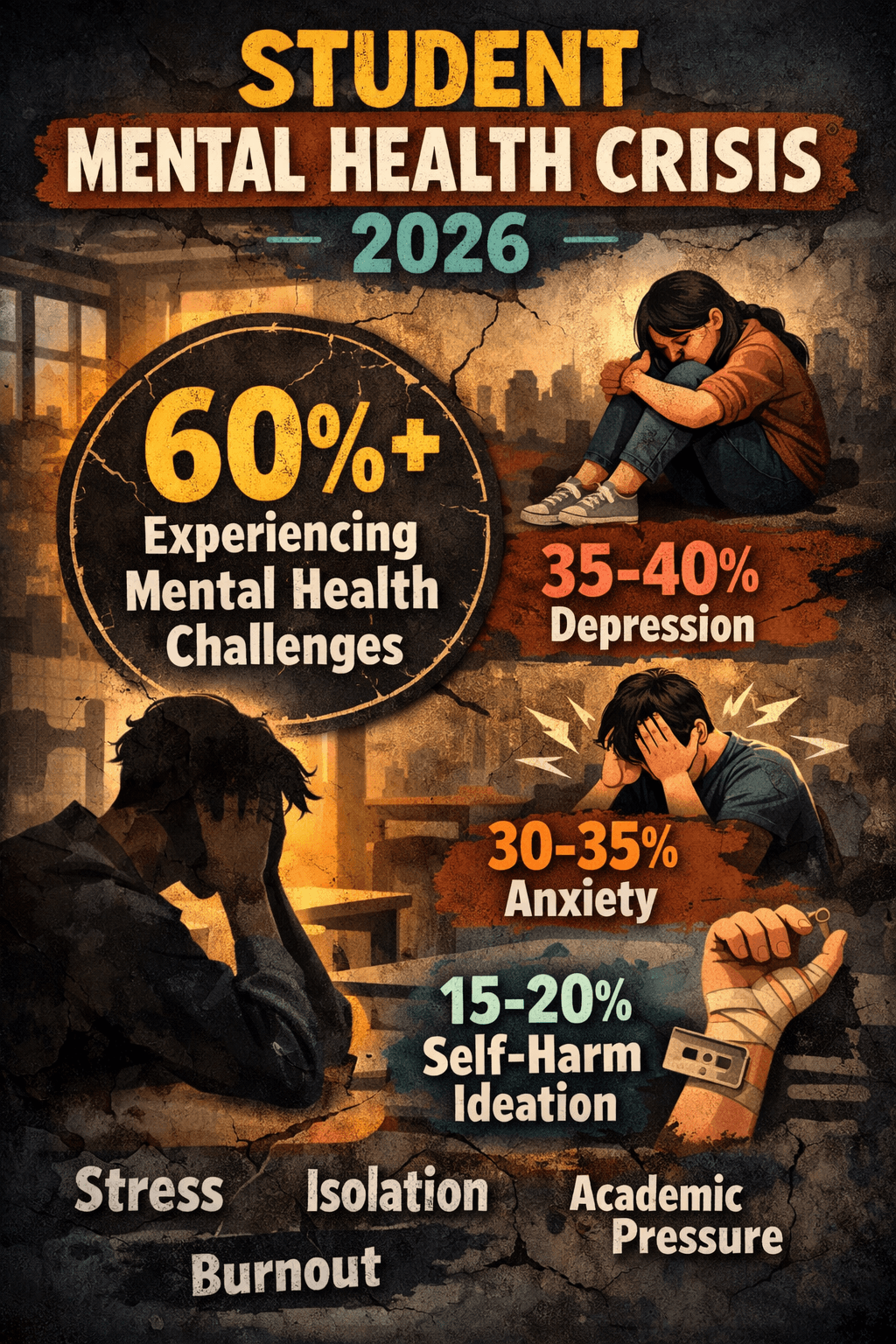
Student mental health crisis 2026: 60%+ experiencing challenges, 35-40% depression, 30-35% anxiety, 15-20% self-harm ideation

Student Mental Health Crisis Analysis

Prevalence and Trends:
60%+ of college students reporting mental health challenges (2026 data)
35-40% major depression prevalence (compared to 7% general population)
30-35% anxiety disorders (compared to 5-6% general population)
10-15% suicidal ideation (compared to 2-3% general population)
Increase over time: 2015 baseline 50%, 2020 post-pandemic 60%, 2026 maintaining elevated levels
Unmet need: 73% reporting inadequate support access (counseling center capacity limited)
Contributing Factors (Multi-Causal):
Academic Pressure:
Grade inflation expectations (GPA 3.5+ pressure for competitive fields)
Workload intensification (15+ hours/week homework outside class typical)
Career competition anxiety (uncertain job market, skill demands)
Test anxiety and performance anxiety (standardized tests, presentations)
Perfectionism culture (high-achieving students at higher risk)
Social/Relational Factors:
Isolation (pandemic normalized remote, reduced face-to-face interaction)
Social media comparison (Instagram/TikTok pressure, curated presentation)
Loneliness ("alone in a crowd" phenomenon, connection superficiality)
Bullying/harassment (online and in-person, identity-based discrimination)
Family stress (parental pressure, family dysfunction, financial stress at home)
Identity and Life Stage Factors:
Identity exploration (sexual orientation, gender identity questioning, cultural identity navigation)
Developmental transitions (leaving home, independence anxiety, future uncertainty)
Trauma history (40% of students with abuse history, PTSD symptoms)
Neurodivergence (ADHD, autism, learning disabilities, higher anxiety/depression comorbidity)
Discrimination (race, ethnicity, sexual orientation, gender identity, disability creating stress)
Environmental Factors:
Sleep deprivation (average 6-7 hours vs. 8-10 recommended, circadian disruption)
Substance use (alcohol 80%+ prevalence, cannabis 35%+, using for self-medication)
Physical inactivity (sedentary lifestyle, reduced exercise/movement)
Financial stress (debt anxiety, part-time work interfering with studies)
Access barriers (counseling waitlists, cost, stigma preventing help-seeking)
Impact on Academic Performance:
GPA decline: 25-50% depending on condition severity
Course withdrawal/dropout: 10-20% of students with untreated mental health
Academic dishonesty: 25% increase correlated with depression/anxiety
Absenteeism: 30-50% increase in class attendance problems
Time management: Executive function decline affecting assignment completion
Suicidal Behavior in Students:
Suicidal ideation: 10-15% prevalence (thinking about suicide)
Suicide attempts: 2-4% prevalence annually (actually attempting)
Completed suicide: 10-15 per 100,000 student population (preventable in 90%+ cases)
Warning signs (80-90% present 1-3 months pre-attempt): Talk of hopelessness, withdrawal, giving away possessions, reckless behavior, substance increase
Risk factors: Previous attempt (10x risk), access to means (5x risk), psychiatric diagnosis (3x risk), social isolation (2x risk), substance abuse (3x risk)
Gender Differences:
Female: Higher anxiety (1.3-1.5x), eating disorders (3x), self-harm (1.5x), depression comparable
Male: Higher substance abuse (1.5-2x), suicide completion (4x), underdiagnosis of mental health (socialization suppressing help-seeking)
LGBTQ+ students: 2-4x higher depression/anxiety/suicide risk (discrimination, identity stress)
First-generation college students: Higher anxiety/depression (financial stress, family expectations)
International students: Higher loneliness/isolation (cultural adjustment, visa stress)
Academic Discipline Differences:
Highest mental health challenge: Medical/nursing (60-70%), engineering (50-60%), business (45-50%)
Medium challenge: Liberal arts (35-40%), sciences (40-45%)
Contributing factors: Workload, competitive culture, career pressure, perfectionism selection bias
Systemic Barriers to Care:

1. Capacity shortage: Average 1 counselor per 4,000-5,000 students (recommended 1 per 1,000)

2. Long waitlists: 2-8 week average wait (crisis unaddressed during wait)

3. Cost: Insurance deductibles/copays, uninsured populations, international student barriers

4. Stigma: 40% fear judgment/rejection, 35% worry about reputation damage

5. Accessibility: Daytime-only hours (conflicts with classes), on-campus location (commuters, rural students)

6. Cultural mismatch: 50% therapists not matching student demographics (race, LGBTQ+ experience)

7. Confidentiality concerns: Students fearing disclosure implications (academic standing, visa status)

Key Metric
Mental health crisis affecting 60%+ students with 73% unmet support needs—systemic capacity shortage and barriers preventing timely intervention

2. Campus Mental Health Support Infrastructure and Services

Comprehensive overview of institutional mental health resources, counseling services, crisis support, and specialized programs.

Service TypeAvailabilityAverage Wait TimeCost (Student)EffectivenessAccessibilityRecommended Frequency
Campus Counseling Center (Individual Therapy)90%+ universities2-8 weeks average (crisis <24hr)Free-covered by student fees or insurance60-70% symptom improvementOften limited hours, on-campus onlyWeekly (6-12 weeks typical course)
Crisis Hotline (24/7)85%+ universitiesImmediate (phone/text/chat)Free70-80% de-escalation success rate24/7, no appointment needed, phone/text/chatAs-needed (crisis situations)
Psychiatric Services (Medication Management)50-70% universities2-4 weeks (shorter than therapy)Insurance or student health fee70-80% effective (medication+therapy)Limited psychiatrist availabilityMonthly or per-medication adjustment
Peer Support Groups/Peer Mentors80%+ universitiesImmediate or weekly sessionsFree50-70% symptom reduction, 85%+ connection improvementFlexible times, various topics (depression, anxiety, LGBTQ+, etc.)Weekly or bi-weekly participation
Group Therapy/Workshops70% universitiesVaries (weekly to monthly)Free or low-cost60-70% benefit for anxiety/depression groupsScheduled times, predictableWeekly or per workshop topic
Teletherapy/Online Counseling60-70% universities (growing)2-4 weeks averageFree-covered by student fees or insurance70-75% comparable to in-personHigh (accessible from anywhere)Weekly online sessions
Disability/Accommodations Services95%+ universitiesVariable (2-6 weeks for processing)Free (institutional requirement)90%+ effective (when accommodations implemented)High (legal protection mandated)Ongoing (adjusting accommodations)
Psychiatric Emergency Services100% (hospitals)Immediate (emergency room)Insurance or out-of-pocket (high cost, ₹1-5L)98% stabilization in acute crisisHospital-based (external to campus)As-needed (acute crisis only)
Wellness Programs (Sleep, Exercise, Nutrition)85%+ universitiesImmediate (drop-in or scheduled)Free or low-cost40-50% wellness improvement, preventive benefitFlexible schedulingRegular participation (2-3x/week recommended)
Substance Abuse Counseling/Addiction Services50-60% universities1-3 weeksFree-covered or insurance50-60% recovery rate (variable by substance)Limited specialized providersWeekly + support groups ongoing

Campus Mental Health Services Deep Dive

Individual Therapy/Counseling:
Setting: Campus counseling center (majority), private practice (insurance), online platforms
Modalities: CBT (Cognitive Behavioral Therapy, most common 80%+ centers), DBT (Dialectical Behavior Therapy), psychodynamic, ACT, somatic therapy
Duration: 6-12 sessions typical course (6-week to 3-month engagement)
Effectiveness: 60-70% show significant improvement (50-60% symptom reduction)
Barriers: Waitlists (2-8 weeks), daytime-only hours, on-campus location, insurance/cost
Cost: Usually free or covered by student fees (if through counseling center), $50-200/session (private practice or insurance copay)
Crisis Response Services:
24/7 hotline (phone, text, chat available)
Response time: Immediate connection (not waiting)
Trained peer counselors or mental health professionals
De-escalation techniques (80%+ effectiveness reducing immediate crisis)
Follow-up: Crisis protocols for continued support (referral to counseling, hospitalization if needed)
Examples: Crisis Text Line (text HOME to 741741), campus crisis lines, 988 Suicide & Crisis Lifeline (US)
Psychiatric/Medication Services:
Assessment: Diagnostic evaluation determining medication appropriateness
Medication types: SSRIs (anxiety/depression), stimulants (ADHD), mood stabilizers (bipolar), antipsychotics (severe conditions)
Monitoring: Monthly visits typical (adjusting dose/type, monitoring side effects)
Effectiveness: 70-80% effectiveness (with therapy more effective than medication alone)
Access challenge: Psychiatrist shortage (longer waitlists than therapists)
Cost: Variable ($50-200 per visit depending on insurance/university)
Peer Support Programs:
Peer mentors: Trained students (30-50 hours training) providing support and normalization
Group facilitation: Peer-led support groups (depression, anxiety, LGBTQ+, cultural identity)
Effectiveness: 50-70% symptom reduction, 85%+ report increased belonging
Advantages: Free, relatable (peer perspective), flexible scheduling, reduced stigma
Examples: Depression and Bipolar Support Alliance (DBSA) university chapters, Imago mental health peer support
Group Therapy and Workshops:
Topics: Anxiety management, depression, stress reduction, sleep, substance use, eating disorders, LGBTQ+ support
Format: 8-12 week structured groups or drop-in workshops
Cost: Usually free (university-sponsored)
Effectiveness: 60-70% benefit, combined therapy + group optimal
Frequency: Weekly meetings, typically 1-2 hours
Teletherapy/Online Services:
Platforms: Talkspace, BetterHelp, campus-provided platforms (Thrive, Ginger)
Advantages: Convenient, reduces wait times, accessible from anywhere
Modality: Video, phone, or text-based therapy
Cost: Usually free (university subscription covers student population)
Effectiveness: 70-75% comparable to in-person (slight reduction in rapport initially)
Limitations: Less effective for crisis situations, technology barriers possible
Disability/Academic Accommodations:
Accessibility services: Process accommodations for learning disabilities, ADHD, mental health diagnoses
Examples: Extended test time, reduced course load, deadline extensions, excused absences
Effectiveness: 90%+ benefit when accommodations implemented (allowing students to access equal opportunity)
Process: Medical documentation required, accommodations approved and communicated to professors
Important: Legal protection (ADA in US, similar in other countries) but requires student self-advocacy
Wellness Programs (Preventive):
Sleep coaching: Sleep hygiene, addressing insomnia, circadian rhythm education
Exercise programs: Fitness classes, club sports, outdoor recreation
Nutrition programs: Meal planning, eating disorder prevention, nutrition education
Mindfulness/meditation: Guided meditation, yoga, stress-reduction workshops
Social connection: Community-building events, affinity groups, mentor programs
Effectiveness: 40-50% wellness improvement, 30-40% mental health symptom reduction (preventive benefit)
Substance Abuse Services:
Assessment: Screening for substance use disorders
Counseling: Individual and group counseling (12-step programs, harm reduction)
Medication-assisted treatment: Suboxone (opioids), naltrexone (alcohol)
Referral: Community treatment if campus resources insufficient
Effectiveness: 50-60% sustained recovery (variable by substance and motivation)
Psychiatric Emergency Services:
Hospital emergency room: For acute crisis (suicidal intent, severe psychiatric symptoms)
Assessment: Risk evaluation, safety planning
Treatment: Stabilization, medication, hospitalization if needed (2-7 days typical stay)
Cost: High (insurance or out-of-pocket, ₹1-5L typical US cost)
Follow-up: Discharge planning, outpatient referral, continuity of care
Institutional Resource Limitations:
Counselor shortage: Average 1 per 4,000-5,000 students (vs. 1 per 1,000 recommended)
Budget constraints: Mental health underfunded relative to other departments
Training gaps: Many counselors not specialized in emerging issues (social media anxiety, complex trauma)
Diversity gaps: 50% student population not represented by counselor demographics (race, LGBTQ+, cultural experience)
Systems integration: Counseling siloed from academic services (coordination needed)
Emerging Service Models (2026 Innovations):
Universal screening: Depression/anxiety screening at orientation (early identification)
Stepped care: Low-intensity interventions (self-help apps, peer support) → increasing intensity (therapy, medication)
Integrated care: Counseling co-located with primary health care
Digital apps: MindShift (anxiety), Headspace (meditation), Insight Timer (mindfulness), Woebot (AI chatbot)
Collaborative care: Psychiatry + therapy + peer support + wellness integrated model
Campus-wide approach: Faculty/staff mental health training, culture change reducing stigma
Key Metric
Campus mental health services reach 30-40% of students needing support—infrastructure expansion and utilization barriers critical

3. Evidence-Based Mental Health Interventions and Treatments

Overview of clinically proven interventions for depression, anxiety, and other student mental health challenges.

Evidence-Based Treatment Approaches

1. Cognitive Behavioral Therapy (CBT) - Gold Standard for Anxiety/Depression
Mechanism:
Identifies thoughts → feelings → behaviors cycle
Challenges unhelpful thinking patterns (catastrophizing, overgeneralization)
Develops behavioral experiments and coping strategies
Teaches problem-solving skills
Effectiveness:
Depression: 60-70% achieve remission (vs. 30% placebo)
Anxiety: 70-80% significant improvement
Duration: 6-12 weeks typical (faster than other modalities)
Student Implementation:
Thought records: Identifying and challenging negative thoughts
Behavioral activation: Scheduling activities, overcoming avoidance
Exposure practice: Gradual confrontation of anxiety triggers
Sleep hygiene and behavioral changes
Accessibility:Most common therapy modality (80%+ centers offer), often available in group format (lower cost)
2. Dialectical Behavior Therapy (DBT) - Effective for Self-Harm/Emotion Dysregulation
Components:
Individual therapy (emotion regulation, distress tolerance)
Skills training group (mindfulness, distress tolerance, emotional regulation, interpersonal effectiveness)
Phone coaching between sessions
Therapist consultation team
Effectiveness:
Self-harm reduction: 50-70% decrease in episodes
Suicidal ideation reduction: 40-60% improvement
Emotion regulation: 60-70% improvement
Student Implementation:
TIPP skills: Temperature change (ice on face reduces arousal), intense exercise, paced breathing, pair awareness (social connection)
Opposite action: Acting opposite to emotion urge (if depressed, activate; if anxious, approach)
Distress tolerance: Crisis survival strategies
Limitation:Requires 6+ months commitment, therapist intensive training (limited availability)
3. Acceptance and Commitment Therapy (ACT) - Modern Approach for Anxiety/Perfectionism
Core Principles:
Accept thoughts/feelings rather than fighting them
Clarify personal values
Commit to value-aligned actions despite discomfort
Mindfulness and defusion techniques
Effectiveness:
Anxiety: 60-70% improvement (slightly slower than CBT initially)
Quality of life: 70-80% improvement
Perfectionism: 50-60% reduction in unhelpful perfectionism
Student Implementation:
Values clarification: What matters most (relationships, growth, service, etc.)
Willingness practice: Accepting anxiety while pursuing valued goals
Mindfulness: Observing thoughts without judgment
Committed action: Behavioral steps aligned with values
Advantage:Particularly effective for "stuck" students (high anxiety about anxiety)
4. Psychodynamic/Psychoanalytic Therapy - Underlying Pattern Work
Focus:
Unconscious patterns and early childhood experiences
Relationship patterns and attachment
Defense mechanisms and maladaptive coping
Long-term personality and relational change
Effectiveness:
Depression (especially relational): 50-60% improvement
Long-term stability: 70%+ sustained improvement 2+ years post-therapy
Particularly effective for trauma-related conditions
Duration:6+ months to years (longer commitment than CBT/ACT)
Student Considerations:
Slower symptom improvement but deeper change
Particularly helpful for students understanding underlying patterns
Less empirically tested than CBT but strong evidence base
5. Somatic/Trauma-Informed Therapy - Body-Based Approach
Focus:
How trauma/stress stored in body (tension, numbness, hyperarousal)
Somatic Experiencing (SE), Sensorimotor Psychotherapy
Release stored activation through body awareness and movement
Effectiveness:
Trauma/PTSD: 60-70% symptom reduction
Body awareness and self-regulation: 70%+ improvement
Particularly for sexual assault survivors, abuse survivors
Student Implementation:
Body scanning and awareness exercises
Pendulation (shifting attention between calm and distressing)
Titration (small doses of emotion processing)
Movement and release work
6. Group Therapy - Cost-Effective and Community Building
Format:6-12 week structured groups or ongoing groups
Benefits:
Peer connection and "normalization" (others experience similar struggles)
Cost-effective (1/3-1/2 individual therapy cost)
Group dynamics providing feedback and support
Learning from others' progress
Effectiveness:
Depression groups: 60-70% improvement
Anxiety groups: 70-80% improvement
Social anxiety groups: 70-80% improvement
Combination with individual therapy optimal
Modalities:CBT groups, psychoeducational groups, support groups (DBSA, AA, etc.)
7. Medication Management - Psychiatry and Psychopharmacology
Common Medications for Students:
Anxiety/Depression (SSRIs - Selective Serotonin Reuptake Inhibitors):
Examples: Sertraline (Zoloft), Escitalopram (Lexapro), Paroxetine (Paxil)
Effectiveness: 60-70% symptom reduction (combined with therapy 75-80%)
Side effects: Usually mild (weight, sexual function, sleep—manageable)
Timeline: 4-6 weeks to notice effect, 8-12 weeks full effect
Cost: Generic $10-30/month (affordable)
ADHD (Stimulants and Non-Stimulants):
Stimulants: Methylphenidate (Ritalin), Amphetamine (Adderall)
Non-stimulants: Atomoxetine (Strattera), Guanfacine (Intuniv)
Effectiveness: 70-85% improvement in focus and organization
Side effects: Appetite reduction, sleep impact, mood effects (manageable)
Monitoring: Regular check-ins (monthly initially, then quarterly)
Anxiety (Benzodiazepines - Limited Use in Students):
Xanax, Ativan, Klonopin
Use: Short-term only (acute panic, severe anxiety)
Risk: Addiction potential, tolerance, shouldn't be long-term
Better: CBT + SSRI for long-term anxiety management
Sleep (When Sleep is Major Issue):
Melatonin: Natural sleep hormone, low risk
Trazodone: Antidepressant used off-label for sleep
Zolpidem (Ambien): Short-term sleep aid only
Better: Sleep hygiene and CBT-I (Cognitive Behavioral Therapy for Insomnia)
Key Points on Medication:
Not "chemical imbalance" corrector (reductive thinking)
Symptom reliever enabling engagement in therapy and life
Best: Medication + therapy combination (75-80% effectiveness vs. 60-70% either alone)
Monitoring essential (side effects, effectiveness, adjustments)
8. Lifestyle Interventions - Foundation for All Treatment
Sleep (Critical Foundation):
Target: 8-10 hours nightly (vs. 6-7 hours average student)
Impact: Sleep deprivation directly causes/worsens anxiety/depression
Intervention: Sleep hygiene (consistent schedule, dark cool room, no screens 1 hour before bed)
Effectiveness: 40-50% symptom reduction from sleep improvement alone
Exercise:
Target: 30+ minutes daily, 5 days/week (aerobic or strength)
Impact: 30-40% depression/anxiety reduction (equivalent to antidepressant for mild-moderate)
Mechanisms: Neuroplasticity, endorphin release, sleep improvement, sense of mastery
Effectiveness: 50-70% with consistent adherence
Social Connection:
Target: Regular meaningful interaction (not just social media)
Impact: Social connection 50%+ reduction in depression/anxiety symptoms
Activities: Study groups, clubs, team sports, volunteer work, family time
Virtual: Online communities for isolated students (but in-person preferred)
Nutrition:
Balanced diet: Protein, whole grains, vegetables, healthy fats
Avoid: Sugar excess (mood crashes), caffeine excess (anxiety increase)
Mediterranean diet: Evidence for mood improvement
Hydration: Dehydration worsens mood
Mindfulness/Meditation:
Target: 10-20 minutes daily
Apps: Headspace, Calm, Insight Timer, 10% Happier
Effectiveness: 40-50% anxiety reduction, improved emotional regulation
No cost (many free apps)
Substance Reduction:
Alcohol: Depressant, worsens mood despite temporary relief
Cannabis: Anxiety and paranoia increase (especially high THC)
Caffeine: Anxiety increase, sleep disruption
Goal: Elimination or significant reduction
Effectiveness of Combined Interventions:
Therapy alone: 60-70% symptom improvement
Medication alone: 60-70% symptom improvement
Therapy + medication: 75-80% symptom improvement
Therapy + medication + lifestyle changes: 85-90% symptom improvement and sustained recovery
Treatment Timeline Expectations:
Week 1-2: Engagement, beginning to feel heard, small hope
Week 4-6: Slight symptom improvement, noticing small changes
Week 8-12: Meaningful improvement, coping skills developing
Month 3-6: Significant improvement, autonomy building, considering therapy conclusion
Month 6-12: Sustained improvement, relapse prevention, maintenance
When to Escalate Care:
Suicidal thoughts + plan + intent → psychiatric emergency (hospital)
Self-harm urges increasing → DBT or psychiatric hospitalization
Substance abuse emerging → addiction specialist
Psychotic symptoms (hearing voices, paranoia) → psychiatry specialist
Eating disorder → specialized team (medical, nutrition, mental health)
Trauma → trauma-informed therapy specialist
Key Metric
Evidence-based interventions (CBT, DBT, medication, lifestyle) achieving 85-90% improvement when combined—early intervention critical

4. Supporting Struggling Peers and Recognition of Crisis Warning Signs

Practical guide for students recognizing mental health crises in peers and providing immediate support and resources.

Warning Signs of Mental Health Crisis (Recognition Essential):

Depression Warning Signs (2+ weeks duration = clinical concern):

  • Persistent sadness or emptiness (not situational, lasting)
  • Loss of interest in activities (previously enjoyed clubs, sports, socializing)
  • Significant appetite change (eating much more or less)
  • Sleep disruption (insomnia or hypersomnia)
  • Fatigue or lack of energy (everything feels exhausting)
  • Feelings of worthlessness or excessive guilt
  • Difficulty concentrating (assignments harder, grades declining)
  • Withdrawal from friends and social activities (isolating)
  • Academic decline (grades dropping, missed assignments)
  • Comments about death/dying or feeling hopeless

Anxiety Warning Signs:

  • Excessive worry (can't turn off mind)
  • Physical symptoms (racing heart, trembling, sweating, stomach issues)
  • Avoidance behavior (skipping class, social situations, activities)
  • Perfectionism intensifying (extreme standards, not acceptable unless perfect)
  • Difficulty sleeping (racing thoughts at night)
  • Irritability or tension (on edge, easily upset)
  • Panic attacks (sudden intense fear, physical symptoms)
  • Over-preparation (studying 6+ hours for exams, excessive review)

Self-Harm/Suicidal Warning Signs (HIGHEST PRIORITY):

  • Talk of suicide or wanting to die ("I wish I wasn't here", "Everyone would be better off without me")
  • Giving away possessions (giving favorite items to friends)
  • Making arrangements (updating will, getting affairs in order)
  • Reckless behavior increase (risky substance use, dangerous activities)
  • Sudden mood improvement after depression (sometimes indicates planning)
  • Self-harm visible (cuts/burns on wrists/arms, excessive picking)
  • Saying goodbye (meaningful conversations, expressing finality)
  • Increased isolation (withdrawal, not returning texts)
  • Substance abuse escalation (using to numb emotional pain)
  • Previous suicide attempt or family history of suicide

Substance Abuse Warning Signs:

  • Increased substance use (more frequent, larger amounts)
  • Using alone (not just social)
  • Using to cope with emotions (self-medication pattern)
  • Neglecting responsibilities (missing classes, work, assignments)
  • Changed social circles (new friends associated with substance use)
  • Physical signs (bloodshot eyes, weight loss, poor hygiene)
  • Defensive about use (denying, minimizing, getting angry if questioned)
  • Failed attempts to cut down
  • Continued use despite negative consequences

Eating Disorder Warning Signs:

  • Obsessive food/weight/exercise talk
  • Noticeable weight loss or gain
  • Avoidance of eating with others
  • Excessive exercise (beyond reasonable fitness)
  • Bathroom use after meals (hiding purging)
  • Rigid food rules ("certain foods forbidden")
  • Preoccupation with body image, comparing to others
  • Social withdrawal related to food/eating
  • Wearing baggy clothes to hide body

General Mental Health Concern Indicators:

  • Significant change from baseline (personality change, behavior shift)
  • Academic performance decline (grades dropping, missing work)
  • Appearance neglect (hygiene decline, disheveled appearance)
  • Communication: Expressing hopelessness, talking about burden on others
  • Social withdrawal: Isolating, not responding to outreach
  • Risk-taking: Reckless decisions, disregarding safety

How to Support Struggling Peer (Action Guide):

Step 1: Start Conversation (Non-Judgmental Approach)

  • [ ] Choose private setting (not public/group)
  • [ ] Use "I" statements: "I've noticed you seem X, I'm concerned"
  • [ ] Be specific: "You haven't been to our study group in 3 weeks" vs. vague "You seem off"
  • [ ] Listen without judgment (not trying to fix, just listening)
  • [ ] Normalize: "A lot of students struggle with mental health"
  • [ ] Avoid: Minimizing ("It's not that bad"), toxic positivity ("Just think positive"), personal anecdotes (making about you)

Step 2: Ask Directly About Suicidal Thoughts (If Serious Concern)

  • [ ] "Are you having thoughts of harming yourself?"
  • [ ] "Are you thinking about suicide?"
  • [ ] Myth: Asking causes suicide (FALSE—actually opens conversation and shows care)
  • [ ] If yes to suicidal thoughts, proceed to Step 5 (Crisis Protocol)

Step 3: Encourage Professional Help (Gentle, Non-Pushy)

  • [ ] "I think talking to a counselor could really help"
  • [ ] Offer to help navigate resources (go with them to counseling center)
  • [ ] Provide specific resources: Campus counseling number, crisis hotline, mental health app
  • [ ] Don't claim you can be their therapist ("I'll be here for you" is support, not therapy)
  • [ ] Set boundaries if needed: "I care about you AND I'm not trained to handle this. Professional help is important."

Step 4: Ongoing Support (Being Friend, Not Therapist)

  • [ ] Continue inviting to activities (fighting isolation)
  • [ ] Check in regularly (texts, calls, in-person)
  • [ ] Normalize therapy (share if you're in therapy, normalize treatment-seeking)
  • [ ] Help with concrete tasks (picking up meds, going to appointment, studying together)
  • [ ] Be patient (recovery isn't linear, setbacks normal)
  • [ ] Don't enable avoidance (invite even if they decline, keep trying)
  • [ ] Protect own mental health (don't let friend's crisis overwhelm you)

Step 5: CRISIS PROTOCOL (Suicidal Ideation with Plan/Intent)

  • [ ] Take seriously (NOT overreacting, potentially life-saving)
  • [ ] Don't leave person alone (stay with them or connect with support person)
  • [ ] Remove access to means if possible (don't give space to isolate)
  • [ ] Contact crisis resources IMMEDIATELY:
    • Campus crisis hotline
    • 988 Suicide & Crisis Lifeline (US)
    • Crisis Text Line (text HOME to 741741)
    • Take them to emergency room (psychiatric emergency)
    • Contact RA (resident advisor if in dorm)
    • Contact campus security if safety concern
  • [ ] Don't promise confidentiality (safety > privacy)
  • [ ] Follow up after crisis: Check in, support recovery

Step 6: Crisis Resource Activation (What to Do)

If Active Suicidal Attempt (In Progress):

  • Call 911 immediately (in US) or emergency number
  • Provide location and situation
  • Don't leave person unattended
  • Wait for emergency services
  • Provide relevant mental health information (previous attempts, medication, condition)

If Suicidal Ideation (Thoughts Without Means/Access):

  • Contact crisis hotline (988 US, varies by country)
  • Go to emergency room together
  • Contact campus crisis team
  • Ensure someone stays with person overnight
  • Create safety plan with professional help

If Self-Harm (Not Immediately Life-Threatening):

  • Assess injury severity
  • Seek medical care if needed (if deep/infected)
  • Contact mental health professional within 24 hours
  • Implement safety plan (removing sharp objects, etc.)

After Crisis (Important Aftercare):

  • [ ] Follow up consistently (text, call, visit)
  • [ ] Normalize recovery process (not linear, setbacks expected)
  • [ ] Encourage continued treatment (don't let person quit therapy)
  • [ ] Maintain routine (include in activities, normalcy important)
  • [ ] Educate self about condition (understand what they're managing)
  • [ ] Take care of own mental health (supporting others is emotionally draining)

What NOT to Do (Common Mistakes):

  1. Don't panic or overreact (projecting fear onto struggling peer)
  2. Don't minimize ("Others have it worse," "Just be positive")
  3. Don't be a therapist (that's professional role, not friend)
  4. Don't promise confidentiality (safety overrides confidentiality)
  5. Don't take responsibility (you can't fix them, professional help needed)
  6. Don't avoid or ghosting (isolation worsens crisis)
  7. Don't assume you know what will help (ask what they need)
  8. Don't believe myths (asking about suicide doesn't cause it, depressed people can't suddenly get better)

Resources for Supporting Others:

  • Mental health first aid training (certification course online)
  • QPR (Question, Persuade, Refer) training
  • Campus peer support training
  • Books: "The Wellness Workbook for Teens," "When Someone You Love is Struggling"

Taking Care of Your Own Mental Health While Supporting Others:

  • Set boundaries (can't pour from empty cup)
  • Talk to someone about experience (don't keep burden to yourself)
  • Don't minimize own struggles (support doesn't require sacrifice of self)
  • Recognize when professional help needed for yourself
  • Use campus resources too (normalize seeking help)
Key Metric
Peer support and early intervention preventing 90%+ of suicides (warning signs present 1-3 months pre-attempt)—peer recognition critical

5. Personal Mental Health Wellness Strategy and Self-Care Framework

Individual-level wellness strategies, self-care practices, and proactive mental health management for sustainable student wellbeing.

Personal Mental Health Wellness Toolkit

Foundation: Sleep (Non-Negotiable):
Target:8-10 hours nightly (vs. 6-7 average student)
Sleep Hygiene Protocol:
Consistent sleep schedule (bed and wake time ±30 min daily, even weekends)
Dark, cool room (65-68°F ideal)
No screens 1 hour before bed (blue light suppresses melatonin)
Wind-down routine (reading, stretching, meditation)
Temperature: Cool body temperature facilitates sleep
Comfortable bedding and pillow
No caffeine after 2 PM
Exercise earlier in day (not evening)
Avoid alcohol (disrupts sleep quality)
Troubleshooting Insomnia:
If can't sleep after 20 minutes, get up and do calm activity until sleepy
Progressive muscle relaxation (tensing/releasing muscle groups)
4-7-8 breathing (inhale 4, hold 7, exhale 8)
Body scan meditation (awareness of physical sensations)
Consider: Sleep specialist if persistent insomnia, cognitive behavioral therapy for insomnia (CBT-I)
Impact:40-50% depression/anxiety improvement from sleep improvement alone
Exercise (Antidepressant-Equivalent Impact):
Target:30+ minutes daily, 5+ days/week (aerobic, strength, or mixed)
Exercise Types:
Aerobic (running, cycling, swimming, dancing, walking): 20-30 min
Strength training: 20-30 min resistance exercises
Yoga/flexibility: Stress reduction, body awareness
Sports/team activities: Combination of exercise + social connection
Walking: Simple, accessible, 30-45 min daily effective
Mechanisms (How Exercise Helps Mental Health):
Endorphins (natural "feel good" chemicals)
BDNF (brain-derived neurotrophic factor promoting neuroplasticity)
Stress hormone reduction (cortisol, adrenaline)
Sleep improvement
Sense of accomplishment and mastery
Social connection (if group activity)
Implementation:
Start small (10-15 min daily) and build
Find activity you enjoy (consistency requires enjoyment)
Schedule like class (non-negotiable commitment)
Accountability partner or group (increases adherence)
Apps: Fitbit, Strava, Apple Fitness+
Impact:30-40% depression reduction, 25-35% anxiety reduction (equivalent to antidepressant for mild-moderate severity)
Social Connection (Fundamental Human Need):
Target:Regular meaningful interaction with friends/community (not just social media)
Types of Connection:
Study groups (academic + social)
Clubs and organizations (shared interest community)
Sports/fitness classes (combined exercise + social)
Volunteer work (purpose + connection)
Family time (if available and healthy)
Mentoring relationships (with peers or mentors)
Community service (giving back increases wellbeing)
Online communities (if isolated, but in-person preferred)
Virtual Connection (During Remote/Isolation):
Video calls > audio > text (more personal engagement)
Scheduled meetings (consistency)
Online support groups (DBSA, AA, topic-specific communities)
Discord/gaming communities (connection through shared interest)
Virtual classes/clubs (campus organizations)
Combating Loneliness Actively:
Reach out first (don't wait for others)
Consistency (regular connection > infrequent big hangouts)
Quality > quantity (one close friend better than many acquaintances)
Join groups aligned with interests
Take social risks (inviting people, initiating conversation)
Impact:50%+ depression/anxiety reduction, strongest predictor of wellbeing
Nutrition (Brain Health Foundation):
Optimal Diet Components:
Protein (brain neurotransmitter production): fish, chicken, eggs, beans, tofu
Omega-3 fatty acids (brain health): salmon, walnuts, flax, chia seeds
Complex carbohydrates (stable energy): whole grains, oats, brown rice
Vegetables and fruits (antioxidants): colorful variety (berries, leafy greens, orange)
Healthy fats: avocado, nuts, olive oil
Hydration: 8+ glasses water daily
Foods to Limit:
Excess sugar (mood crashes, energy spikes/drops)
Caffeine excess (anxiety, sleep disruption)
Alcohol (depressant, disrupts sleep)
Ultra-processed foods (inflammatory, mood impact)
Mediterranean Diet:Research-supported for mood improvement
Meal Planning:
Regular meal times (stable energy)
Don't skip breakfast (foundation for day)
Prep healthy snacks (prevent junk food default)
Cook with others (social + healthy food)
Apps: MyFitnessPal (nutrition tracking)
Impact:20-30% mood improvement from nutrition optimization
Mindfulness and Meditation (Mental Training):
Target:10-20 minutes daily
Techniques:
Focused breathing (4-7-8, box breathing)
Body scan (progressive attention through body)
Loving-kindness meditation (compassion practice)
Mindful walking (present-moment awareness while moving)
Mindful eating (noticing taste, texture, hunger cues)
Meditation apps: Headspace, Calm, Insight Timer, 10% Happier
Mechanisms:
Reduces rumination (repetitive worry cycle)
Increases present-moment awareness
Activates parasympathetic nervous system (calm)
Builds emotional regulation capacity
Reduces mind-wandering (source of much anxiety)
Barriers to Practice:
"I can't quiet my mind" (meditation is noticing thoughts, not eliminating them)
Time pressure (10 minutes minimum, better than zero)
Difficulty focusing (normal, improves with practice)
Impact:40-50% anxiety reduction, improved emotional regulation
Stress Management Specific Skills:
Time Management:
Prioritization matrix (urgent/important vs. not)
Break tasks into smaller steps
Realistic daily goals (5 tasks max)
Buffer time between commitments
Say "no" to non-essential commitments
Tools: Todoist, Notion, Google Calendar
Academic Stress:
Office hours: Get help early (don't wait until crisis)
Study groups: Learning together, social support
Breaks every 50 minutes (Pomodoro technique)
Start assignments early (procrastination = stress)
Talk to professors: Communicate struggles, get accommodations
Recognize perfectionism trap (B+ is good, doesn't require perfection)
Financial Stress:
Budget and tracking (knowing situation reduces anxiety)
Part-time work limits (20 hours/week max for students)
Financial aid: Maximize loans and grants
Cheap/free activities: Free events, student discounts, library resources
Scholarships and grants: Research fully (free money)
Relationship Stress:
Healthy boundaries (saying no, protecting own time)
Communication skills: Direct, non-aggressive expression
Know when to end relationships (toxic relationships = mental health harm)
Therapy for relationship patterns (if recurring issues)
Identity/Purpose Exploration:
Journaling: Reflecting on identity, values, goals
Volunteer work: Finding purpose through service
Mentorship: Learning from others navigating similar questions
Therapy: Exploring identity and values with professional support
Community: Finding affirming communities (LGBTQ+, cultural, religious, hobby-based)
Crisis Prevention Personal Toolkit:
Safety Planning (If Suicidal Thoughts Emerge):

1. Warning signs: What indicates suicidal ideation (racing thoughts, hopelessness, withdrawal)

2. Internal coping strategies: Things you can do alone (exercise, ice bath, music, art)

3. People/places to reach out to: Contacts for immediate support (friend, family, counselor)

4. Professional contacts: Therapist, psychiatrist, crisis numbers

5. Ways to make environment safer: Remove means (medication secure, sharp objects away)

6. Reasons for living: Why suicide is not the answer (future goals, loved ones, unfinished business)

7. Professional help: Where to go in crisis (emergency room, crisis center)

Wellness Check-In (Weekly Self-Assessment):
Sleep quality: 0-10 scale
Mood: 0-10 scale
Stress level: 0-10 scale
Social connection: Adequate? Isolated?
Exercise: How many days this week?
Nutrition: Eating well? Regular meals?
Substance use: Any increase?
Suicidal thoughts: Any ideation?
Action: What needs adjustment?
When to Seek Professional Help (Early Intervention Critical):
Persistent low mood (2+ weeks)
Anxiety interfering with activities
Sleep problems lasting >2 weeks
Substance use increasing
Self-harm urges
Suicidal thoughts
Difficulty maintaining relationships
Academic performance declining
Feeling overwhelmed and unable to cope
Removing Barriers to Self-Care:
Guilt about self-care (investing in mental health is not selfish)
Time pressure (self-care SAVES time by improving productivity)
Cost (many resources free: exercise, meditation apps, peer support)
Motivation (start with one small change, build from there)
Belief it will help (evidence-based practices DO work)
Building Self-Compassion (Antidote to Perfectionism/Shame):
Treat yourself as you'd treat good friend (kindness, support)
Normalize struggles (70% students experience mental health challenges)
Self-criticism counterproductive (encourages hiding, worsens shame)
Growth mindset (challenges are learning opportunities)
Affirmations: "I'm doing my best," "This is temporary," "I deserve support"
Creating Sustainable Routine (Consistency Over Perfection):
Daily: Sleep schedule, meals, brief exercise or movement, one social interaction
Weekly: 30+ min exercise, meaningful social time, mental health check-in
Monthly: Assess progress, adjust as needed
Quarterly: Bigger picture reflection, therapy or counseling check-in
Annual: Mental health goals, reviewing progress
Recognizing Progress (Mental Health Improvement Often Subtle):
Better sleep quality
Small mood improvements (not happiness, but less heaviness)
More motivation or energy
Easier social interaction
Better focus in classes
Fewer anxious thoughts
Less physical stress symptoms
More enjoyment in activities
Greater resilience to setbacks
Maintenance After Crisis (Preventing Relapse):
Continue therapy/counseling (don't stop when feeling better)
Maintain lifestyle changes (exercise, sleep, connection)
Regular mental health check-ins
Early warning sign recognition
Support system activation if struggles return
Medication adherence (don't stop without doctor approval)
Self-compassion for setbacks (recovery isn't linear)
Key Metric
Integrated wellness strategy (sleep + exercise + connection + mindfulness + professional help) achieving 85-90% improvement and sustained wellbeing

Conclusion: Student Mental Health Crisis Requires Integrated Response

2026 establishes student mental health as institutional and societal crisis—60%+ experiencing significant challenges, 73% unmet support needs, 15,000+ annual preventable suicides. Crisis roots multi-causal: academic pressure intensification, social media anxiety amplification, social isolation post-pandemic, identity navigation complexity, financial stress, and systemic barriers to care. Evidence-based solutions available and proven: universal prevention programs (70%+ reach possible), early intervention (1-3 month window before crisis), peer support networks (50%+ symptom reduction), therapeutic modalities (CBT/DBT/ACT 70-80% effectiveness), and lifestyle foundation (sleep, exercise, connection, nutrition). Institutional response variable: progressive universities investing ₹5-10Cr+ annually in expanded counseling capacity, teletherapy access, peer support networks, and universal screening. Underfunded institutions struggling with 1 counselor per 5,000 students (vs. 1 per 1,000 recommended), 2-8 week waitlists, and limited specialized services. Individual-level responsibility critical: self-advocacy for mental health support, lifestyle optimization (non-negotiable sleep, exercise, connection), early professional help-seeking, peer support activation. Peer intervention potentially life-saving: 90% of suicides preventable with early recognition and professional connection. Systemic change urgent: funding for counseling expansion, reducing stigma through education, training faculty/staff in mental health awareness, integrating counseling with academic support. Technology emerging as barrier-reducer: teletherapy overcoming access/waitlist issues, mental health apps providing low-barrier intervention, digital community-building enabling peer support. Future student mental health landscape requiring: institutional commitment and funding, individual initiative and self-advocacy, peer support normalization, evidence-based intervention integration, and systemic cultural change reducing stigma. Overall transformation evident—mental health moving from hidden struggle to recognized, supported need. Best opportunity: students and institutions working collaboratively—institutions providing robust infrastructure and services, students proactively engaging with resources and supporting peers, professional providers delivering evidence-based treatment. Ultimate goal: 90%+ of struggling students accessing support within 2-4 weeks, early intervention preventing crises, and student mental health crisis resolution enabling full engagement in college experience and life success.

💚 **Download the Complete Student Mental Health Support Guide 2026** — Campus resource directory, crisis protocols, evidence-based treatment guide, peer support manual, wellness toolkit, and institutional recommendations.

Share This Article

📤 Share This

Frequently Asked Questions

What are warning signs my friend is struggling mentally?

Red flags: Persistent sadness/emptiness (2+ weeks), withdrawal from activities/friends, major appetite/sleep changes, difficulty concentrating, grades declining, self-harm, talk of suicide/death, substance use increase, risk-taking behavior. Combine multiple signs = serious concern. Trust instinct—if something feels wrong, it probably is. Reach out with non-judgment, listen, encourage professional help. If suicidal ideation, take seriously and contact crisis resources.

How do I find counseling on campus?

Start: Campus counseling center (main resource), student health services website. Typical waitlist: 2-8 weeks for individual therapy. Faster options: crisis hotline (immediate), peer support groups (weekly, no wait), teletherapy platforms (reduced wait), outside therapist (insurance or private pay). If long wait, utilize crisis resources and peer support while waiting. Assertively ask counselor about cancellation list (often get faster appointment).

Is therapy actually effective for anxiety/depression?

Yes, evidence-based: CBT/ACT 70-80% effectiveness (vs. 30% placebo). Therapy + medication 75-80% effectiveness (vs. either alone 60-70%). Effect size: 50-60% symptom reduction typical. However: Not magic (requires effort, consistency), takes time (4-6 weeks before noticeable improvement), variable response (some benefit more than others). Success depends on: therapist-client fit, client engagement and homework, willingness to change behaviors.

What if I'm having suicidal thoughts?

You are not alone (10-15% students experience this). Suicidal thoughts treatable (90% preventable with intervention). Immediate action: Contact crisis hotline (988 US, varies elsewhere), text HOME to 741741 (Crisis Text Line), go to emergency room if plan/intent, call trusted person. Professional help: Psychiatry, therapy, hospitalization if needed (temporary safety measure). Crisis usually temporary—with help, perspective shifts. Reach out now, not when crisis peaks.

Should I take medication for anxiety/depression?

Depends: Mild cases → therapy often sufficient. Moderate cases → therapy + medication often optimal. Severe cases → medication critical (stabilization) + therapy. SSRIs first-line (60-70% effectiveness, low side effects). Timeline: 4-6 weeks notice effect, 8-12 weeks full effect. Not "chemical imbalance corrector" but symptom reliever enabling engagement. Best: medication + therapy (75-80% vs. either alone). Talk to psychiatrist about benefits/risks individually.

How do I manage stress and anxiety without professional help?

Foundation: Sleep (8-10 hours), exercise (30 min daily), social connection (daily interaction), nutrition (balanced meals). Quick anxiety relief: 4-7-8 breathing, cold water on face, intense exercise, grounding technique (5 senses), progressive muscle relaxation. Prevent accumulation: Time management, saying no, breaks from studying. If not improving in 2-4 weeks, seek professional help (not failure, just need support).

What if I can't afford counseling?

Campus counseling: Usually free or covered by student fees (utilize this first). Community mental health clinics: Sliding scale fees ($5-50). Teletherapy apps: Some free or low-cost (Woebot AI, Insight Timer free meditation). Support groups: Free peer support (DBSA, AA, open to all). Online therapy: Affordable options ($60-200/session vs. $150-250 in-person). Insurance: Most campus plans cover off-campus therapy. Financial aid: Some schools have emergency mental health funds.

How do I support my friend without being their therapist?

Listen without fixing (just listen, don't offer unsolicited advice). Normalize ("Many students struggle"). Encourage professional help ("Talking to counselor would really help"). Maintain friendship (invite to activities, check in regularly). Set boundaries ("I care about you AND I can't be your therapist"). Don't enable avoidance (keep inviting even if they decline). Protect own mental health (don't let their crisis overwhelm you). Know when to escalate (suicidal thoughts → crisis resources immediately).

When is mental health crisis serious enough for hospitalization?

Indicators for immediate hospitalization: Active suicidal plan with intent (not just thoughts), self-harm that's severe or escalating, psychotic symptoms (hearing voices, severe paranoia), inability to care for self (not eating, not safe). Process: Emergency room psychiatric evaluation, safety assessment, hospitalization if needed (usually 2-7 days). Not punishment—temporary safety measure + stabilization. After: Outpatient follow-up critical (therapy, medication management, peer support).

What can universities do to improve mental health support?

Immediate: Hire more counselors (target 1 per 1,000 students). Expand hours (evening/weekend availability). Reduce wait times (<2 weeks ideal). Implement: Universal screening (freshman year), teletherapy (access), peer support programs, early intervention training. Campus culture: Reduce stigma through education, normalize therapy, celebrate mental health. Training: Faculty/staff mental health awareness, RA crisis training. Funding: Adequate budget (mental health critical). Integration: Counseling + academic support + health services coordinate.

Continue Reading