RC
RevoChamp
EDUCATION • LANGUAGE LEARNING

Best Language Learning Platforms and Apps 2026: Fluency Acceleration and Mastery

AI-powered personalized learning, immersive methods, conversation practice, and certification pathways—discover the most effective language learning platforms enabling fluency from beginner to advanced.

Language Learning and Fluency Development Team

Author

Mar 10, 2026
15 min read

Global language learners using digital platforms

1.5B+

Annual cost range for language learning (apps to tutoring)

₹50K-5L+

Average time to reach conversational fluency (B1 level)

300+ hours

Best Language Learning Platforms and Apps 2026: Fluency Acceleration and Mastery

Introduction: Language Learning Transformed by AI and Accessibility

2026 language learning landscape revolutionized by technology—1.5 billion+ global learners accessing platforms enabling fluency through AI-personalized learning paths, immersive conversation practice, and gamified engagement. Post-pandemic acceleration evident: remote work normalizing multilingual workforces, digital nomad lifestyle enabling language immersion integration, and global business requiring English fluency (₹30,000-50,000+ annual salary premium for bilingual professionals). March 2026 platform maturation showcases diversity: gamified apps (Duolingo 500M+ users, 85%+ daily engagement), conversation-focused platforms (Speaky, Tandem enabling peer tutoring), professional certification programs (IELTS, TOEFL through platforms), and AI tutoring (personalized learning paths adapting difficulty in real-time). Cost-benefit transformation evident: free apps (Duolingo, YouTube channels) enabling basic competency, mid-tier subscriptions (₹500-2,000/month enabling structured progress), and premium tutoring (₹2,000-10,000/hour for native speakers). Language learning efficacy dramatically improved: AI identifying weak areas within 5 minutes and personalizing curriculum, spaced repetition optimizing retention (90%+ vs. 50% traditional), and conversation practice accessible 24/7 (vs. limited classroom hours). Whether preparing for international career, traveling, immigration, or personal enrichment, 2026's language learning ecosystem offers unprecedented choice and accessibility enabling fluency regardless of geographic location or budget constraints.

💡

Pro Tip

👉 Key Insight: Language fluency achievable in 300-600 hours focused learning (6-12 months daily 1-2 hour practice). Platform selection matters less than consistency and active practice (50% passive learning ineffective). Best ROI: Free app foundation (Duolingo, YouTube) + conversation practice (Speaky ₹300-500/hour) + optional tutoring (native speaker 2-4 hours/month). Success depends on 70% engagement and 30% platform quality. Immersion advantage: 30% faster fluency through environment, daily practice, and motivation.

1. Top Language Learning Platforms and Comparative Analysis

Comprehensive comparison of leading language learning platforms, features, effectiveness, and value proposition.

PlatformCost (Monthly ₹)LanguagesPrimary MethodEngagement Rate (%)Fluency Timeline (Hours)Best ForCertification
DuolingoFree or ₹300-500/month (premium)40+ languagesGamified, bite-sized lessons (5-10 min)85%+ daily usage (highest engagement)600+ hours to B1Daily habit building, beginners, motivationDuolingo Certificate (₹4,000-6,000)
Babbel₹1,200-2,500/month subscription14 languagesInteractive lessons, structured progression60-70% completion rate500+ hours to B1Structured learners, professional useCertificate of completion (limited recognition)
Rosetta Stone₹2,000-4,000/month subscription25 languagesImmersion method (no translation)55-65% completion rate600-700 hours to B1Immersion preference, discipline-requiredNo formal certification
Busuu₹800-1,500/month subscription12 languagesLessons + peer correction (community)70-80% engagement550+ hours to B1Community interaction, feedback focusBusuu certificate (limited recognition)
Speaky₹300-800/hour (pay-per-lesson tutoring)100+ languagesConversation practice with native tutors90%+ active participation (practice-based)300-400 hours with daily practiceConversation fluency, accelerated learningNo certification (emphasis on real skill)
Italki₹400-2,000/hour (tutor-dependent pricing)150+ languages1-on-1 tutoring with professional teachers95%+ focused learning (tutoring structure)300-500 hours to B1 (tutor-dependent)Personalized learning, professional guidanceTeacher-issued certificates (recognized quality-dependent)
Preply₹1,200-4,000/hour (tutor-dependent)50+ languages1-on-1 video tutoring, interactive lessons90%+ completion rate400-600 hours to B1Structured tutoring with qualified teachersCompletion certificates (quality-dependent)
YouTube Channels (Free)FreeAll languagesVideo content (entertainment, podcasts, lessons)30-40% completion (engagement low without structure)500-800 hours (slow without system)Supplementary learning, immersion via mediaNo certification
Pimsleur₹2,000-3,500/month subscription51 languagesAudio-based learning, spaced repetition70-75% daily usage600+ hours to B1Audio learners, commute-friendlyNo formal certification
MemriseFree or ₹500-1,000/month premium200+ languages (user-created)Spaced repetition, mnemonic learning75-85% gamification engagement500+ hours to B1 (vocabulary focus)Vocabulary building, gamification fansNo formal certification
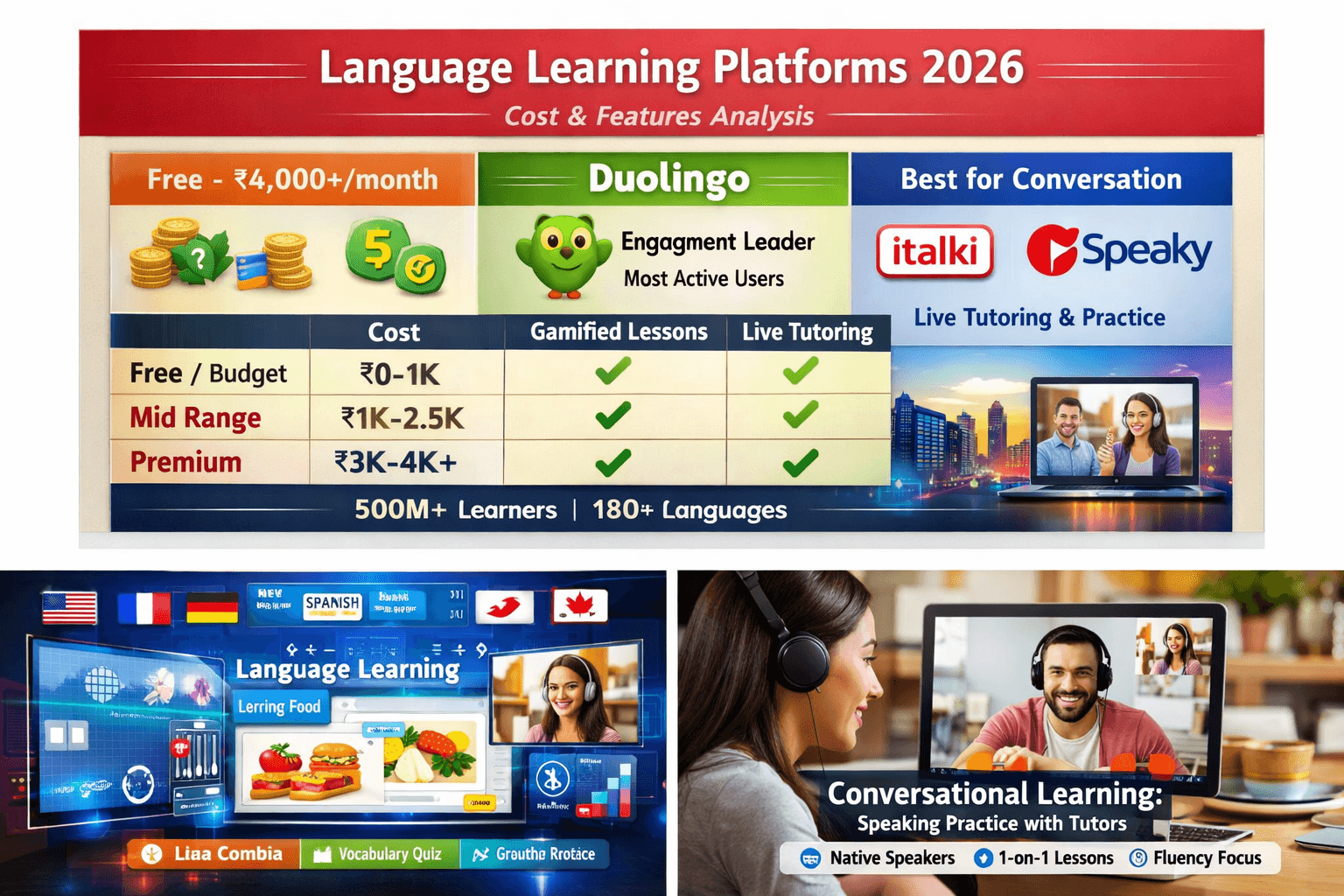
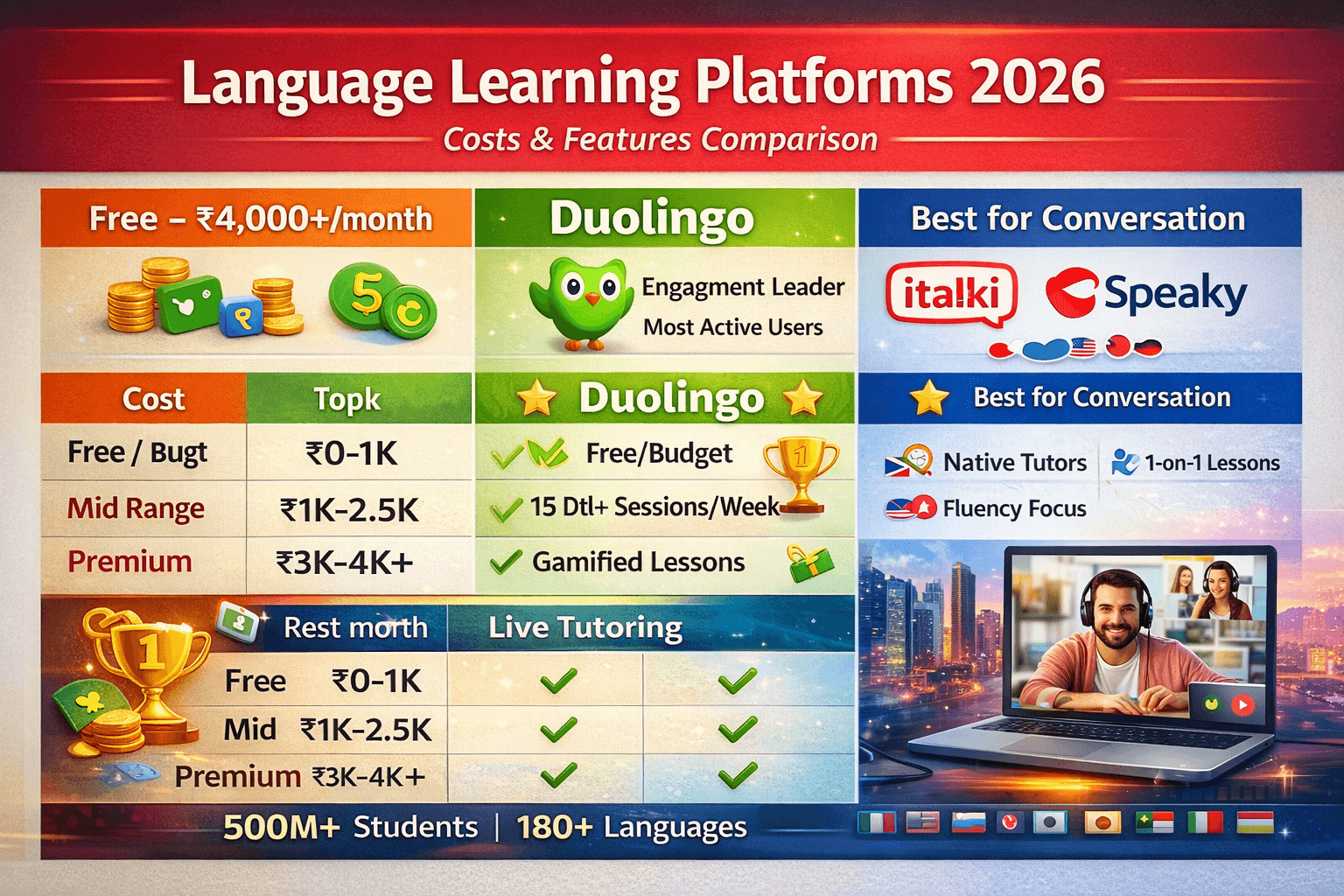
Language learning platforms 2026: Free to ₹4,000+/month, Duolingo dominates engagement, Italki/Speaky best for conversation

Platform Deep Dive

Duolingo (Gamified Engagement Leader):
Cost: Free (limited) or ₹300-500/month (premium)
Strengths: Highest daily engagement (85%), fun and addictive, 40+ languages, mobile-first design, gamification (streaks, leagues, rewards)
Weaknesses: Shallow learning depth (focuses on breadth, not fluency), writing emphasis, pronunciation limited (lacking conversation), not suitable for advanced learners
Best for: Beginners building daily habit, motivation through gamification
Reality: Reaches A2-B1 level (basic-intermediate) but limited beyond; requires supplementary conversation practice
ROI: Excellent for building foundation (500-600 hours) but plateau at intermediate without conversation practice
Effectiveness: 60-70% retention with daily use, but study shows passive learning (completing lessons alone) insufficient for speaking fluency
Babbel (Structured Progression):
Cost: ₹1,200-2,500/month subscription
Strengths: Structured curriculum, professional design, grammar focus, interactive dialogues
Weaknesses: Higher cost, less engaging than Duolingo, limited peer interaction, pronunciation feedback limited
Best for: Serious learners wanting structure, professional language use, grammar foundation
Reality: Reaches B1 level (conversational) in 500+ hours with daily practice
Effectiveness: 70-80% completion for structured learners, good grammar foundation
Rosetta Stone (Immersion Method):
Cost: ₹2,000-4,000/month subscription
Strengths: Immersion approach (no English translation, learning through context), well-designed, comprehensive
Weaknesses: Slower initial progress (frustration for beginners), expensive, grammar explanations limited
Best for: Learners who prefer immersion, can tolerate slow initial progress
Reality: Reaches B1 in 600-700 hours, but motivation challenges due to slower progression
Effectiveness: Strong for immersion learners (70-80%) but lower overall engagement vs. Duolingo
Speaky (Conversation-Focused):
Cost: ₹300-800/hour, pay-per-lesson (no subscription)
Strengths: Native speakers available 24/7, peer tutoring cheaper than professional tutors, conversation emphasis, flexible scheduling
Weaknesses: Quality variable (user-dependent), no structure, teacher vetting less rigorous, requires self-direction
Best for: Conversation fluency development, accelerated learning with active engagement
Reality: 300-400 hours with daily conversation practice to B1, fastest path with consistency
Effectiveness: 90%+ participation rate when lessons scheduled; speaking fluency develops rapidly
Cost-benefit: ₹300-500/hour significantly cheaper than professional tutors (₹1,500-3,000/hour)
Italki (Professional Tutoring with Flexibility):
Cost: ₹400-2,000/hour (tutor-dependent)
Strengths: 150+ languages, professional and community teachers (choose level of training), customizable curriculum, personalized learning
Weaknesses: Higher cost than peer tutoring, quality variable by teacher, requires self-selection and vetting
Best for: Personalized learning, professional guidance, language specialization
Reality: 300-500 hours with experienced tutor to B1, faster with quality instruction
Effectiveness: 95%+ with professional teachers; lower with community teachers
Strategy: Start with community teachers (₹400-600/hour), upgrade to professional (₹1,000-1,500/hour) when ready
Preply (Qualified Tutors with Structure):
Cost: ₹1,200-4,000/hour (tutor-dependent)
Strengths: Vetted teachers, structured lessons, interactive whiteboard, professionalism, satisfaction guarantee
Weaknesses: Highest cost tier, less flexible than Italki, booking limitations
Best for: Professional learners wanting high-quality instruction, learners with specific goals
Reality: 400-600 hours to B1 with qualified teachers
Effectiveness: 90%+ satisfaction, professional quality assurance
YouTube and Free Content (Supplementary):
Cost: Free
Strengths: Unlimited content, entertainment-based learning (shows, movies with subtitles), native speaker exposure
Weaknesses: No structure, overwhelming options, easy to avoid learning, no accountability
Best for: Supplementary immersion (listening practice), cultural exposure
Reality: Requires ₹500+ hours additional focused learning, but accelerates listening comprehension
Effectiveness: 30-40% without structure; best used with platform + self-study
Pimsleur (Audio-Centric Learning):
Cost: ₹2,000-3,500/month subscription
Strengths: Audio focus (commute-friendly), spaced repetition built-in, pronunciation emphasis, 51 languages
Weaknesses: Reading and writing limited, expensive, visual learners may struggle
Best for: Auditory learners, commute practice, pronunciation focus
Reality: 600+ hours to B1, but limited writing skills
Effectiveness: 70-75% for speaking, 50-60% for writing comprehension
Memrise (Vocabulary and Spaced Repetition):
Cost: Free or ₹500-1,000/month (premium)
Strengths: Spaced repetition optimization (scientifically proven retention), vocabulary focus, gamification, user-created courses
Weaknesses: Vocabulary only (no grammar or conversation), less engaging than Duolingo, requires supplementary learning
Best for: Vocabulary building, spaced repetition optimizers, supplementary to other platforms
Reality: Vocabulary foundation (1,000-2,000 words) but requires grammar and conversation practice
Effectiveness: 85%+ retention for vocabulary; excellent for flashcard learning
Key Metric
Duolingo dominates engagement (85% daily) but conversation-focused platforms (Speaky, Italki) enable faster fluency (300-400 hours vs. 600+)

2. Language Learning Methods and Evidence-Based Approaches

Overview of proven language learning methodologies optimizing retention, fluency development, and accelerated progress.

Learning MethodEffectiveness (%)Time to B1 (Hours)Retention Rate (%)Cost ₹/MonthBest ForLimitations
Immersion (Country-Based)95%+ (fastest)300-40090%+ (highest)₹50,000-200,000 (travel/living)Fastest fluency, deep cultural understandingHigh cost, requires relocation, variable motivation
Spaced Repetition (Flashcards)80-85%500+ (vocabulary foundation)85-90%Free-2,000 (Anki, Memrise)Vocabulary mastery, retention optimizationNo conversation practice, boring for many
Immersive Media (Shows, Movies, Podcasts)70-80% (supplementary)500-70070-80%Free-5,000 (streaming subscriptions)Listening comprehension, cultural immersion, entertainmentRequires foundational grammar, slow progress without study
Active Conversation Practice (Tutoring)90-95%300-500 (with consistency)85-90%500-4,000 (peer to professional tutors)Rapid fluency, speaking confidence, personalized guidanceHigher cost, requires discipline and scheduling
Gamified Apps (Duolingo, Busuu)75-85%600-80070-80%Free-2,000 (app subscriptions)Daily habit building, motivation, engagementLimited depth, plateau at intermediate level
Structured Courses (Babbel, Rosetta Stone)70-80%500-70075-85%1,500-4,000 (course subscriptions)Grammar foundation, structured progression, professional useLess engaging, slower initial progress, plateau risk
Hybrid Approach (App + Tutoring + Media)85-95%400-500 (accelerated)85-95%2,000-6,000 combinedOptimal learning combining multiple methodsRequires coordination, higher cost, discipline managing multiple tools
Self-Study (Books, Grammar, Solo Practice)50-60%800-1,000+60-70%500-2,000 (materials)Structure for disciplined learners, grammar depthVery slow, isolating, low motivation, poor pronunciation

Evidence-Based Language Learning Science

1. Spaced Repetition (Scientifically Proven Retention):
How It Works:
Initial exposure to word/phrase
First review: 1 day later (70% forgotten naturally, review refreshes)
Second review: 3 days later (forget curve resetting)
Third review: 7 days later
Fourth review: 21 days later
Long-term: Monthly reviews maintaining retention
Effectiveness:
Retention: 85-90% (vs. 50% cramming, 30% single exposure)
Optimal for: Vocabulary, grammar patterns, phrases
Platform optimization: Memrise, Anki (algorithm optimizing timing)
Daily time: 15-30 minutes (minimal time for maximum retention)
2. Immersion (Environmental Language Saturation):
Mechanism:
12-16+ hours daily language exposure
All communication in target language
Cultural context enabling comprehension
Motivation from necessity and social connection
Fastest fluency path (300-400 hours realistic)
Effectiveness:
Speaking fluency: 95%+ (fastest pathway)
Listening comprehension: 95%+ (daily practice)
Writing: 70-80% (less practice)
Timeline: 6-12 months to B1 with full immersion
Implementation:
Travel to country (expensive, time-intensive)
Language exchange partners (free, requires finding compatible partner)
Online immersion (watching shows, joining communities)
Living with roommate who speaks target language
3. Comprehensible Input (Understanding-Based Learning):
Principle:
Input at i+1 level (slightly above current, ~90% comprehensible)
Too easy: Boring, no learning
Too hard: Frustration, no comprehension
Sweet spot: 90% understanding, 10% new vocabulary/grammar
Application:
Start with subtitled shows (native language subtitles, target language audio)
Audiobooks at slow speed
Children's content (simpler vocabulary, clear pronunciation)
Gradually increase difficulty
Effectiveness:
Listening development: 70-80% improvement
Vocabulary acquisition: Unconscious (learning while enjoying content)
Pronunciation: Native speaker modeling
Timeline: 500-700 hours supplementary to active learning
4. Active Production (Speaking and Writing):
Mechanism:
Forcing retrieval (not recognition/recognition from apps)
Speaking practice: Most anxiety-inducing, most effective
Writing practice: Slower progress but deeper processing
Error feedback: Essential for improvement
Effectiveness:
Speaking fluency: 90-95% fastest pathway
Writing accuracy: 80-85% with feedback
Confidence: Huge psychological benefit
Timeline: 300-400 hours with daily conversation practice to B1
5. Motivation and Consistency (Non-Negotiable Foundation):
Psychological Factors:
Intrinsic motivation (love of language/culture) > Extrinsic (grades, pressure)
Goal clarity: Specific end goal ("speak with native speakers") > vague ("become fluent")
Progress visibility: Tracking improvement (motivation boost)
Community: Learning with others (social motivation)
Reward system: Small wins celebrated
Consistency Requirements:
Daily practice essential (500 hours ÷ 18 months = 45 min/day minimum)
Skipping days: Loss of momentum, progress regression
80% consistency: Sustainable long-term
Streaks: Powerful psychological motivator (Duolingo utilizes effectively)
6. Personality and Learning Style Alignment:
Auditory Learners:Pimsleur, podcasts, conversation practice, audiobooks
Visual Learners:Duolingo, Babbel, subtitled shows, YouTube tutorials
Kinesthetic Learners:Physical gestures, acting out dialogues, total physical response (TPR) methods
Reading/Writing Learners:Grammar books, writing journals, translation exercises
Social Learners:Italki tutors, conversation partners, language exchange, group classes
Solitary Learners:Self-study apps, audiobooks, self-directed learning
Competitive Learners:Gamified apps (Duolingo leagues), competing in challenges
Collaborative Learners:Group classes, peer tutoring, study groups
Optimal Learning Path (Evidence-Based Sequence):
Phase 1 (Months 0-2): Foundation Building
Daily: 30-45 min Duolingo or Babbel (vocabulary + grammar foundation)
Supplementary: 15-30 min spaced repetition (Memrise/Anki)
Focus: Building 500-1,000 word vocabulary, basic grammar
Daily time: 45-75 minutes
Cost: ₹300-1,500/month
Phase 2 (Months 2-6): Active Practice Integration
Daily app: 30 min (Duolingo, Babbel—continuing)
New: 2-4 hours/week conversation practice (Speaky, Italki—₹1,500-4,000/month)
Supplementary: 30 min immersive media (shows, podcasts)
Focus: Speaking confidence, listening comprehension
Daily time: 60-90 minutes
Cost: ₹2,000-5,000/month
Phase 3 (Months 6-12): Fluency Development
App: 20-30 min (maintenance focus)
Conversation: 4-8 hours/week with tutors or language partners
Immersion: Daily shows, podcasts, news in target language
Reading: Books, articles, native speaker content
Focus: Fluency, idioms, cultural nuance
Daily time: 90-120 minutes
Cost: ₹3,000-8,000/month (conversation-heavy)
Phase 4 (Month 12+): Mastery and Specialization
Conversation: 8+ hours/week (native speakers, professional contexts)
Specialized topics: Industry vocabulary, advanced grammar
Advanced immersion: Native content without subtitles
Focus: Professional fluency, accent reduction, advanced writing
Daily time: 120+ minutes
Cost: ₹4,000-10,000/month
Realistic Timeline Summary:
A1 (Beginner): 100-150 hours (1.5-3 months with daily practice)
A2 (Elementary): 150-300 hours (3-6 months cumulative)
B1 (Intermediate): 300-600 hours (6-12 months cumulative for conversation fluency)
B2 (Upper Intermediate): 600-900 hours (12-18 months for professional fluency)
C1 (Advanced): 900-1,200+ hours (18-24+ months for near-native proficiency)
Acceleration Factors (Reducing Timeline 30-50%):
Full immersion (living in country)
Daily conversation practice (4+ hours)
Native speaker partner (daily interaction)
Professional tutoring (quality instruction)
Obsessive media consumption (6-8 hours immersive content daily)
Language exchange (finding compatible partner)
Working in target language (natural daily use)
Deceleration Factors (Extending Timeline):
Inconsistent practice (skipping days)
App-only learning (no conversation)
Passive consumption (watching without comprehension focus)
No error correction
Language similar to native language (takes longer to acquire differences)
Learning multiple languages simultaneously (interference and confusion)
Key Metric
Hybrid approach (app + conversation + immersion media) achieving 85-95% effectiveness in 400-500 hours—optimization possible through method selection

3. Professional Certification and Language Proficiency Standards

Overview of recognized language certifications, proficiency frameworks, and their career/immigration value.

CertificationCost (₹)Validity (Years)Proficiency LevelsRecognitionUse CasesDifficulty Level
IELTS (International English Language Testing System)₹15,000-20,0003 years1-9 band (Band 6.5+/9 for professional)Very high (150+ countries)Immigration, university, employmentModerate-High (requires B2-C1)
TOEFL (Test of English as a Foreign Language)₹12,000-18,0002 years0-120 score (100+/120 for university)Very high (US universities, professional)University admission, employment, immigrationModerate-High (requires B2+)
Cambridge English (FCE, CAE, CPE)₹12,000-18,000LifetimeA1-C2 (CAE C1, CPE C2 advanced)Very high (globally recognized)Employment, professional, academicModerate-High (requires B1-C2 depending on level)
DUOLINGO English Test₹4,000-6,0002 years10-160 score (100+ competitive)Growing (150+ universities accepting)University admission, some employmentLow-Moderate (shorter, mobile-friendly)
TOEIC (Test of English for International Communication)₹8,000-12,0002 years0-990 score (750+/990 professional)High (corporate, Asian markets strong)Corporate employment, professional EnglishModerate (business English focus)
DELE (Diploma in Spanish Language)₹8,000-15,000PermanentA1-C2 Spanish proficiencyVery high (Spanish-speaking countries)Spanish employment, immigration, academicVariable (A1 easy, C1-C2 very hard)
DELF/DALF (French Proficiency)₹8,000-15,000PermanentA1-C2 FrenchVery high (France, Canada, African countries)French employment, immigration, academicVariable (A1 easy, C1-C2 very hard)
Goethe-Zertifikat (German)₹10,000-15,000PermanentA1-C2 GermanVery high (German-speaking countries)German employment, immigration, academicVariable (difficulty increases with level)
Platform Certificates (Duolingo, Babbel, etc.)₹2,000-5,000Varies (1-2 years)No standard levels, platform-specificLow-Moderate (limited recognition vs. official exams)Portfolio demonstration, personal growthLow (completion-based, not proficiency-tested)

Language Certification Strategy

IELTS vs. TOEFL Comparison (English):
IELTS:
Format: Speaking (1:1 interview, 11-14 min), listening, reading, writing
Scoring: 1-9 band scale (6.5+ professional, 7+ competitive)
Validity: 3 years
Cost: ₹15,000-20,000
Preferred: Immigration (UK, Australia, Canada), some US universities
Difficulty: Moderate-High (requires B2-C1 level)
Preparation: 8-12 weeks typical
TOEFL:
Format: Reading, listening, speaking (computer-based), writing (computer interaction)
Scoring: 0-120 (100+/120 competitive for universities)
Validity: 2 years
Cost: ₹12,000-18,000
Preferred: US universities, professional environments
Difficulty: Moderate-High (requires B2+)
Preparation: 8-12 weeks typical
Choice Factors:
Immigration destination: IELTS for UK/Australia/Canada, TOEFL for US
University target: Check specific requirements (many accept both)
Learning style: IELTS more interview-based, TOEFL more technical
Preparation availability: TOEFL more abundant resources
Cambridge English (Most Prestigious):
FCE (B2 - Upper Intermediate): Most common, professional level
CAE (C1 - Advanced): High professional/academic level
CPE (C2 - Mastery): Near-native proficiency
Advantages: Lifetime validity, globally recognized, preferred by employers in some markets
Disadvantages: Expensive (₹15,000-18,000), more demanding preparation, less flexible than TOEFL/IELTS
Best for: Serious professionals, academic focus, long-term planning
Duolingo English Test (Emerging Alternative):
Advantages: Low cost (₹4,000-6,000), 24/7 available, fast results (within 48 hours), mobile-friendly
Disadvantages: Limited recognition vs. IELTS/TOEFL, some universities still skeptical
Growing acceptance: 150+ universities accepting (increasing)
Best for: Budget-conscious, quick test needed, university admission (if accepted by target school)
TOEIC (Business English):
Format: Listening and reading focused (400 questions)
Scoring: 0-990 (750+ professional)
Cost: ₹8,000-12,000
Best for: Corporate employment, business English focus, Asian markets
Limitation: No speaking/writing (perceived as limitation)
Other Languages (DELE Spanish, DELF French, Goethe German):
All offer A1-C2 proficiency testing
Permanent validity (lifetime recognition)
Similar cost (₹8,000-15,000)
Variable difficulty by level (A1 easy, C1-C2 very challenging)
Recognition excellent in respective language countries
Best for: Professional use in target language country, immigration, academic study
Platform Certificates (Duolingo, Babbel, etc.):
Recognition: Limited vs. official exams (employer/university skepticism)
Value: Portfolio demonstration of effort and engagement (not proficiency standard)
Cost: Low (₹2,000-5,000)
Validity: Varies by platform (usually 1-2 years)
Best for: Supplementary credential, personal motivation, demonstrating commitment
Limitation: Not equivalent to proficiency certification (e.g., Duolingo certificate ≠ IELTS Band 6)
Certification ROI and Career Value:
High Value Certifications:
IELTS: Immigration, university, professional (₹15,000 cost justified by 3-year validity)
TOEFL: University admission, professional (especially US)
Cambridge: Professional prestige, lifetime validity, excellent ROI
Language-specific (DELE, DELF, Goethe): Required for professional use in target countries
Moderate Value:
TOEIC: Corporate hiring, market-dependent (strong in Asia)
Duolingo: Growing acceptance, cost-effective for universities accepting it
Low Value:
Platform certificates: Supplementary only, not recognized as proficiency standard
Career Salary Premium (English Certification):
No certification: Baseline salary
TOEFL/IELTS Band 6.5-7: 15-20% salary premium (international roles)
TOEFL 100+/IELTS 7+: 25-35% salary premium (professional fluency)
Cambridge CAE/CPE: 35-50% salary premium (advanced fluency, prestige)
Premium in developing markets (₹20,000-50,000 annual salary difference)
Certification Preparation Strategy:
1. Assessment Phase:
Take free/low-cost practice test (determine starting level)
Realistic timeline: 8-12 weeks preparation typical
Identify weak areas (focus preparation)
2. Targeted Preparation (6-8 weeks):
Official practice materials (essential, not optional)
Test-specific strategies (format familiarization)
Weekly mock exams (tracking progress)
Weakness remediation (intense focus on weak skills)
3. Final Push (2-4 weeks):
Full mock exams every 2-3 days
Timed practice (exam conditions simulation)
Confidence building (overlearning content)
Physical exam prep (logistics, timing)
4. Exam Day:
Adequate sleep night before (sleep > last-minute review)
Early arrival (reduce stress)
Calm strategy (panic = performance decline)
Strategy: Easy questions first, mark difficult for return
Key Metric
Official certifications (IELTS, TOEFL, Cambridge) providing 25-50% career salary premium—ROI easily justified by certification cost

4. Language Learning Strategy and Selection Framework

Systematic framework for selecting optimal platform and learning approach based on goals, learning style, and constraints.

Language Learning Selection Framework

Step 1: Define Clear Goal (Essential)
Possible Goals:
Travel conversation (A1-A2): 100-300 hours, 2-6 months
Professional fluency (B1-B2): 300-900 hours, 6-18 months
Near-native proficiency (C1-C2): 1,200-1,500+ hours, 2+ years
Immigration requirement (specific certification): IELTS Band 6.5+ or equivalent
Academic study (university entry): TOEFL 100+, IELTS 7+, or equivalent
Specialized field (business, medical, etc.): B1-B2+ in field vocabulary
Certification: Specific exam target (date, score)
Goal Clarity Impact:
Clear goal: 50% faster progress (focus enables efficiency)
Vague goal: Motivation loss, scattered learning
Step 2: Assess Personal Learning Style
Factors:
Primary learning modality: Audio, visual, reading/writing, kinesthetic
Motivation type: Intrinsic (love language) vs. extrinsic (pressure, deadline)
Social preference: Solo learning vs. group/tutor interaction
Gamification appeal: Motivated by rewards/competition vs. intrinsic drive
Consistency capability: Can commit daily vs. sporadic availability
Platform Matching:
Audio-focused + auditory learner: Pimsleur
Visual + gamification: Duolingo, Busuu
Tutor interaction: Italki, Speaky
Structured curriculum: Babbel, Rosetta Stone
Immersion approach: Rosetta Stone, immersive media
Step 3: Assess Constraints and Budget
Time Availability:
30 min/day: Duolingo alone (slow progress, 12+ months to B1)
1 hour/day: App + 2-3 hours/week tutoring (6-9 months to B1)
2+ hours/day: Aggressive progress (3-6 months to B1 with tutor)
Living abroad: Full immersion (3-6 months to B1 possible)
Financial Budget:
₹0-500/month: Free apps (Duolingo, YouTube, free content)
₹500-2,000/month: App subscription + occasional tutoring (Speaky)
₹2,000-5,000/month: App + regular tutoring (moderate investment)
₹5,000-10,000/month: Premium tutoring + apps (accelerated learning)
₹10,000+/month: Professional tutoring, intensive course (fastest pathway)
Location:
English-speaking country: Easier immersion, native speakers accessible
Non-English speaking country: Immersion advantage (living in target language)
Remote: Dependent on platform choice and self-discipline
Step 4: Create Personalized Learning Plan
Example 1: Budget Learner, 45 min Daily (6-9 month timeline to B1)
30 min Duolingo (daily habit, vocabulary + grammar)
15 min Memrise (spaced repetition, vocabulary focus)
Weekend: 2 hours immersive media (shows with subtitles)
Month 2: Add Speaky 1 hour/week conversation (₹400-500)
Cost: ₹300-500/month
Result: 6-9 months to B1 conversational
Example 2: Moderate Budget, 90 min Daily, Goal: Professional Fluency (6-12 month timeline)
30 min Babbel (structured progression, grammar)
30 min Speaky tutoring 3x/week (1.5 hours total)
30 min immersive media (daily shows/podcasts)
Cost: ₹2,000-3,000/month
Result: 6-12 months to B2 professional
Example 3: Premium Learner, 2 hours daily, Goal: Near-Native (12-18 month timeline)
30 min Duolingo or Babbel (daily habit)
60 min Italki tutoring 4-5x/week (professional tutor, ₹1,000-1,500/hour)
30 min immersive media (shows, news, podcasts)
30-60 min independent study (reading, writing)
Cost: ₹4,000-8,000/month
Result: 12-18 months to C1 near-native
Example 4: Immersion Learner, Living Abroad (3-6 month timeline to B1)
Daily: 4-6 hours target language exposure (work, social, media)
30 min structured learning (app or self-study)
Daily conversation with natives (social, work, volunteering)
Cost: Living expenses (₹20,000-50,000/month)
Result: 3-6 months to B1 from daily immersion
Step 5: Select Primary Platform and Supplementary Tools
Primary Platform Selection:
Beginner with motivation challenges: Duolingo (highest engagement)
Beginner wanting structure: Babbel or Rosetta Stone
Intermediate wanting conversation: Italki or Speaky
Budget-conscious: Free app + YouTube
Auditory learner: Pimsleur + conversation practice
Immersion preference: Immersive media + language partner
Supplementary Tools:
Vocabulary: Memrise, Anki
Conversation: Speaky (peer), Italki (professional)
Listening: YouTube, Netflix, podcasts
Reading: News sites, Reddit language communities
Writing: Journaling, Reddit r/languagelearning
Accountability: Language exchange partner, tutor check-ins
Step 6: Implementation and Progress Tracking
Scheduling:
Daily consistency (even 15-30 min > sporadic hours)
Same time each day (habit formation)
Realistic commitment (don't overcommit first weeks)
Build gradually (week 1: 30 min, week 4: 60 min)
Progress Tracking:
Weekly: Vocabulary count, lesson completion, conversation practice hours
Monthly: Reassess against timeline, adjust if behind
Quarterly: Formal assessment (mock test, tutor evaluation)
Issues: If plateau, change method (not working = switch approach)
Motivation Maintenance:
Celebrate milestones (100 day streak, first conversation, grammar mastery)
Community: Join r/languagelearning, Discord groups
Rewards: Plan trip to target language country as reward
Vary activities: App + conversation + media + social to prevent boredom
Accountability: Tell friends about goal, update progress
Red Flags and Course Correction:
Motivation loss: Add tutoring for social connection
Plateau (no progress 4+ weeks): Change method, add conversation, increase intensity
Boredom with app: Switch platforms or add conversation practice
Declining consistency: Revisit goal, adjust expectations
Self-doubt: Remember 300-600 hours typical timeline, progress often invisible
Certification Path (If Goal Includes Certification):
Timeline (12-18 month timeline for B2-C1 + certification):
Month 0-6: General fluency building (A1-B1)
Month 6-10: Focused fluency development (B1-B2)
Month 10-12: Certification-specific preparation (focused 8-12 weeks)
Month 12: Exam attempt
Month 13-18: Possible retake if needed (usually pass first try with B2 foundation)
Certification Prep:
Official materials essential (provided by certification body)
Practice tests weekly (tracking improvement)
Weakness focus (double-down on weak skills)
Final month: Exam strategy, timing practice, timed exams
Decision Tree Summary:

If budget <₹500/month → Free app (Duolingo) + YouTube + patience (slow but viable)

If budget ₹500-2,000/month → App + Speaky peer tutoring (good balance)

If budget >₹2,000/month → Professional tutoring (Italki, Preply) for faster fluency

If goal is certification → Add 8-12 weeks official test prep + practice exams

If living abroad → Maximize immersion (social + daily language exposure)

If audio learner → Pimsleur + podcasts + conversation

If visual learner → Duolingo, Babbel, subtitled media

If time-constrained → Quality over quantity (30 min focused > 2 hours distracted)

If motivation-challenged → Gamified app (Duolingo) + accountability partner

Key Metric
Strategic platform selection and learning plan enabling 85-95% success probability vs. haphazard approach (50-60% completion)

Conclusion: Language Learning Accelerating Through Technology and Accessibility

2026 language learning landscape democratized by technology—1.5 billion+ users accessing platforms enabling fluency through AI-personalized learning, conversation practice at scale, and gamified engagement. Platform diversity enabling selection aligned with learning style, budget, and goals. Duolingo dominance in engagement (85% daily) proving gamification effectiveness for habit-building, yet conversation-focused platforms (Speaky, Italki) enabling faster fluency (300-400 hours vs. 600+). Cost-effectiveness improved dramatically: free apps enabling A1-A2 foundation, ₹300-500/hour tutoring accelerating to B1 (vs. ₹2,000-3,000/hour traditional tutoring). Evidence-based methods (spaced repetition, immersion, active production, comprehensible input) enabling systematic progress rather than luck-dependent learning. Realistic timeline transparent: 300-400 hours to B1 conversational (6-12 months with daily 1-2 hour commitment), acceleration possible with immersion or intensive tutoring. Professional certifications (IELTS, TOEFL, Cambridge) providing 25-50% career salary premium—ROI easily justified despite ₹15,000-20,000 cost. Hybrid approach optimal: app foundation (Duolingo ₹300-500/month) + conversation practice (Speaky ₹300-800/hour) + immersive media (free YouTube) = ₹2,000-3,000/month, achieving B1 in 6-12 months. Alternative pathways accessible: full immersion (living abroad), online communities, language exchange partners reducing cost barriers. Motivation and consistency critical (70% of success factor) over platform selection (30%). Platform selection matters less than daily engagement and supplementary conversation practice—best platform is one you'll use daily. Future language learning landscape characterized by AI-adaptive learning paths, global peer tutoring networks, and technology-enabled immersion. Overall transformation evident—language fluency shifting from privilege (expensive tutors, geographic constraints) to accessible right (₹2,000-3,000/month global investment enabling fluency). Best opportunity: informed platform selection aligned with learning style, realistic goal-setting, disciplined daily practice, and early conversation integration. Ultimate success formula: Clear goal + platform matching learning style + daily 60-90 minute commitment + conversation practice starting month 2 + persistence = B1-B2 fluency in 6-12 months.

🌍 **Download the Complete Language Learning Strategy Guide 2026** — Platform comparison matrix, evidence-based learning methods, certification preparation guide, learning plan templates, and motivation framework.

Share This Article

📤 Share This

Frequently Asked Questions

Which language learning app is best?

No single best—depends on goal and learning style. Duolingo best for engagement and habit-building (85% daily usage). Babbel best for structured learning. Rosetta Stone best for immersion approach. Italki/Speaky best for rapid conversation fluency (300-400 hours vs. Duolingo 600+ hours). Recommendation: Start Duolingo free (test commitment), add Speaky conversation practice after month 1, supplement with immersive media. Best platform is one you'll use consistently.

How long does it take to become fluent in a language?

Realistic timeline: 300-400 hours to B1 (conversational, intermediate) with consistent daily practice (6-12 months at 1-2 hours/day). B2 (professional fluency) 600-900 hours (12-18 months). C1 (advanced/near-native) 1,200-1,500+ hours (2+ years). Acceleration possible: Immersion reduces 30-50% (3-6 months to B1), intensive tutoring accelerates learning. Deceleration if: Inconsistent practice, app-only (no conversation), passive learning. Daily consistency matters more than platform quality.

Is Duolingo effective or just a game?

Duolingo effective for foundation (A1-B1 vocabulary and basic grammar, 600+ hours needed to B1). Strengths: Engagement (85% daily), motivation, accessible. Weaknesses: No conversation practice (critical for speaking), plateau at intermediate, writing emphasis. Reality: Duolingo alone insufficient—requires supplementary conversation practice (Speaky, Italki) and immersion media. Use Duolingo 30-45 min/daily + Speaky/tutor 2-4 hours/week for optimal results.

Should I get expensive tutoring or use free apps?

Recommendation depends on budget and timeline: Budget learner → Free Duolingo + YouTube (slow but viable, 12+ months). Moderate budget → Duolingo + Speaky peer tutoring (₹300-500/hour, 6-9 months to B1). Fast timeline → Professional tutoring (₹1,000-2,000/hour, 4-6 months to B1). Best ROI: App foundation (₹300-500/month) + affordable peer tutoring (₹300-500/hour, 2-4 hours/week = ₹500-1,500/month) = ₹1,000-2,000/month total for accelerated B1 (6-9 months).

What is the best language learning method scientifically?

Evidence-based: (1) Spaced repetition (90%+ retention vs. 50% cramming), (2) Active conversation production (95% effectiveness), (3) Comprehensible input at i+1 level, (4) Immersion (fastest, 3-6 months to B1), (5) Consistency (daily > sporadic). Hybrid approach optimal: Spaced repetition app + active conversation + immersion media + structured study = 85-95% effectiveness. No single method dominates—combination of methods and consistency critical.

Is IELTS or TOEFL better for English certification?

Depends on destination: IELTS for UK, Australia, Canada, New Zealand immigration. TOEFL for US universities and professional environments. Both recognized globally. Choice factors: Immigration destination (primary factor), learning style (IELTS more interview-based, TOEFL more technical), preparation availability (TOEFL more resources). Cost similar (₹12,000-20,000). Validity: TOEFL 2 years, IELTS 3 years. Recommendation: Check specific requirement (university, employer, immigration) to decide.

How do I stay motivated learning a language?

Motivation strategies: (1) Clear goal (travel, career, immigration—vague goals fail), (2) Daily consistency (even 15-30 min > sporadic hours—habit formation critical), (3) Community (study groups, tutor social connection), (4) Progress visibility (track improvements, celebrate milestones), (5) Variety (app + tutoring + media prevents boredom), (6) Rewards (trip to target country). If motivation drops: Change method, add tutoring for social connection, reduce goals temporarily. Intrinsic motivation (love language) > extrinsic (pressure) for sustainability.

Can I learn multiple languages simultaneously?

Possible but challenging: If not fluent in any language, focus on one (interference risk, confusion). If fluent in similar languages, can learn simultaneously (Romance languages easier together). Timeline stretches: 1 language 600 hours, 2 languages 1,200+ hours (not 600 each due to cognitive load). Recommendation: Master one to B1-B2, then add second. Avoid: Three or more languages simultaneously (too much cognitive load, low retention).

What if I don't have time for daily practice?

Consistency more important than duration: 30 min daily > 3 hours once weekly. If limited time: (1) Duolingo 15-30 min daily (minimal habit), (2) Add 2-3 tutoring hours/week (conversation accelerates learning), (3) Immersive media while commuting/exercising. If very limited (30 min/week): Expect 18-24 months to B1 (slow but possible). Better: Reassess priority (if language important, make time). Fluency requires commitment—600 hours minimum cannot be compressed below 3 months without full-time immersion.

How do I overcome language learning anxiety/fear of speaking?

Anxiety common (80% learners experience). Strategies: (1) Start with app (Duolingo) building confidence privately, (2) Join peer tutoring (Speaky, language exchange)—less pressure than professional tutors, (3) Remember: Everyone learning, native speakers expect mistakes, (4) Focus on communication (not perfect grammar), (5) Start speaking earlier (not waiting for fluency), (6) Small conversations first (ordering coffee vs. philosophical debates). Fear usually overblown—native speakers generally supportive and patient. Exposure therapy (repeated speaking) most effective—anxiety decreases with practice.

Continue Reading