Introduction: A Shifting Auto Landscape
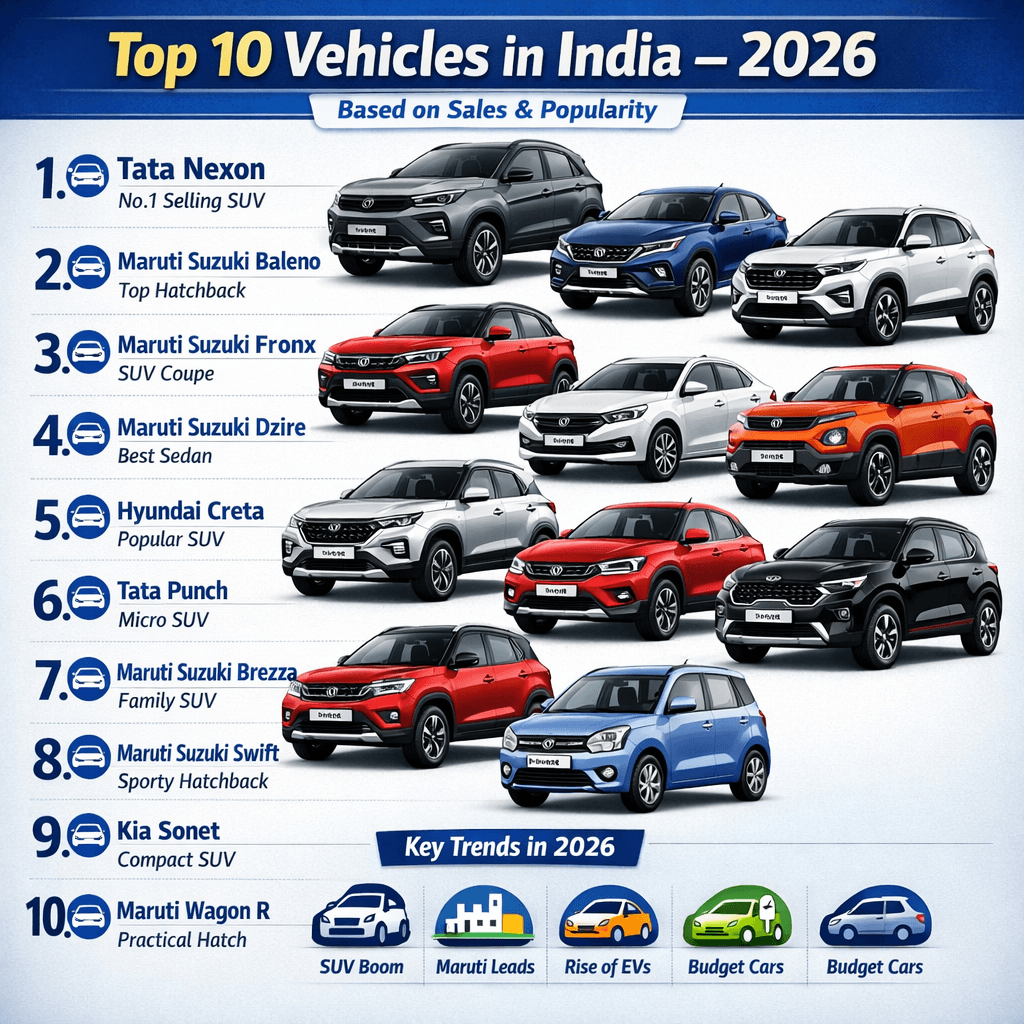
India’s passenger vehicle market in 2026 reflects a dramatic shift toward SUVs, electric mobility, and feature‑rich compact cars. While Maruti Suzuki continues to dominate in volume, Tata Motors and Hyundai have carved out strong niches with high‑scoring safety ratings and innovative EV offerings. This analysis ranks the top 10 best‑selling vehicles based on January 2026 sales data, the first full month of the year, and explores what these numbers tell us about Indian consumer preferences.
Pro Tip
👉 Key Insight: The top three spots are split between Tata (Nexon, Punch) and Maruti (Dzire)—showing that buyers are equally drawn to safety‑rated SUVs and fuel‑efficient sedans/hatchbacks.
The Top 10 Best-Selling Vehicles (January 2026)
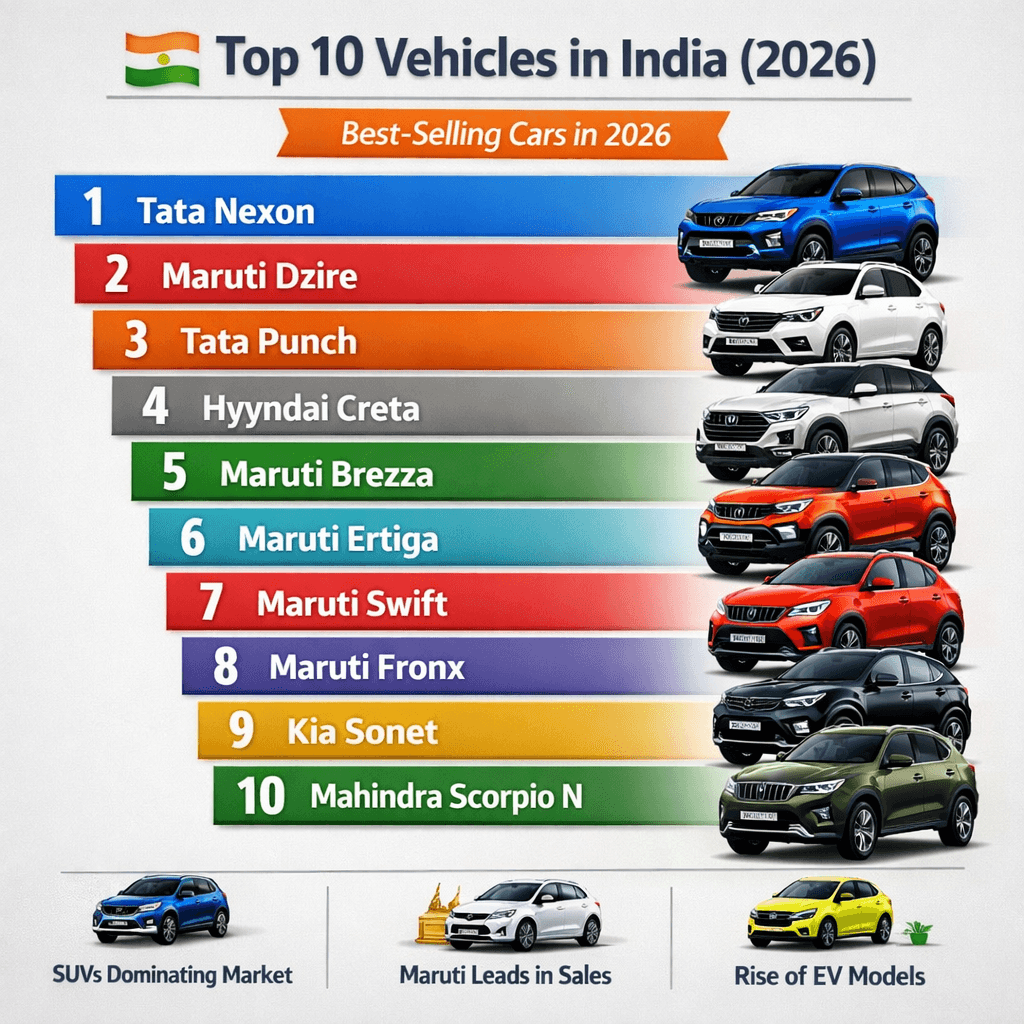
| Rank | Model | Manufacturer | Jan'26 Sales | YoY Growth | Key Highlight |
|---|---|---|---|---|---|
| 1 | Nexon / EV | Tata Motors | 23,365 | +51.75% | Best‑seller overall; EV variant contributes ~20% |
| 2 | Dzire | Maruti Suzuki | 19,629 | +27.60% | Compact sedan leader with new gen appeal |
| 3 | Punch / EV | Tata Motors | 19,257 | +18.64% | Micro‑SUV that outpunches its size |
| 4 | Creta / EV | Hyundai | 17,921 | -3.24% | Premium SUV icon, slight dip but strong |
| 5 | Ertiga | Maruti Suzuki | 17,892 | +25.58% | Family MPV continues to grow |
| 6 | Swift | Maruti Suzuki | 17,806 | +4.24% | Hot hatch legacy holds steady |
| 7 | Brezza | Maruti Suzuki | 17,486 | +18.57% | Compact SUV with urban appeal |
| 8 | Baleno | Maruti Suzuki | 16,782 | -15.94% | Premium hatchback faces competition |
| 9 | Scorpio / N | Mahindra | 15,542 | +0.65% | Rugged SUV with loyal following |
| 10 | Victoris | Maruti Suzuki | 15,240 | New Entry | New-gen MPV enters top 10 |
Note: February 2026 data shows the Tata Nexon retained the top spot with 19,430 units, while the rankings among lower spots saw minor shifts—highlighting the sustained dominance of Tata’s compact SUV lineup.
1. Tata Nexon: The Unstoppable All‑Rounder
The Nexon’s commanding lead—over 3,700 units ahead of the second‑place Dzire—stems from its unique combination of 5‑star Global NCAP safety, a wide range of powertrains (petrol, diesel, and electric), and aggressive pricing. The Nexon EV alone accounts for roughly one‑fifth of its total sales, making it India’s most popular electric passenger vehicle. Tata’s dealership network and service reach have also improved significantly, boosting consumer confidence.
Why it wins
Safety rating, EV option, strong resale value, and a design that appeals to both young buyers and families.
2. Maruti Suzuki Dzire: The Sedan That Refuses to Fade
While sedans have lost ground to SUVs, the Dzire remains a perennial favorite, especially among first‑time buyers and fleet operators. Its fuel efficiency, low maintenance cost, and extensive service network give it an edge. The recent facelift with improved safety features (including 6 airbags in higher trims) helped boost sales by 27.6% year‑on‑year.
Dzire strengths:
- ✓Market‑leading fuel economy (24 km/l)
- ✓Maruti’s wide service network
- ✓Strong resale value
- ✓Affordable entry price
3. Tata Punch: The Micro‑SUV Phenomenon
Launched as India’s smallest SUV, the Punch has consistently delivered volumes above 15,000 units. Its rugged design, high ground clearance, and 5‑star safety rating appealed to buyers wanting SUV aesthetics without the bulk. The introduction of the Punch EV in late 2025 expanded its appeal, contributing to the model’s 18.6% growth.
Despite a slight sales dip of 3.2%, the Creta remains the best‑selling mid‑size SUV in India. Its upmarket interiors, feature‑packed cabin (including a dual‑screen setup and advanced driver assistance systems), and the recent Creta EV have helped it maintain a loyal following. Hyundai’s strategy of offering a full range of powertrains (petrol, diesel, EV) mirrors Tata’s approach.
5. Maruti Suzuki Ertiga: The MPV Comeback
With a 25.6% growth, the Ertiga has become the go‑to choice for large families and cab aggregators. The MPV segment is witnessing renewed interest as buyers look for flexible seating (7‑seater) and practicality. The Ertiga’s mild‑hybrid technology and sub‑4‑meter length (benefiting from lower taxes) give it a pricing advantage over larger MPVs like the Toyota Innova.
The SUV Domination and EV Surge
Six out of the top 10 vehicles are SUVs or crossover‑styled models (Nexon, Punch, Creta, Brezza, Scorpio, and the Victoris MPV also shares SUV design cues). The growing preference for higher seating, better road presence, and perceived safety is clear. Meanwhile, electric variants are now mainstream: the Nexon EV, Punch EV, and Creta EV together accounted for nearly 7% of the total passenger vehicle market in January 2026—a significant jump from 2% two years ago.
💡 Insight: Government subsidies (FAME III) and expanded charging infrastructure have made EVs a practical option for urban buyers, while new models with 300‑400 km real‑world range address range anxiety.
What’s Ahead for 2026
Key trends to watch:
- ✓EV penetration – Expected to cross 10% of overall passenger vehicle sales by year‑end.
- ✓SUV share – Forecast to hit 45% by Q3 2026.
- ✓Price wars – Maruti is launching new CNG and hybrid models to counter Tata’s EV advantage.
- ✓Safety focus – With Bharat NCAP now mandatory, all new models will need 5‑star safety to stay competitive.
Warning
⚠️ **Watch out:** Supply chain constraints for semiconductor chips and lithium‑ion cells could still cause sporadic inventory shortages, especially for EV models.
Conclusion: A Market in Transformation
India’s top‑selling vehicles in 2026 reflect a mature market where buyers demand safety, technology, and choice—whether that’s an electric compact SUV or a frugal compact sedan. The dominance of Tata Motors in the EV space and Maruti Suzuki’s hold on affordable mass‑market models set the stage for a year of intense competition. For consumers, this means more options, better pricing, and ultimately, better vehicles.
💡 Final Insight: The next 12 months will likely see the entry of several new EV models from Maruti, Mahindra, and even foreign players, potentially reshuffling this top‑10 ranking by the end of 2026.
📊 **Want to explore more automotive data?** [Download our free 2026 India Auto Market Report](/resources/india-auto-market-report-2026) for monthly sales dashboards, EV infrastructure maps, and model‑wise analysis.
Share This Article
📤 Share This