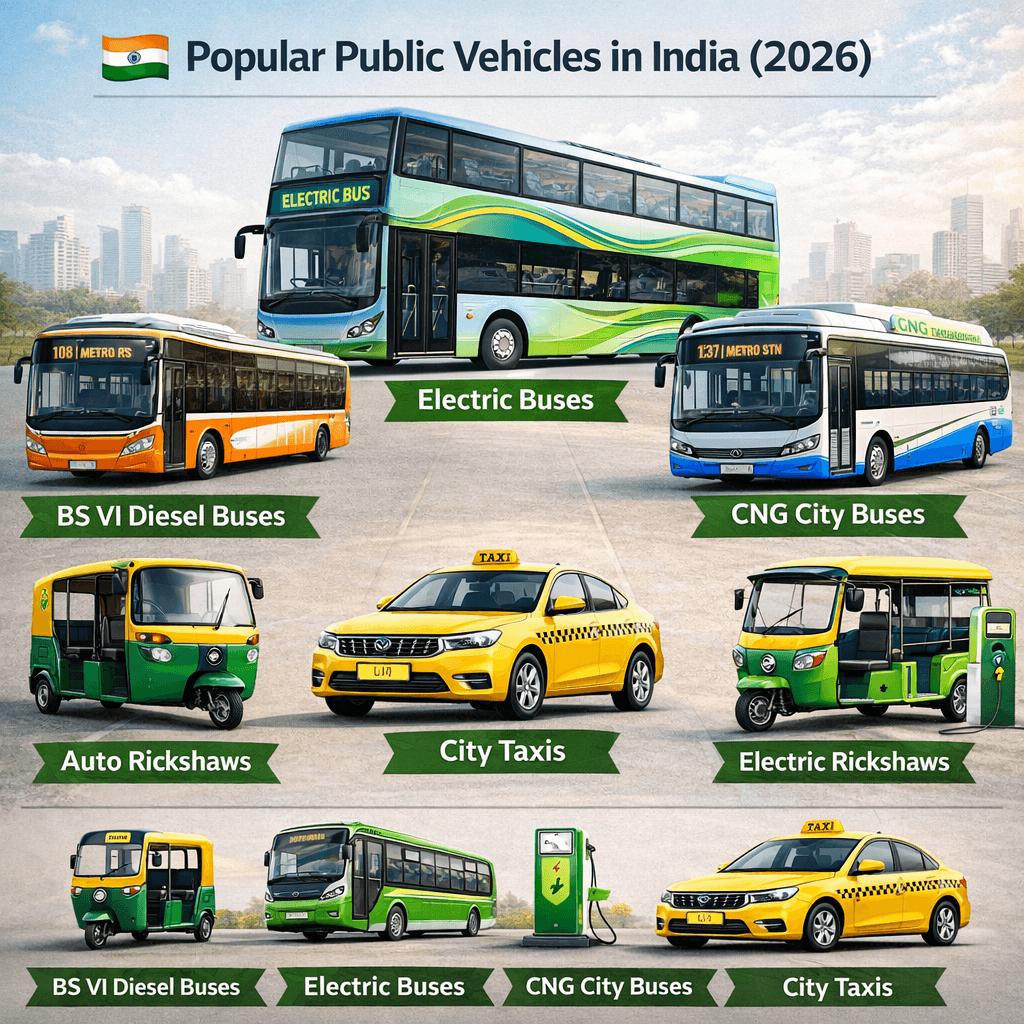
Introduction: India's Public Transport Revolution
India's public transport sector is witnessing an unprecedented transformation in 2026. With state transport undertakings (STUs) across the country placing massive orders for new buses—particularly electric vehicles—the nation is racing to modernize its fleet, reduce emissions, and improve last-mile connectivity. From Delhi's ambitious electric bus expansion to Maharashtra's launch of 3,000 smart buses, the scale of change is historic [citation:5][citation:1][citation:2].
Pro Tip
👉 Key Insight: The convergence of central schemes (PM E-DRIVE, PM e-Bus Sewa) and state-level initiatives has created a perfect storm for public transport modernization. Over 10,000 new buses are expected to hit Indian roads in 2026 alone [citation:5].
Major State-Wise Public Bus Expansions (2026)
| State/UT | Fleet Addition | Type | Timeline | Key Highlights |
|---|---|---|---|---|
| Delhi | 3,330 mini e-buses | Electric | Mid-2026 onwards | Includes 500 ultra-compact 7m buses for narrow lanes; 3,535 e-buses already operational [citation:1][citation:10] |
| Delhi | +200 e-buses | Electric | March 2026 | Fleet to reach 7,500 by year-end; total EV buses to cross 5,000 by March [citation:1] |
| Maharashtra | 3,000 'Rajmata Jijau' buses | Diesel/CNG | March 2026 launch | 56-seat capacity, CCTV, GPS, panic buttons; first 50 deployed in Nagpur [citation:2][citation:4] |
| Chandigarh | 428 e-buses | Electric | By FY 2027-28 | 25 flagged off in Feb 2026; 12m low-floor, 224 km range; all diesel buses to be replaced [citation:7] |
| Ahmedabad | 1,000 e-buses | Electric | By H2 2027 | Part of PM E-DRIVE scheme; 3,600 total across 3 cities [citation:8] |
| Surat | 600 e-buses | Electric | By H2 2027 | PM E-DRIVE allocation [citation:8] |
| Hyderabad | 2,000 e-buses | Electric | By H2 2027 | Largest single-city allotment under PM E-DRIVE [citation:8] |
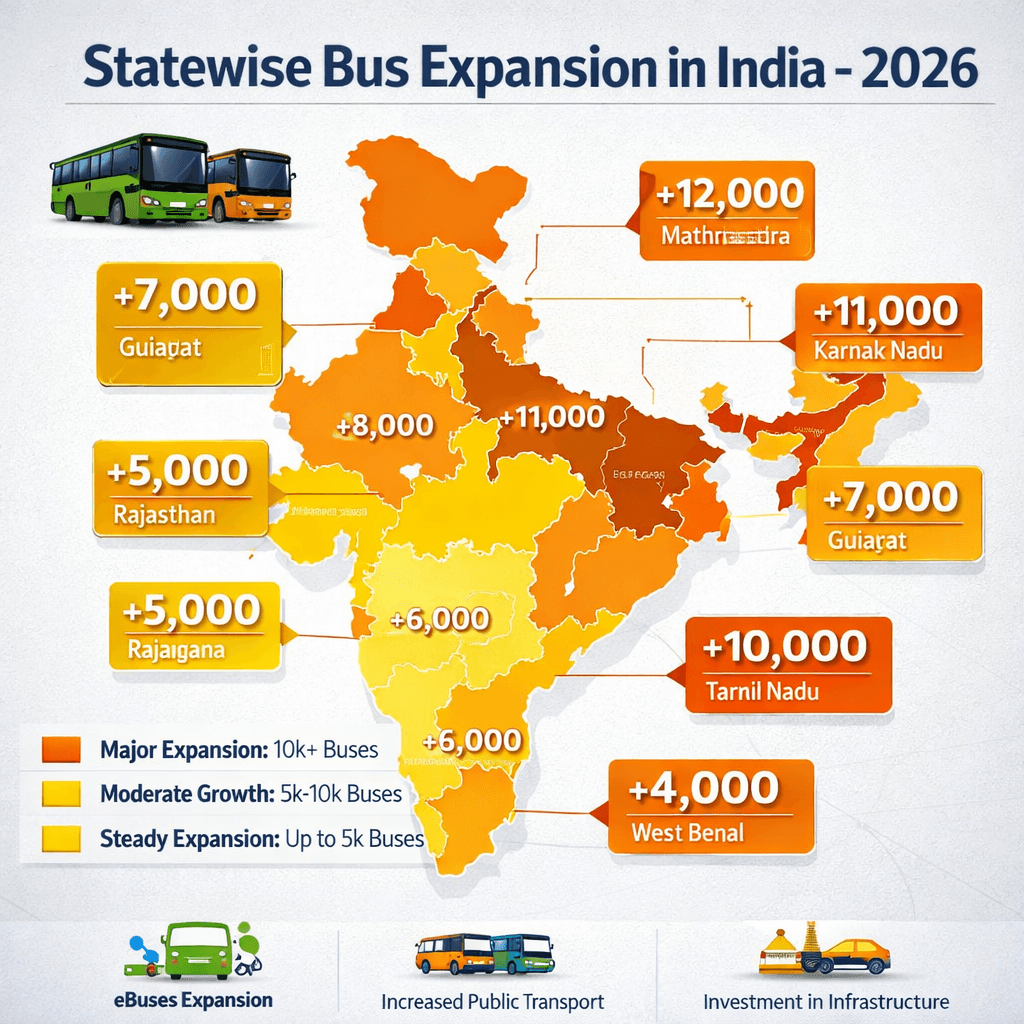
1. Delhi: The EV Bus Capital of India
Delhi is leading India's public transport electrification with an aggressive expansion plan. Currently operating over 4,000 electric buses, the capital aims to reach 7,500 EV buses by December 2026—the largest electric bus fleet of any Indian city [citation:1].
Delhi's 2026 e-bus roadmap:
- ✓Existing fleet: 4,000+ e-buses (as of March 2026) [citation:1]
- ✓March 2026 target: 5,000+ e-buses [citation:10]
- ✓December 2026 target: 7,500 e-buses [citation:1]
- ✓New induction: 200 EV buses added in March 2026 [citation:1]
- ✓Mini e-buses: 3,330 compact electric buses under Phase-2 of PM E-DRIVE, including 500 ultra-compact 7-meter models for narrow lanes [citation:10]
Innovation Spotlight
Delhi's 7-meter mini e-buses are designed specifically for navigating narrow residential lanes, providing true last-mile connectivity to areas traditional buses cannot access. This model could become a template for other congested Indian cities [citation:10].
2. Maharashtra's 'Rajmata Jijau' Smart Bus Revolution
On March 24, 2026, Maharashtra Chief Minister Devendra Fadnavis launched the 'Rajmata Jijau' smart bus service—a fleet of 3,000 modern buses for the Maharashtra State Road Transport Corporation (MSRTC). This represents one of the largest single-state bus inductions in recent years [citation:2][citation:4].
| Feature | Specification |
|---|---|
| Seating Capacity | 56 seats (3x2 layout, higher capacity than existing models) [citation:2] |
| Safety Features | CCTV cameras, panic buttons, GPS tracking [citation:2][citation:4] |
| Passenger Amenities | Public announcement system, electronic route display boards [citation:4] |
| Route Focus | Shuttle services between major cities on high-traffic routes [citation:2] |
| Initial Deployment | 50 buses in Nagpur [citation:2] |
| Total Induction | 3,000 buses to be added [citation:2] |
💡 Cultural Connect: The buses are named after Rajmata Jijau, mother of Chhatrapati Shivaji Maharaj, continuing MSRTC's tradition of naming buses after historical figures (Shivneri, Shivshahi, Shivai, Yashwanti, Hirkani) [citation:2][citation:4].
3. The PM E-DRIVE Scheme: National E-Bus Rollout
The Prime Minister Electric Drive Revolution in Innovative Vehicle Enhancement (PM E-DRIVE) scheme is the central government's flagship program for electrifying public transport. With a total outlay of ₹10,900 crore, the scheme is transforming urban mobility across India [citation:8].
| City | E-Buses Allotted | Status | Operator |
|---|---|---|---|
| Hyderabad | 2,000 | LoA issued | Olectra [citation:8] |
| Ahmedabad | 1,000 | LoA issued | PMI Electro [citation:8] |
| Surat | 600 | LoA issued | EKA Mobility [citation:8] |
| Delhi | To be allocated | Expected soon | CESL coordination [citation:8] |
| Mumbai | Under process | Tendering | PM E-DRIVE scheme [citation:8] |
| Bengaluru | Under process | Tendering | PM E-DRIVE scheme [citation:8] |
| Pune | Under process | Tendering | PM E-DRIVE scheme [citation:8] |
The scheme operates under a Gross Cost Contract (GCC) model, where private operators manage vehicles and cities pay on a per-kilometer basis. Incentives are capped at ₹35 lakh for 10-12 meter buses, ₹25 lakh for 8-10 meter buses, and ₹20 lakh for 6-8 meter mini buses [citation:8].
4. Tata Motors' Dominance in Public Bus Manufacturing
Tata Motors has emerged as the preferred supplier for India's public transport modernization, securing cumulative orders for over 5,000 buses and chassis from multiple state transport undertakings through competitive e-bidding [citation:5].
Order details:
- ✓Total orders: 5,000+ buses and chassis [citation:5]
- ✓Key customers: Maharashtra ST, Gujarat ST, North Western Karnataka ST [citation:5]
- ✓Models: Tata Magna, Tata Cityride, Tata Starbus, Tata Starbus Prime [citation:5]
- ✓Chassis platforms: LPO 1618, LPO 1622, LPO 1822 [citation:5]
- ✓Competitors: Ashok Leyland (secured 1,937 buses from Tamil Nadu), Eicher Motors [citation:5]
Lifecycle Support
Tata Motors supports its public bus fleet through 'Sampoorna Seva 2.0', a comprehensive service program covering maintenance, spare parts availability, and breakdown assistance—critical for minimizing downtime of public transport fleets [citation:5].
5. Chandigarh: The All-Electric City Vision
Chandigarh is on track to become India's first city with an entirely electric public bus fleet. Under the PM e-Bus Sewa Scheme, the Union Territory will phase out all diesel buses by the end of FY 2027-28 [citation:7].
Chandigarh's e-bus milestones:
- ✓Total sanctioned: 428 electric buses under PM e-Bus Sewa [citation:7]
- ✓Current fleet: 105 e-buses (80 existing + 25 flagged off in Feb 2026) [citation:7]
- ✓Target by April-May 2026: 180 e-buses (first lot completion) [citation:7]
- ✓Ultimate target: 508 e-buses (including additional 70) by FY 2027-28 [citation:7]
- ✓Operating model: Operator handles procurement, maintenance, operation; UT collects fare revenue at ₹61.80/km [citation:7]
💡 Accessibility Features: The 12-meter low-floor buses feature 400-mm floor height, power-operated ramps, kneeling mechanisms for Divyangjan passengers, seating for 36, wheelchair space, and standing capacity for 20 [citation:7].
Key Challenges and the Road Ahead
Despite the ambitious expansion, India's public transport modernization faces several challenges that will shape the sector's trajectory through 2026 and beyond [citation:5].
Challenges:
- ✓Charging infrastructure: E-bus adoption requires widespread depot-level charging infrastructure—a significant capital investment [citation:5]
- ✓Supply chain constraints: Semiconductor and lithium-ion cell shortages could impact delivery timelines [citation:5]
- ✓Financial sustainability: State transport undertakings often operate at a loss; per-kilometer operating costs must be carefully managed [citation:5]
- ✓Tender delays: While bids are finalized, actual rollout can be delayed by administrative processes [citation:8]
- ✓Skill development: Maintenance of advanced e-buses requires specialized training for mechanics and technicians [citation:5]
Warning
⚠️ **Looking Ahead:** Industry estimates suggest 10,000-15,000 buses will be tendered or ordered by state transport undertakings in 2026. A significant portion will be electric, as authorities push for cleaner public transport under central government incentives [citation:5].
Conclusion: A New Era for Indian Public Transport
The scale of public bus modernization underway in India is unprecedented. From Delhi's race to 7,500 e-buses to Maharashtra's 3,000 smart bus induction, from Chandigarh's all-electric vision to the national PM E-DRIVE scheme, 2026 represents a inflection point for urban mobility. As these new fleets hit the roads, millions of daily commuters will experience safer, cleaner, and more comfortable travel—while contributing to India's ambitious climate goals [citation:1][citation:2][citation:5].
💡 Final Insight: The success of this public transport revolution will depend not just on bus procurement, but on building sustainable operating models, robust charging infrastructure, and last-mile connectivity ecosystems that truly reduce private vehicle dependence.
📊 **Want to track India's public transport transformation?** [Download our free India EV Bus Tracker](/resources/india-ev-bus-tracker) for monthly updates on fleet additions, state-wise progress, and charging infrastructure rollout. Or explore our interactive map of e-bus deployments across India.
Share This Article
📤 Share This