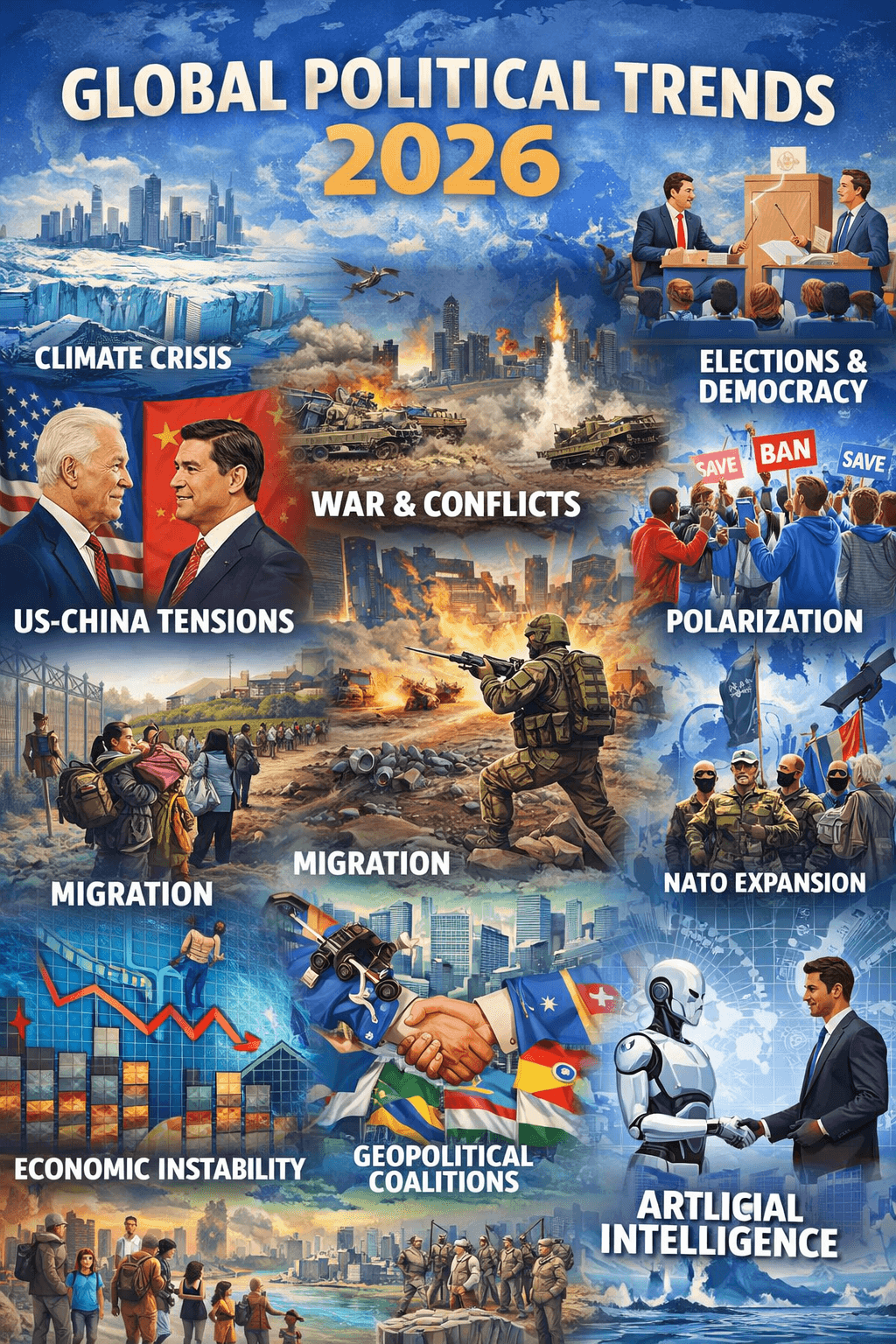
Introduction: The Great Political Reordering
2026 is a year of profound political transformation. Across every continent, the foundations of governance are shifting—democracies are under unprecedented internal pressure, authoritarian models are evolving with new technological tools, and the post-Cold War international order continues its accelerated dissolution. With 72 national elections held this year, representing over 3.2 billion voters, 2026 is a referendum on how the world wants to be governed in an era of climate crisis, technological disruption, and geopolitical fragmentation.
Pro Tip
👉 The Defining Tension: The central political struggle of 2026 is no longer democracy vs. authoritarianism in the traditional sense—it's the battle over what governance looks like in a digitally saturated, climate-stressed, multipolar world. Both democratic and authoritarian systems are evolving rapidly, often borrowing each other's tools.
1. Democracy's Mixed Picture: Resilience in Some, Erosion in Many
The narrative of global democratic decline is more complex than simple headlines suggest. While established democracies face unprecedented internal challenges—from polarization to institutional distrust—some nations have shown surprising resilience. Meanwhile, democratic backsliding continues in regions from Eastern Europe to Southeast Asia, with the lines between democratic and authoritarian governance increasingly blurred.
| Region | Democratic Trend | Key 2026 Events | Outlook |
|---|---|---|---|
| North America | Polarized, stable institutions | US midterms; Canada elections | Fragile but resilient |
| Europe | Mixed—East backsliding, West stable | EU elections; Hungary tensions | Diverging trajectories |
| Latin America | Volatile democracy | Brazil, Mexico, Colombia elections | Populist cycles continue |
| Asia-Pacific | Declining | Philippines, Thailand, Taiwan tensions | Authoritarian drift evident |
| Sub-Saharan Africa | Fragile democratic gains | Nigeria, South Africa, Kenya | Coups and elections alternate |
| Middle East | Authoritarian consolidation | GCC reforms limited; Iran unrest | Repression with digital modernization |
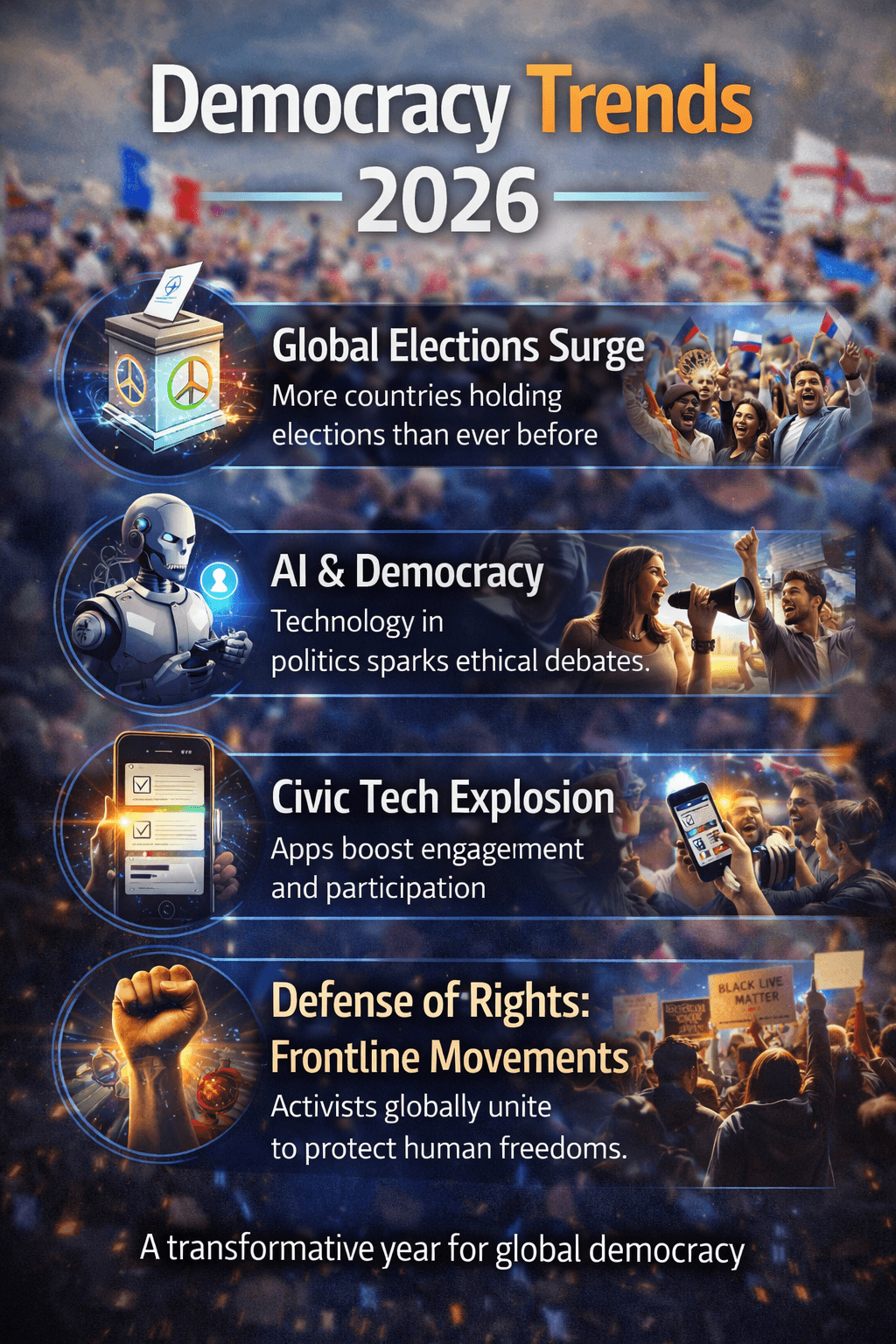
Case Study: India
— The world's largest democracy held state elections in 2026 that served as a bellwether for national trends. Opposition coalitions showed unexpected strength, while the ruling party's digital governance model—including biometric identification and direct benefit transfers—continued to redefine state-citizen relationships in ways both praised and criticized.
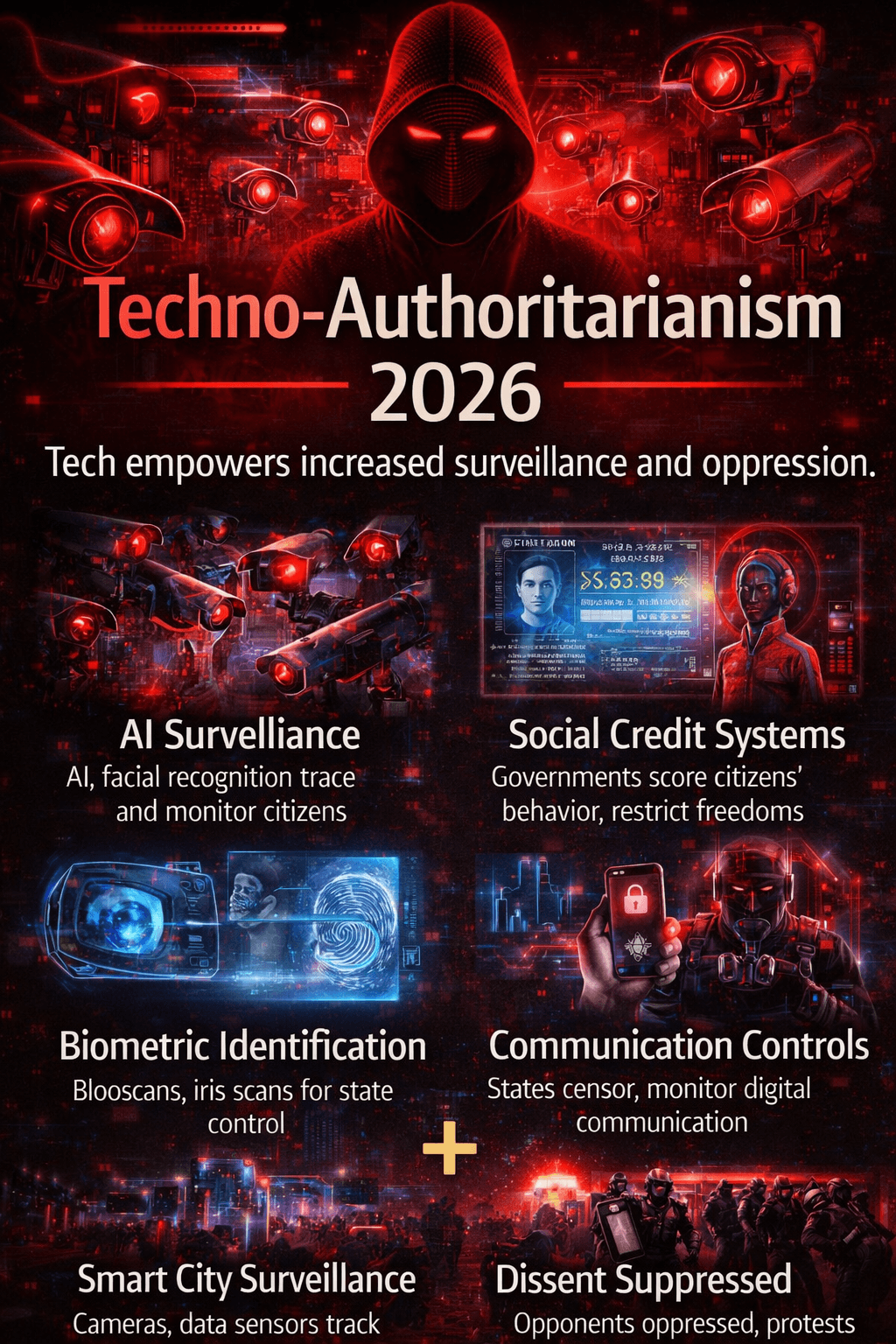
The most significant political innovation of 2026 isn't a new ideology—it's a new toolkit. Techno-authoritarianism combines the surveillance capabilities of digital states with the populist appeal of modern communication platforms. From China's social credit system evolution to Hungary's algorithmic media control to Saudi Arabia's AI-powered governance, authoritarians are proving remarkably adept at using technology to consolidate power while maintaining legitimacy.
Pro Tip
👉 Defining Feature: Techno-authoritarian regimes don't simply repress—they optimize. Using AI, biometrics, and ubiquitous surveillance, they deliver efficiency, predictability, and often genuine public services in exchange for political freedom. This value proposition resonates with populations weary of democratic dysfunction.
Techno-Authoritarian Tools Deployed in 2026:
Predictive Policing: AI systems identify "potential dissidents" before protest activity—used in China, Russia, Egypt, and increasingly in democratic nations
Algorithmic Media Control: Social media algorithms programmed to demote opposition content while amplifying government messaging—Hungary, Turkey, India
Digital Identity Infrastructure: National ID systems linked to financial services, travel, and social benefits create leverage points for control—expanding across Africa and Asia
AI-Powered Censorship: Large language models now auto-generate and distribute propaganda while filtering prohibited content at scale
Biometric Border Control: Facial recognition databases enable unprecedented tracking of citizens and visitors alike
3. Geopolitical Realignment: The Multipolar World Arrives
If 2025 was the year multipolarity was discussed, 2026 is the year it became operational. The post-Cold War unipolar moment is definitively over, replaced by competing poles of power—the United States, China, a fractured Europe, a rising Global South, and non-aligned middle powers. The result is a world of competing systems, fragmented trade, and strategic ambiguity that smaller nations increasingly navigate by playing great powers against each other.
💡 Insight: The defining geopolitical development of 2026 isn't US-China competition—it's the Global South's refusal to choose sides. Brazil, India, Indonesia, South Africa, and others have successfully carved out independent positions, extracting concessions from both Washington and Beijing while building alternative institutions like the expanded BRICS+.
Geopolitical Milestones of 2026:
BRICS+ Formalization: Expanded bloc of 15 nations holds first summit as a formalized economic alliance, representing 42% of global GDP and 47% of world population
EU Strategic Autonomy: European Union announces €800B defense and industrial strategy to reduce dependency on both US and China
Global South Institutions: New Development Bank, Asian Infrastructure Investment Bank, and others now offer alternatives to IMF/World Bank
US-China Decoupling: Complete semiconductor supply chain separation achieved, with cascading effects across global technology sectors
Middle East Multipolarity: Saudi Arabia, UAE, and Iran pursue independent foreign policies, no longer aligning strictly with Washington or Beijing
African Union in G20: AU becomes permanent G20 member—first new member since 1999—giving Africa unified voice in global governance
4. Election Year 2026: Democracy on the Ballot
With 72 national elections in 2026—affecting over 3.2 billion people—this is one of the largest election years in history. The outcomes will shape political trajectories for years to come. Across these contests, several patterns emerged: incumbents face unprecedented anti-establishment sentiment, AI-powered campaigning reached new sophistication, and election integrity remains a central concern even in established democracies.
| Country | Election Type | Key Dynamics | Outcome Significance |
|---|---|---|---|
| United States | Midterms | Congressional control; AI disinformation battles | Shapes final two years of presidential term |
| Brazil | Presidential | Lula vs. Bolsonaro rematch | Amazon policy, democratic stability at stake |
| Germany | Federal | Post-Merkel era consolidation | Europe's largest economy direction |
| India | State Elections | Opposition coalition test | Preview of 2027 national elections |
| South Africa | National | ANC majority risk | First coalition government possible |
| Mexico | Presidential | AMLO succession | North America's left-right divide |
| Turkey | Parliamentary | Erdoğan's coalition test | NATO member's democratic trajectory |
| Philippines | Midterms | Marcos consolidation | Southeast Asian democratic health |
Election Integrity Watch
2026 saw the first major elections where AI-generated content—deepfakes, synthetic voices, automated propaganda—constituted over 15% of campaign content in several nations. Democratic institutions scrambled to adapt, with mixed success in distinguishing authentic from synthetic political speech.
5. Climate Politics: From Protest to Power
Climate change has evolved from a policy issue to a defining political cleavage in 2026. Green parties have gained governing power in multiple countries, climate-driven migration is reshaping electoral maps, and fossil fuel phase-out timelines have become central campaign issues. The politics of climate is no longer about persuasion—it's about managing transition, compensation, and adaptation.
Pro Tip
👉 New Political Calculus: In 2026, climate voters are no longer a niche constituency. Across Europe, North America, and increasingly Asia, voters who prioritize climate action represent 25-35% of electorates—sufficient to swing elections and reshape governing coalitions.
Common Pitfalls in Understanding Global Politics
Warning
❌ **Western-Centric Analysis:** The greatest analytical failure of 2026 political commentary is assuming Western democratic norms and concerns are universal. Most of the world's population lives under or with different governance traditions and priorities.
Misconceptions to Avoid:
False Binary: Framing politics as simply democracy vs. authoritarianism misses the complexity of hybrid regimes, techno-authoritarianism, and democratic backsliding.
Linear Decline Narratives: Democratic erosion isn't uniform or irreversible. Some nations show resilience, and trends can reverse.
Agency of the Global South: The assumption that smaller nations simply choose between US and China misreads their successful strategy of playing both against each other.
Technology Neutrality: Assuming technology itself is politically neutral ignores how algorithms, surveillance, and digital infrastructure inherently carry governance implications.
Election Fixation: Focusing only on elections misses the more significant trend: what happens between elections—judicial appointments, administrative changes, media consolidation—often matters more.
Conclusion: The Shape of Things to Come
2026 reveals a world in political transition without clear destination. Democracy is neither triumphing nor collapsing—it's evolving, unevenly. Authoritarianism is consolidating with new technological tools. Geopolitics has fragmented into competing spheres without clear rules. The coming years will determine whether this transition leads to new forms of accountable governance or to a world where technology enables control without consent. The choice, increasingly, is being made not just in capitals, but in the code that shapes how we live.
💡 Final Insight: The political trends of 2026 point to a fundamental truth: governance models are being rebuilt from the ground up. The tools of power—data, algorithms, surveillance, digital identity—are as important as constitutions and elections. Understanding 21st century politics means understanding how technology and governance intertwine, for better and worse.
📊 **Download the 2026 Global Political Trends Report** — Full analysis of 72 national elections, democracy index data, techno-authoritarianism tracker, and regional forecasts. Available free for a limited time.
Share This Article
📤 Share This