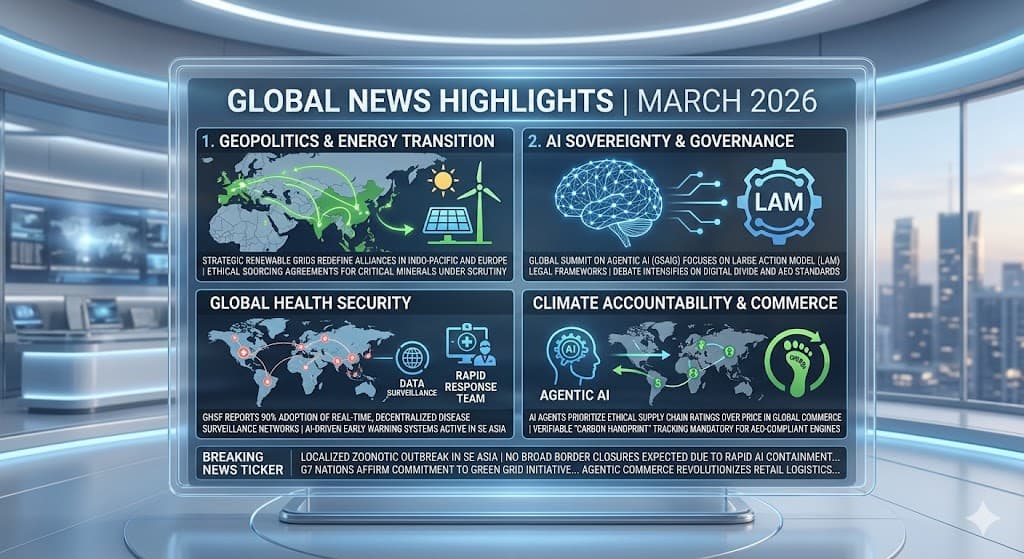
Introduction: A World at the Crossroads
2026 will be remembered as a year of profound transformation. From historic climate agreements that finally moved from promises to action, to geopolitical realignments that redrew global alliances, to technological breakthroughs that blurred the line between science fiction and reality—this was the year the future arrived. As we look back, five key themes emerge: climate action reached a tipping point, artificial intelligence became truly ubiquitous, global demographics shifted, and the world order itself continued its rapid evolution.
Pro Tip
👉 The Big Picture: 2026 marked the first year where global clean energy investment ($2.8T) surpassed fossil fuel investment for the third consecutive year, signaling that the energy transition is no longer a debate—it's a market reality.
1. Climate Action: From Promises to Execution
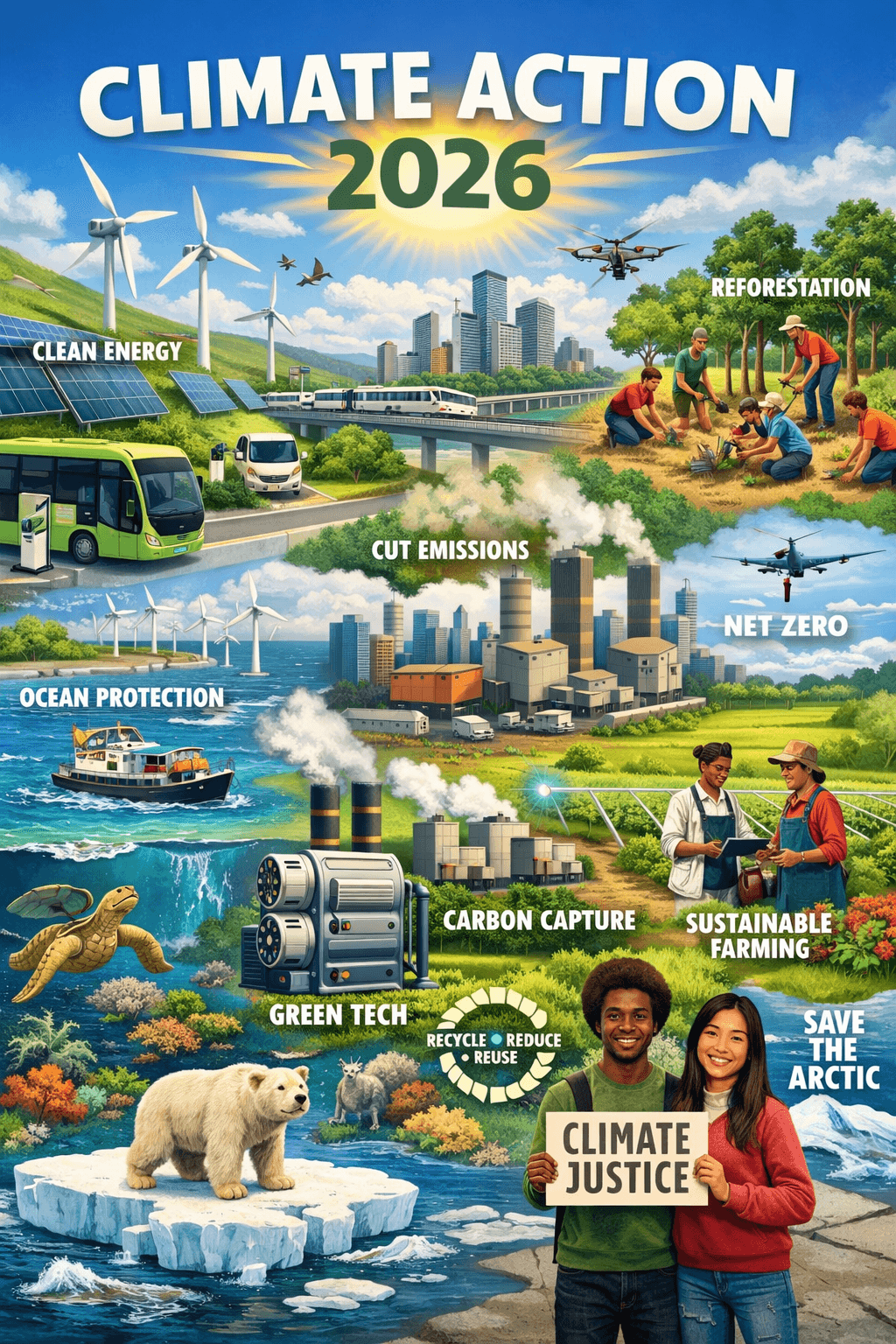
After years of ambitious pledges and incremental progress, 2026 saw climate commitments transform into measurable action. The Global Climate Resilience Pact, signed by 143 countries in Geneva, established binding targets for adaptation funding, renewable energy deployment, and biodiversity protection—with real enforcement mechanisms for the first time.
| Climate Milestone | Date | Global Impact |
|---|---|---|
| Global Climate Resilience Pact | March 2026 | 143 nations commit $500B annually for adaptation |
| EU Bans New ICE Vehicles | January 2026 | Petrol/diesel car sales end across 27 nations |
| Amazon Reforestation Milestone | September 2026 | 1M hectares restored—largest in history |
| China Carbon Peak Achieved | December 2026 | Emissions peak 4 years ahead of schedule |
| Fusion Energy Breakthrough | October 2026 | Net-positive fusion sustained for 30 seconds |
Key Trend
Corporate climate action outpaced government targets in 2026, with 2,100+ companies committing to science-based net-zero targets—representing 45% of global market capitalization.
2. Geopolitical Realignments: The New World Order
2026 witnessed accelerating shifts in global power dynamics. The post-Cold War order continued to fracture, with new alliances forming around economic corridors, resource security, and technological sovereignty. Multipolarity is no longer a forecast—it's the operating reality.
Pro Tip
👉 Key Development: The expanded BRICS+ bloc (now 15 nations representing 42% of global GDP and 47% of the world's population) held its first summit as a formalized economic alliance, signaling a concerted push to rebalance global financial institutions.
Major Geopolitical Events of 2026:
January: European Union admits Ukraine, Moldova, and Georgia as official candidate members—largest expansion since 2004
April: US-China tech decoupling reaches new phase with complete semiconductor supply chain separation
July: African Union formally admitted as permanent G20 member—first new member since 1999
September: Arctic Council reconstituted with China, India, and Brazil as permanent observers as polar region opens for shipping
November: Middle East normalization accelerates with Saudi-Iran diplomatic breakthrough brokered by China
December: UN Security Council reform talks advance with consensus on expanding permanent membership

3. Technology Breakthroughs: The Year AI Went Ambient
If 2023-2025 was the era of AI novelty, 2026 was the year AI became invisible infrastructure. Artificial intelligence embedded itself into every aspect of daily life—from healthcare diagnostics to transportation to creative work—often without users even realizing it. The debate shifted from 'Should we use AI?' to 'How do we ensure it works for everyone?'
💡 Insight: The most significant breakthrough wasn't a single product but the maturation of AI agents—systems that can independently complete complex tasks across multiple applications. By Q4 2026, 37% of white-collar workers reported using AI agents to handle at least one routine job function.
Technology Milestones of 2026:
General AI Agents: First commercially available AI agents capable of independent task completion across software ecosystems
Quantum Advantage: Google and Chinese researchers both demonstrate quantum systems solving commercially relevant problems unreachable by classical computers
Brain-Computer Interfaces: Neuralink and competitors receive expanded FDA approvals for human trials restoring mobility to paralysis patients
6G Rollout: First commercial 6G networks launch in South Korea, Japan, and parts of Europe—offering 100x faster speeds than 5G
Autonomous Vehicles: Level 5 autonomy approved for commercial deployment in 12 countries, with Waymo and Tesla leading mass adoption
Regulatory Milestone
The EU AI Act took full effect in February 2026, establishing the world's first comprehensive AI regulatory framework. Similar legislation followed in Japan, Brazil, and Canada, creating a patchwork of global standards companies must navigate.
4. Global Demographics: The 8 Billion Reality
March 2026 marked the moment global population surpassed 8.2 billion—but more significant than the number itself were the divergent demographic trajectories emerging worldwide. While Africa and parts of Asia continued growing, 38 countries now face population decline, with profound implications for labor markets, social safety nets, and economic growth.
Pro Tip
👉 The Demographic Divide: For the first time in history, more countries have fertility rates below replacement level (2.1 children per woman) than above it. This shift will reshape global economics, migration patterns, and geopolitical influence over the coming decades.
| Region | Population 2026 | Growth Trend | Median Age |
|---|---|---|---|
| Sub-Saharan Africa | 1.4B | Fastest growing (2.4%) | 18.2 |
| South Asia | 2.1B | Moderate growth (0.9%) | 27.3 |
| East Asia | 1.6B | Declining (-0.2%) | 41.7 |
| Europe | 742M | Declining (-0.1%) | 44.1 |
| North America | 378M | Slow growth (0.5%) | 38.4 |
| Latin America | 667M | Slow growth (0.4%) | 31.2 |
5. Economic Transformation: Inflation Tamed, New Risks Emerge
The global economy stabilized in 2026 after years of volatility, with central banks successfully navigating the post-inflationary landscape. However, new challenges emerged: persistent labor shortages in advanced economies, mounting sovereign debt pressures in developing nations, and the accelerating fragmentation of global trade into competing blocs.
Economic Storylines of 2026:
Debt Crisis Averted: IMF and G20 coordinated to restructure $120B in developing nation debt—preventing widespread defaults
Digital Currency Expansion: CBDCs (central bank digital currencies) launched in 27 countries, with cross-border payment systems going live
Labor Market Evolution: AI-driven productivity gains offset workforce shortages, with remote work stabilizing at 28% of full-time positions
Supply Chain Regionalization: Nearshoring accelerated, with Mexico, Vietnam, and Eastern Europe capturing $340B in relocated manufacturing
Housing Affordability Crisis: Global housing costs remained the top economic concern, with 47% of urban residents reporting housing stress
Common Themes That Defined 2026
Warning
❌ **Notable Setbacks:** Despite progress, 2026 saw concerning developments—including ongoing conflicts in Sudan and Myanmar, rising authoritarianism in several nations, and the first year where climate-related disasters exceeded $500B in damages.
The 5 Themes That Defined 2026:
- ✓
Acceleration: Climate action, AI adoption, and economic transformation all accelerated faster than forecasters predicted
- ✓
Fragmentation: The world continued to fragment into competing economic and geopolitical blocs
- ✓
Demographic Divergence: The gap between growing and shrinking populations reshaped global labor markets
- ✓
Technological Ubiquity: AI ceased to be a technology and became an invisible layer of everyday life
- ✓
Climate Reality: Extreme weather events made climate adaptation unavoidable, even for skeptics
Conclusion: A Year of Reckoning and Reinvention
2026 was a year when long-anticipated trends finally crystallized into reality. Climate pledges became contracts. AI promises became products. Demographic forecasts became labor shortages. The world that emerged is more complex, more fragmented, and more technologically integrated than ever before. The question for 2027 and beyond isn't whether these trends will continue—it's whether our institutions, policies, and values can evolve fast enough to ensure they benefit everyone.
💡 Final Insight: Historians will likely view 2026 as a hinge year—the moment when the 21st century truly came into focus. The decisions made, agreements signed, and technologies deployed this year will echo for decades.
📊 **Download the Complete 2026 Global Review** — In-depth analysis of key events, data visualizations, and forward-looking forecasts for 2027. Available free for a limited time.
Share This Article
📤 Share This