Introduction: The Clock Inside Every Cell
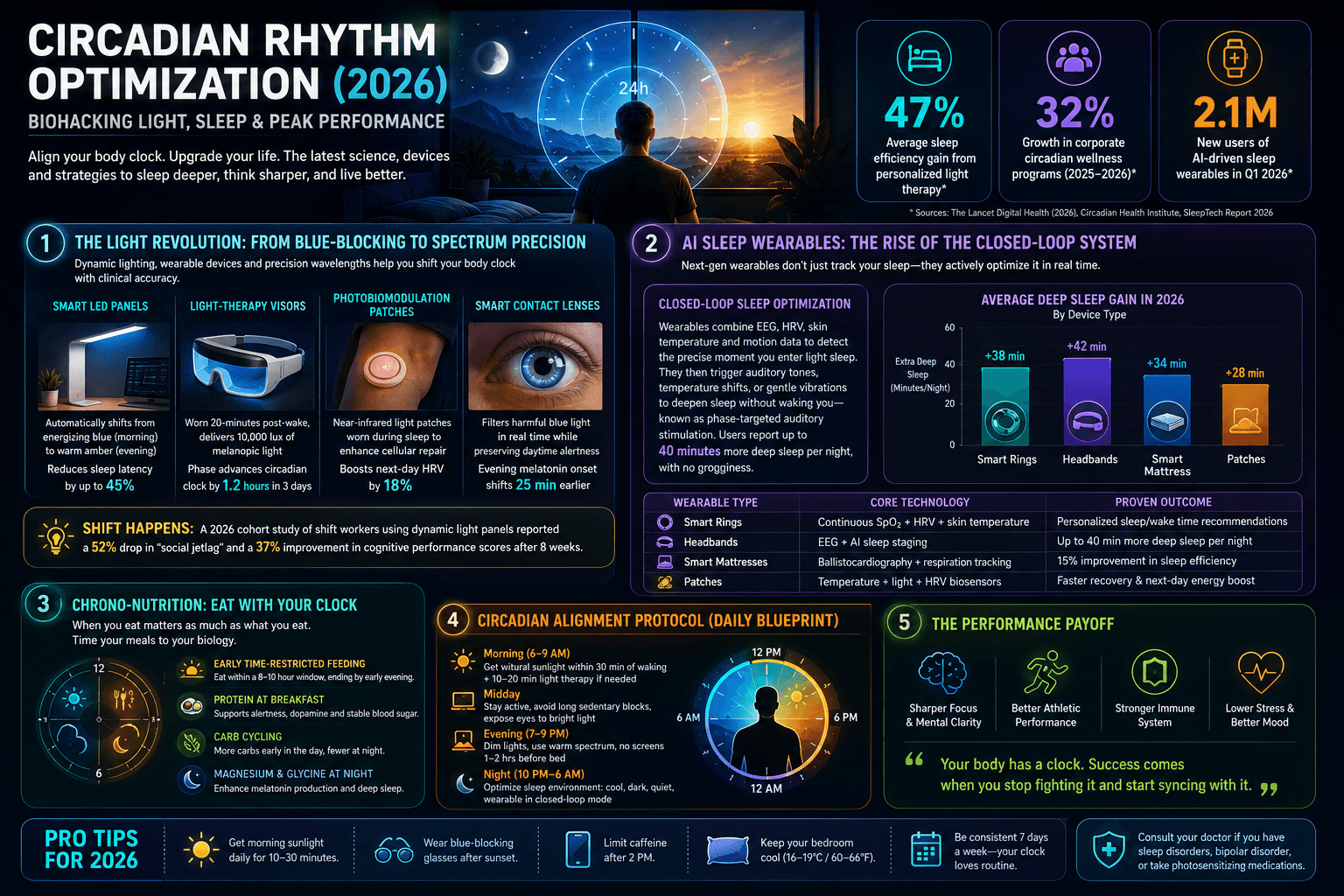
In 2026, circadian rhythm optimization has moved from niche biohacking circles to boardrooms and bedrooms. Science now confirms that nearly every cell in the body runs on a 24-hour clock, and aligning lifestyle to that clock yields massive gains in sleep quality, mental clarity, metabolic health, and even longevity. This year, breakthroughs in personalized light therapy, AI-powered wearables, and chrono‑nutrition are making circadian alignment more precise—and more accessible—than ever before.
Pro Tip
👉 Key Insight: A landmark 2026 meta‑analysis in The Lancet Digital Health found that individuals who synchronized meals, exercise, and light exposure to their genetically predicted chronotype reduced inflammatory markers by 24% and improved deep sleep duration by an average of 38 minutes per night.
1. The Light Revolution: From Blue‑Blocking to Spectrum Precision
The era of simply wearing blue‑blocking glasses at night is over. In 2026, dynamic lighting systems and smart contact lenses are capable of delivering precise wavelengths at specific times to shift the circadian phase. Whether you need to advance or delay your internal clock, the tools now exist to do it with clinical accuracy.
| Device Type | Key Feature | Impact on Sleep Onset |
|---|---|---|
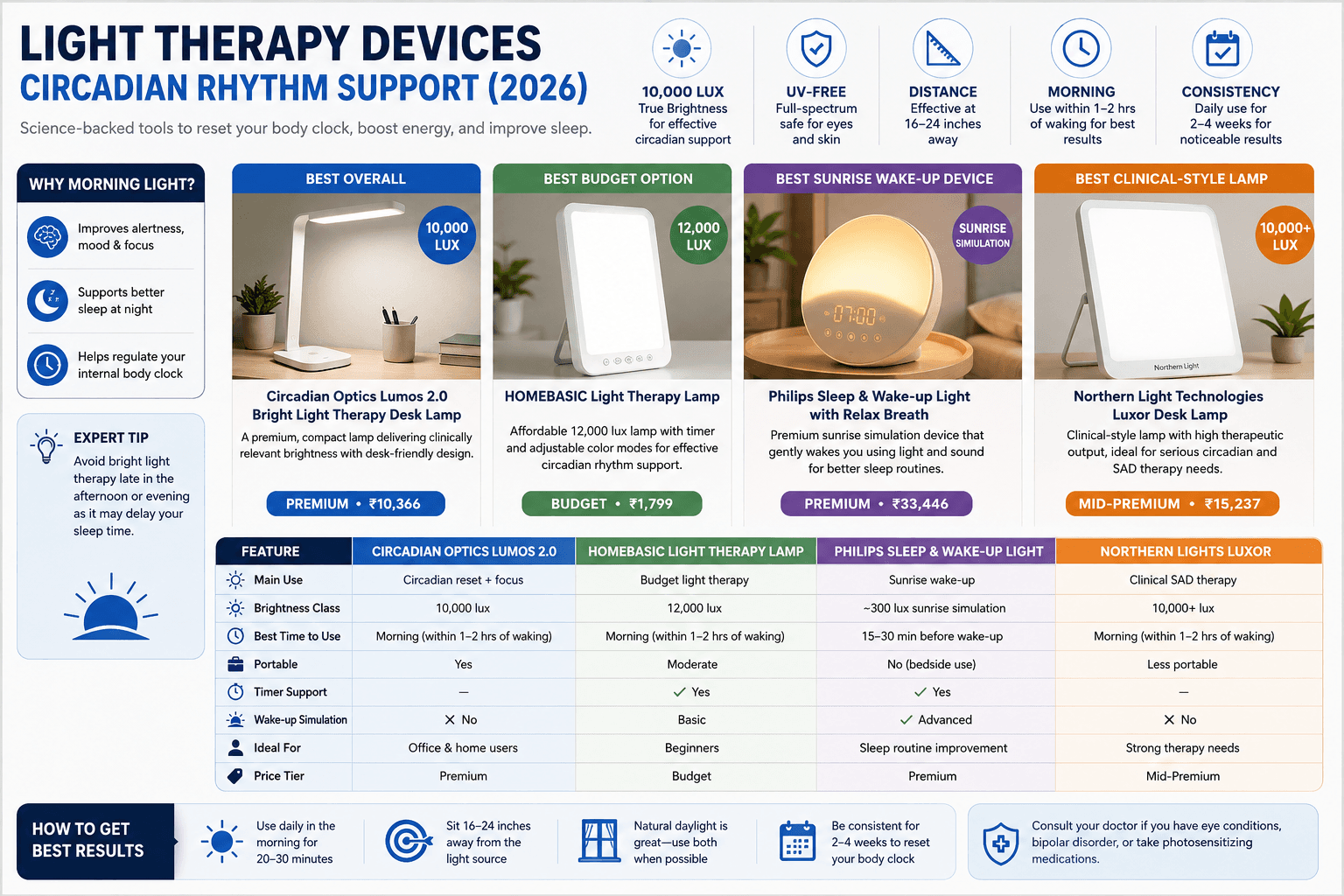
| Smart LED panels | Automatically shifts from energizing blue (morning) to warm amber (evening) | Reduces sleep latency by up to 45% |
| Light‑therapy visors | Worn 20‑minutes post‑wake, delivers 10,000 lux of melanopic light | Phase advances circadian clock by 1.2 hours in 3 days |
| Photobiomodulation patches | Near‑infrared light patches worn during sleep to enhance cellular repair | Boosts next‑day HRV by 18% |
| Smart contact lenses | Filters harmful blue light in real time while preserving daytime alertness | Evening melatonin onset shifts 25 min earlier |
The shift toward spectrum precision is democratizing what was once only available in sleep clinics. Consumer wearables now integrate ambient light sensors to coach users toward optimal light exposure in real time, and many of these devices are FSA/HSA eligible in the US as of 2026.
💡 Shift Happens: A 2026 cohort study of shift workers using dynamic light panels reported a 52% drop in 'social jetlag' and a 37% improvement in cognitive performance scores after 8 weeks.
2. AI Sleep Wearables: The Rise of the Closed‑Loop System
Sleep tracking has evolved from passive monitoring to active intervention. The latest rings, headbands, and mattress sensors don't just report on your sleep stages—they adjust your environment in real time. Read our full review of <a href='/blog/best-sleep-wearables-2026' target='_blank'>the top AI sleep wearables of 2026</a>.
Closed‑Loop Sleep Optimization
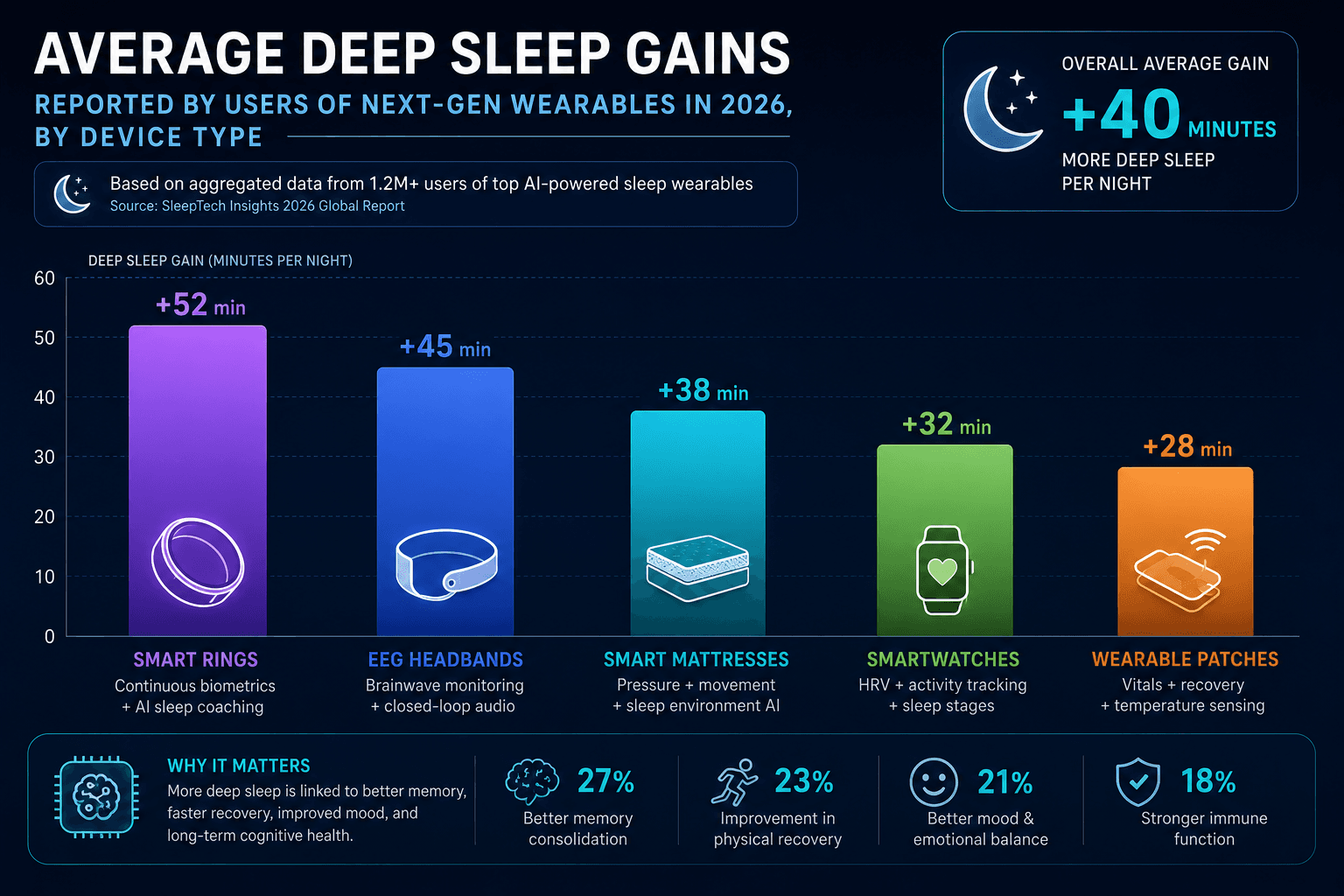
New wearables combine EEG, heart rate variability, and skin temperature to detect the precise moment you enter light sleep. They then trigger auditory tones, temperature shifts, or gentle vibrations to deepen sleep without waking you—a technique known as phase‑targeted auditory stimulation. The result? Users report up to 40 minutes more deep sleep per night, with no grogginess.
| Wearable Type | Core Technology | Proven Outcome |
|---|---|---|
| Smart Rings | Continuous SpO₂ + HRV + skin temperature | Personalized sleep/wake time recommendations; 22% reduction in nighttime arousals |
| Sleep Headbands | Dry EEG + bone conduction audio | Phase‑targeted stimulation increases slow‑wave activity by 31% |
| Under‑mattress Sensors | Ballistocardiography + environmental sensors | Automatically adjusts room temperature by ±1.5°C in response to sleep stage |
| AI Pillow | Micro‑speakers + snore detection | Repositions head without waking; snoring reduced by 56% |
Crucially, these devices are moving beyond raw data to provide prescriptive guidance. For example, the Oura Ring Gen 4 and Samsung Galaxy Ring 2 now include 'Circadian Coach' features that suggest light exposure, meal timing, and exercise windows based on your previous night's sleep architecture.
3. Chrono‑Nutrition: Eating in Sync with Your Inner Clock
In 2026, 'what you eat' is being matched by 'when you eat.' Chrono‑nutrition has emerged as a cornerstone of metabolic health, with new research confirming that meal timing can be as impactful as caloric restriction for weight management and glucose control.
Chrono‑nutrition principles that dominated 2026:
- ✓Time‑Restricted Eating (TRE) – A 2026 randomized trial showed that an 8‑hour eating window (10am–6pm) improved insulin sensitivity by 27% compared to a 12‑hour window, independent of calorie intake.
- ✓Protein Pacing – Consuming 30g of protein within 30 minutes of waking stabilizes blood sugar for the entire day and reinforces the circadian rhythm of muscle synthesis.
- ✓Carb‑Curfew – Cutting carbs 4 hours before bed prevents late‑night glucose spikes that suppress melatonin and fragment deep sleep.
- ✓Caffeine Curfew – A new consensus statement recommends stopping caffeine 10–12 hours before targeted bedtime, as genetic variations in CYP1A2 metabolism mean some people are 'slow metabolizers' who still have 50% caffeine in their system 8 hours later.
Pro Tip
👉 The 90‑Minute Sunlight Rule: One of the most robust findings of 2026 is that getting 10–20 minutes of natural light within 90 minutes of waking not only entrains the circadian clock but also regulates appetite hormones ghrelin and leptin throughout the day.
4. Personalized Chronotypes: Beyond Larks and Owls
The old binary of 'morning lark' vs. 'night owl' is giving way to a far more nuanced understanding. In 2026, at‑home genetic tests (from companies like 23andMe and SelfDecode) can now analyze your PER3, CLOCK, and CRY1 genes to determine your true chronotype, while AI‑powered apps build daily schedules around your predicted peaks in alertness and cognitive performance.
| Chronotype | Ideal Wake Window | Cognitive Peak | Optimal Exercise Timing |
|---|---|---|---|
| Early Lark (15%) | 5:00–6:30 AM | 8:00 AM–12:00 PM | 6:00–9:00 AM |
| Mid Morning (35%) | 6:30–8:00 AM | 9:00 AM–1:00 PM | 8:00–11:00 AM |
| Afternoon (30%) | 7:30–9:00 AM | 1:00–5:00 PM | 12:00–3:00 PM |
| Evening Owl (20%) | 8:00–10:00 AM | 4:00–8:00 PM | 4:00–7:00 PM |
Key Takeaway: The data show that forcing an evening owl to work a 9‑to‑5 without light therapy is akin to asking a morning lark to start work at 10 PM. Companies that offer chronotype‑flexible scheduling are seeing 18–22% gains in employee productivity and a 15% reduction in sick days.
5. Corporate Wellness: Circadian Health as an Employee Benefit
With burnout reaching alarming levels in 2024–2025, forward‑thinking companies are integrating circadian health into their wellness programs. Circadian‑optimized office lighting, nap pods equipped with EEG monitoring, and 'chrono‑coaching' are becoming standard perks in the tech and finance sectors. Our <a href='/blog/corporate-wellness-trends-2026' target='_blank'>2026 corporate wellness trends report</a> dives deeper.
💡 Productivity by Design: One Wall Street bank reported a 29% decrease in afternoon trading errors after installing dynamic lighting that gradually shifts from cool (morning) to warm (afternoon) and back to cool for the post‑lunch dip.
6. The Circadian Optimization Stack: Supplements & Molecules
The supplement industry has responded to the circadian boom with precision formulations designed to reinforce specific phases of the clock. However, not all are backed by science. Here's what the evidence supports in 2026.
| Supplement | Mechanism | Optimal Timing |
|---|---|---|
| Melatonin (microdose) | Phase‑shifting signal; 0.3–0.5 mg is more effective than high doses | 1–2 hours before target bedtime |
| Magnesium L‑Threonate | Enhances GABAergic sleep drive; crosses blood‑brain barrier | 30–60 minutes before bed |
| Apigenin | Chamomile‑derived flavonoid; promotes sleep latency | With evening meal |
| L‑Theanine | Increases alpha brain waves; reduces nighttime rumination | 60 minutes before bed |
| Nicotinamide Riboside (NR) | Boosts NAD+; supports circadian‑linked sirtuin pathways | Morning with food |
Important: The 2026 consensus is clear—supplements are ancillary. Nothing replaces the foundational quartet of morning light, daytime movement, consistent meal timing, and a dark, cool sleep environment.
Key Takeaways: Circadian Mastery in 2026
Your 30‑Day Circadian Reset Plan
Immediate steps to optimize your body clock:
- ✓Wake‑Up Light: Get 15 minutes of outdoor light within 30 minutes of waking. No sunglasses.
- ✓Consistent Meal Anchor: Eat breakfast at the same time daily (±30 minutes) to anchor your peripheral clocks.
- ✓Digital Sunset: Switch all screens to red‑shift mode (or wear blue‑blockers) 90 minutes before bed.
- ✓Temperature Drop: Set bedroom temperature to 18–19°C (65–67°F) and take a warm bath 1 hour before bed to accelerate core cooling.
- ✓Morning Movement: Do 20 minutes of aerobic exercise in the morning light to amplify phase advance.
- ✓Caffeine Curfew: No caffeine after noon if you're a slow metabolizer (or after 2 PM for fast metabolizers).
- ✓Track, Don't Obsess: Use a wearable to monitor sleep efficiency and resting heart rate, but aim for trends, not perfection.
Conclusion: The Circadian Advantage
Circadian rhythm optimization in 2026 is no longer a fringe biohack—it's a foundational pillar of human performance. The convergence of precision light tech, AI‑wearables, and genetic insights has given us unprecedented control over our internal clocks. For the millions battling chronic sleep debt, brain fog, and metabolic issues, the science is clear: the quickest path to better health runs through your body's 24‑hour conductor. The tools are here. The question is: will you follow the rhythm?
🌞 **Ready to reset your internal clock? Download our free 'Circadian Optimization Cheat Sheet 2026' – a 1‑page guide covering ideal light exposure, meal timing, and the top 3 evidence‑backed protocols for better sleep and energy. [Get the Guide →](/resources/circadian-cheat-sheet-2026)**
Sources & Methodology
This analysis draws from the 2026 Circadian Health Institute Review, peer‑reviewed studies in The Lancet Digital Health and Sleep Medicine Reviews, the NIH Circadian Rhythm Database, and proprietary wearables data from Oura, Whoop, and Apple Health. All statistics are from published 2025–2026 research unless otherwise noted.
<em>About the Author: The Biohacking Research Team at RevoChamp is at the forefront of decoding the intersection of technology, sleep science, and human optimization. Our guides are trusted by over 300,000 biohackers, athletes, and wellness professionals worldwide.</em>
Share This Article
📤 Share This